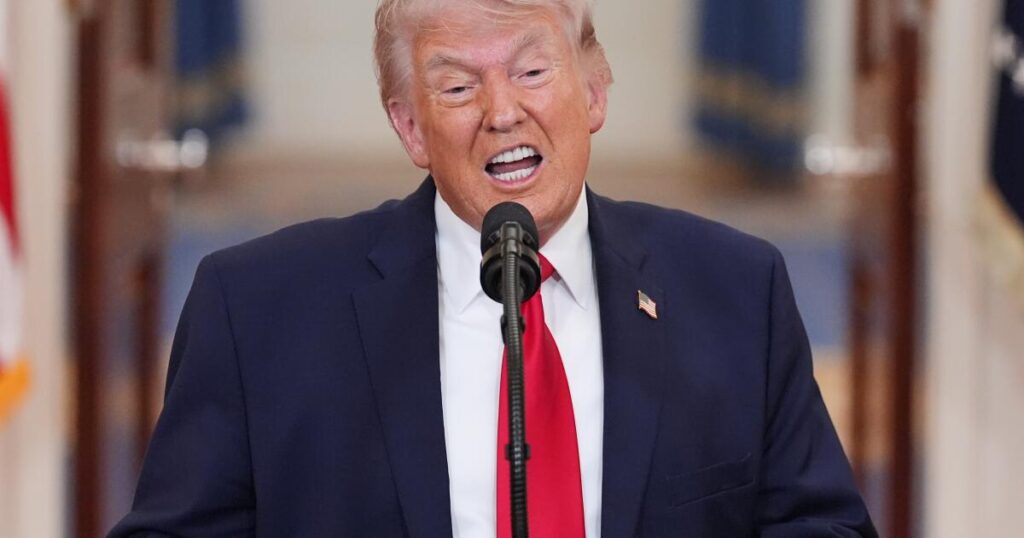
President Trump delivered a speech last week meant to project control over the war he launched against Iran. Markets heard something else. Oil prices surged, investors recoiled and the president still did not explain what political end this war is supposed to produce. These are the visible signs of a war whose objectives are shrinking even as its rhetoric grows more grandiose.
Then came another reality check. After Trump declared Iran “decimated,” the regime shot down a U.S. F-15E over its own territory. The president has also swung from insisting the Strait of Hormuz is someone else’s problem to urging other countries to seize and protect it, while suggesting the United States could simply take the oil and profit from reopening it. None of this reflects a stable understanding of war aims, alliance burdens or regional order. It reflects a government improvising in public as events outrun its theory of the war.
The problem in Iran is not that the military has failed to destroy things. It is that destruction is not the same as control. Wars must be judged by the political conditions they produce, not simply by the targets they hit. The Iranian regime still holds its core position. It is still imposing costs and shaping the terms under which other nations, including the U.S., must operate. Tactical violence has not produced durable strategic effect.
The administration’s justifications have shifted repeatedly, and its claims of victory have grown more theatrical as the war’s practical results have grown less convincing. Trump has described limited ship passage through the Strait of Hormuz as Iran showing a “sign of respect” and suggested the U.S. has already achieved regime change. That is not strategic clarity. It is a government lowering the standard of success and hoping the language obscures the facts.
This cannot be blamed on bad messaging. It is the public collapse of any coherent standard of success.
Wars evolve. Objectives can change. But there’s a difference between adaptation and drift. In a serious strategy, military action remains tied to a political end state that leaders can describe clearly enough for the public, allies and the military itself to understand. Here, that standard keeps slipping. Shrinking expectations are being repackaged as success.
A few more ships are allowed through. Limited relief inside a crisis the war helped create is recast as progress. The benchmarks become less about what this war was supposed to accomplish than about finding some fragment of movement to sell as momentum. That is not how governments speak when a war is delivering on its aims. It is what they say when the facts keep stripping away their earlier claims.
This is not an abstract sideshow. Roughly one-fifth of the world’s oil and gas shipments ordinarily move through the Strait of Hormuz. The war has destabilized a critical artery of the global economy, driving up prices and forcing Americans, allies and energy-dependent states to absorb the consequences.
The Strait of Hormuz is something much bigger than a maritime commerce crisis. It is the clearest example of the strategic incoherence of the entire war. The administration did not begin this campaign to win partial exemptions from Iranian control of a global chokepoint. Yet that is where its public case has drifted. What was sold as an overwhelming show of strength is now being measured by how much pressure Tehran is willing to ease. What Trump calls “respect” is really Iranian coercion, briefly relaxed and repackaged as progress.
The military burden is serious too. The U.S. has burned through enormous quantities of expensive, difficult-to-replace ordnance in pursuit of what is increasingly visible as a strategic failure. The consequences will not end with this war. They will show up in lower readiness and the nation’s weakened ability to respond to crises elsewhere.
Further escalation will not rescue the administration’s case. If the war widens, if Washington edges toward a ground operation, or if the conflict spills farther across the region, none of that will disprove the argument that the strategy has failed. A war that is meeting its objectives should not require ever-larger commitments just to redefine success.
The president launched this war in the name of defending America from imminent threats. He is now applauding limited relief from a coercive order the war itself helped create. What began as a show of force is now a search for smaller and smaller signs of progress. We are no longer shaping the crisis. We are reacting inside it. That is how strategic failure plays out.
Jon Duffy is a retired naval officer. He writes about leadership and democracy.
The post Trump isn’t ready to accept his strategic failures in Iran appeared first on Los Angeles Times.