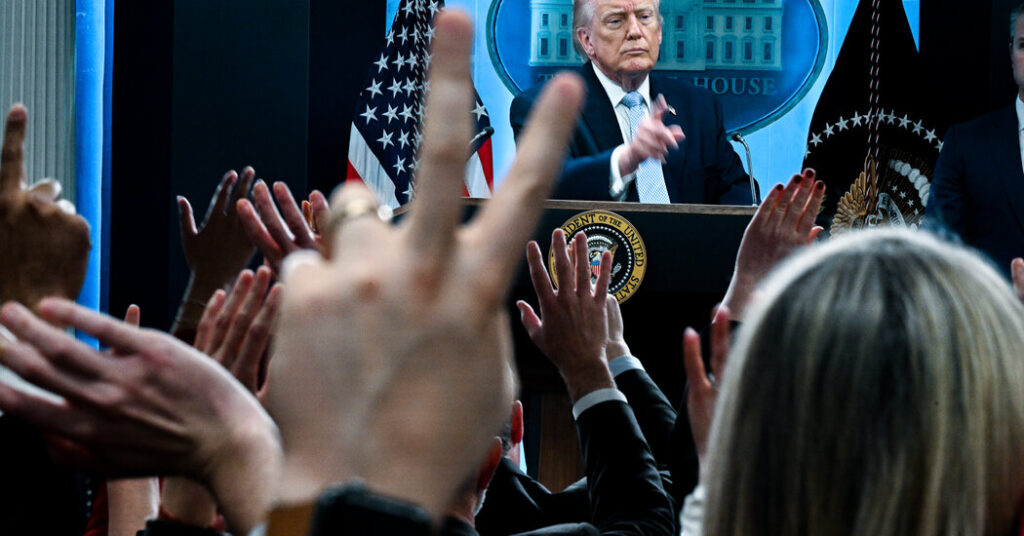
President Trump said on Tuesday that he found a last-minute off-ramp allowing him to delay his threat to obliterate Iran’s power grid and bridges, seizing on a proposal from Pakistan for a 14-day cease-fire that, Mr. Trump said, would include opening the Strait of Hormuz while Washington and Tehran tried to negotiate a peace deal.
In a statement, Mr. Trump declared that at the request of Pakistan’s prime minister, Shehbaz Sharif, he decided to “hold off the destructive force being sent to Iran tonight.”
But it was unclear whether the Iranians had, in fact, committed to fully opening the narrow waterway and allowing a huge backup of tankers free passage to deliver oil to Europe and the Middle East, helium to semiconductor plants around the world and fertilizer to farmers from Africa to Asia.
Mr. Trump said the accord was “subject to the Islamic Republic of Iran agreeing to the COMPLETE, IMMEDIATE, and SAFE OPENING of the Strait of Hormuz.” That suggested that Mr. Trump backed down before he heard from the leadership in Tehran, which until now has insisted it would open the waterway only if it had in hand a complete peace deal. Iran insisted that final agreement must include reparations for war damages and a complete lifting of Western sanctions on its economy.
Left unresolved, at least for now, is the fate of 970 pounds of near-bomb-grade uranium buried primarily at a site in Isfahan, or Mr. Trump’s demand that Iran limit the size and range of its now-depleted arsenal of missiles. And by reaching even a temporary cease-fire with Iran’s Islamic Revolutionary Guards Corps and its new supreme leader, Mojtaba Khamenei, he is essentially endorsing the legitimacy of its new government, five weeks after urging the Iranian people to overthrow it.
And almost immediately the Iranians made claims that seemed to go far beyond anything the president said. Iran’s national security council, in a statement, said the country had been victorious over Israel and the United States, and maintained that the United States had accepted all of Iran’s peace plan, including guarantees not to attack Iran, and Iran’s control over the strait.
Mr. Trump had been under increasing pressure to find a way out of a confrontation after setting an 8 p.m. Eastern deadline for the strait to open, and after declaring on social media early Tuesday that if he is defied, “a whole civilization will die tonight, never to be brought back again.” It was a classic example of Mr. Trump’s chaotic, high-pressure negotiating style, where he creates a crisis and then uses his leverage to strike a deal.
In this case Mr. Trump appeared desperate for a way to escape his own threats and rhetoric, and to engineer a Pakistani proposal that he would then sign on to. Just two days after calling the Iranian leadership “crazy bastards” and telling them they would soon be “living in hell,” he praised them on Tuesday as “a different, smarter, and less radicalized” class of leaders, predicting “something revolutionarily wonderful can happen, WHO KNOWS?”
The temporary cease-fire does nothing to address the fundamental issues that led to the outbreak of the war on Feb. 28: Iran’s refusal to give up its stockpile of nuclear fuel; American and Israeli demands that it limit the size and range of its missile arsenal; and Iranian demands that it retain the right to enrich uranium and, more recently, for war reparations.
But for the first time in nearly six weeks of intense fighting, it offers the possibility of resumed negotiations, and some respite for Iranians whose homes, factories and schools have been bombed and for Israelis who found their missile defenses could not guarantee
The last-minute agreement was bound to relieve investors, and ease a growing crisis in Asia, where some nations are reliant on oil coming through the strait for 80 percent of their supplies. Once a cease-fire is in place, it would put an added burden on Mr. Trump to break it again, or allow Israel to do so.
But it also raises the possibility that the war will end — or at least come to an uneasy truce — without Mr. Trump having accomplished many of the goals he laid out.
Farnaz Fassihi and Anton Troianovski contributed reporting.
David E. Sanger covers the Trump administration and a range of national security issues. He has been a Times journalist for more than four decades and has written four books on foreign policy and national security challenges.
The post Trump Backs Down, but Questions Remain About Iran’s Concessions and the Strait appeared first on New York Times.