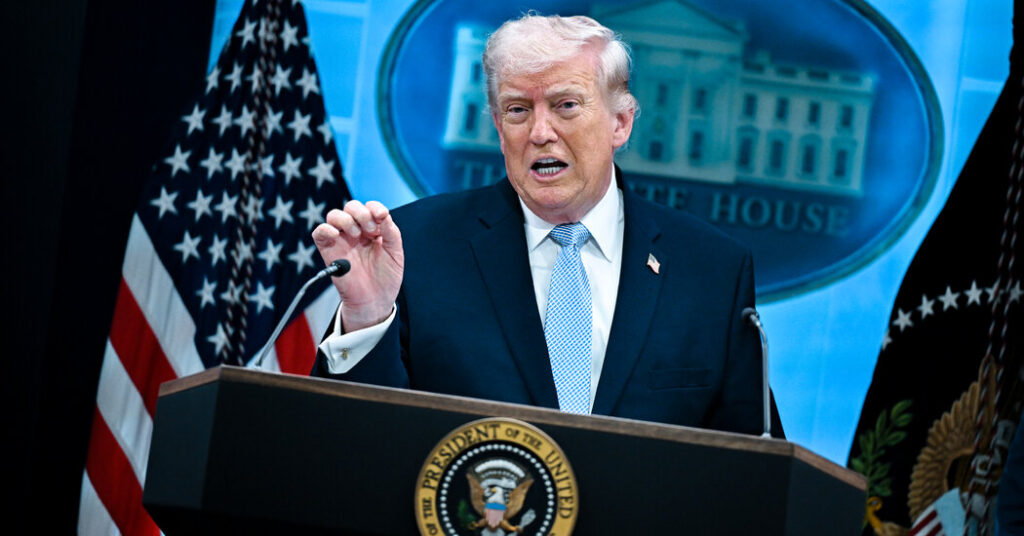
For decades, the U.S. government has helped poor Americans pay their home heating and cooling bills. It sends money to states, which then administer the aid, assisting nearly six million households nationally.
With a roughly $4 billion budget, the bipartisan program known as LIHEAP is just a sliver of a sprawling federal balance sheet that ranges well into the trillions each year. Yet it counts among the vast stable of federal aid that President Trump is trying to eliminate, as he scrounges for ways to cut costs at home and fund a larger, more expensive military.
Mr. Trump has eyed a series of potentially unpopular and divisive domestic spending cuts for the next fiscal year, in a move that may test the political appetite and financial health of a cost-weary American public. Even as voters grow frustrated with the economy — and seem eager to exact their vengeance at the ballot box — the president has proposed to scale back some of the very federal programs that are meant to ease families’ toughest financial burdens.
By the president’s own reasoning, the U.S. government cannot afford the expense. At a private lunch last week, Mr. Trump insisted that Washington needed to prioritize “military protection” above all else, especially with the United States still at war with Iran. Otherwise, he said in a since-deleted video, the country could not continue to shoulder the financial burden of services including “day care,” Medicare and Medicaid.
Formalizing that view in his 2027 budget, Mr. Trump did not address Medicare and Medicaid directly. But he did ask Congress to slash about $73 billion next fiscal year across a wide array of domestic agencies and programs, including education, health care, housing and nutrition assistance. He coupled that call for cuts with a request to ratchet up military spending by about $500 billion, which would amount to one of the largest one-year boosts in modern history.
Mr. Trump’s approach angered congressional Democrats and even some Republicans, months after the two parties banded together to reject broad swaths of his last budget. That included his previous attempt to eliminate LIHEAP, formally known as the Low-Income Home Energy Assistance Program, which Congress not only preserved this fiscal year but also supplied with additional funding.
In an interview, Representative Hakeem Jeffries, Democrat of New York and the minority leader, called Mr. Trump’s latest budget “an extraordinary admission of Republican policy cruelty that they’ve been inflicting on the American people in real time since the very beginning of his presidency.”
Mr. Jeffries said he was “extremely optimistic” that Democrats would win back control of the House in November by a large margin, partly because of Mr. Trump’s actions. He added, “Republicans don’t give a damn about making life more affordable for the American people.”
The White House has sought to frame its actions much differently. In a letter accompanying the president’s budget, Russell T. Vought, the budget director, wrote last week that the goal is to “ensure that the United States continues to maintain the world’s most powerful and capable military.”
Turning to the proposed cuts, Mr. Vought described many of the targeted programs as wasteful or “woke,” adding that the administration had aimed to use “every tool” at its disposal “to achieve real savings.”
The White House also claimed in a statement on Tuesday that it had targeted LIHEAP, in particular, because the money was riddled with fraud and was not needed because states could fill the gap on their own. A spokeswoman added that the funds had disproportionately benefited Democrats.
For Mr. Trump, the renewed debate over federal spending nevertheless arrives at a perilous political and economic moment.
Before the bombing began, many Americans had reported frustration with stubbornly high prices, even though the president routinely dismissed concerns about affordability as a “hoax.” But public angst has only intensified as Mr. Trump has ratcheted up his wartime threats, sending the average price at the pump to $4.14 per gallon nationally on Tuesday. The geopolitical uncertainty has also rattled financial markets, creating new headaches for Americans’ retirement and savings.
“They see the price, they remember it,” said Mark Wolfe, the executive director of the National Energy Assistance Directors Association, referring to oil and gas costs.
Mr. Wolfe, whose group advocates the government’s low-income energy assistance programs, added, “People are concerned about it.”
With no end to the hostilities in sight, economists have warned that other tumult may soon follow. High oil prices could soon translate to higher costs for groceries and other shipped goods — causing a potential slowdown in the nation’s growth, a worsening in unemployment and, in a worst-case scenario, a possible U.S. recession.
Throughout the war, Mr. Trump has brushed aside any economic fallout as nonexistent, temporary or inconsequential, arguing that the United States needed to neutralize an imminent nuclear threat. But the president’s bombing campaign was only the latest in a string of recent military entanglements, which prompted the White House to seek about $1.5 trillion for defense in the 2027 budget unveiled on Friday.
As part of that request, Mr. Trump called on Congress to raise pay for lower-ranking troops, increase money for naval warships, ramp up a new missile defense system and replenish U.S. munitions. If enacted, it would be the second increase for the military during the president’s second term, after he secured roughly $150 billion in new funds for the Pentagon as part of his sweeping package of tax cuts last year.
Democrats vigorously objected to the president’s military request, and many took quick issue with the way he sought to offset it, arguing that Mr. Trump had essentially asked the public to front the cost for a war that it did not want. Mr. Jeffries, for one, described the approach as an open acknowledgment that the “Republican Party is all about warfare, not health care.”
Mr. Trump proposed to slash more than $15 billion at the Department of Health and Human Services, once again targeting federally funded medical research, though the cuts he sought were less stark than those proposed one year ago. The White House also called for revoking about $15 billion in money meant to combat climate change, reprising its desire to eliminate funds that improve clean energy and clamp down on harmful emissions.
Together, those cuts and others would sum to a roughly 10 percent reduction in all domestic spending, according to White House estimates. The depth of those changes troubled at least one senior Republican, Senator Susan Collins of Maine, who leads the Appropriations Committee. In a statement last week, she said the president’s budget had “shortcomings,” pointing to cuts for programs like LIHEAP.
“After careful review, Congress decisively rejected these particular cuts last year,” she said.
Some of Mr. Trump’s harshest proposals targeted money meant to improve lending to minority communities and small businesses, while others reprised the president’s attempts to eliminate the Education Department. And his administration pursued a series of changes to federal nutrition assistance, one of which could reduce the amount that low-income families receive for fruit and vegetables under the Women, Infants and Children program, according to anti-hunger groups.
Mr. Trump did recommend a substantial increase in emergency WIC funds. Still, his proposal followed less than a year after Republicans cemented new restrictions under the government’s largest anti-hunger initiative, known as food stamps, which serves roughly 42 million Americans. Millions are expected to lose benefits in the coming years as a result of the new criteria, which lawmakers imposed to pay for a portion of their expensive package of tax cuts.
On Capitol Hill, some Republicans have openly signaled that they could adopt a similar approach in the coming fiscal year, as they look for ways to deliver Mr. Trump’s request for more military funding. Party leaders are expected to try to boost defense using the same special legislative tactic that had allowed them to adopt their tax package over Democratic objections in 2025.
“We just addressed Medicaid and SNAP. But there are 70-plus means-tested welfare programs across this entire people’s government, and about $1.5 trillion cost,” said Representative Jodey Arrington of Texas, the Republican chairman of the budget committee, referring to the Supplemental Nutrition Assistance Program. He added in the interview, which appeared on Fox News, that the programs could be mined for potential savings by rooting out fraud.
Democrats have seized on those comments as they try to make the case to voters that they would be harmed if Republicans remain in control of Congress. Many anti-poverty advocates have echoed those warnings about the stark effects of spending cuts at a moment when families are already facing serious financial headaches.
“The money you’re spending already on a department that’s overly funded, instead of helping working-class Americans, which is a big part of our population, it is going to impact everyone,” said Gina Plata-Nino, the SNAP director for the Food Research and Action Center, which supports the program.
Some experts said that Mr. Trump’s budget appeared at times to undermine his own agenda. He proposed to cut more than $10 billion at the Department of Housing and Urban Development, for example, by targeting a series of programs that combat homelessness and help low-income people obtain affordable rentals. The budget request followed months after the president promised to take “aggressive” action to make housing more affordable.
Sarah Brundage, the president of the National Association of Affordable Housing Lenders, said the sum total of cuts at H.U.D. seemed to “contradict the president’s own stated commitment” to affordability.
Mr. Trump stopped far short of the more dramatic overhaul to housing assistance that he proposed last year, which lawmakers rejected anyway, as they realized the impact it would have on their states and congressional districts.
Still, Mr. Jeffries said he was astounded that this was the platform on which Republicans were choosing to campaign in an election year.
“Make it make sense,” he said. “It does not.”
Tony Romm is a reporter covering economic policy and the Trump administration for The Times, based in Washington.
The post To Boost Military Budget, Trump Targets Popular Programs at Home appeared first on New York Times.