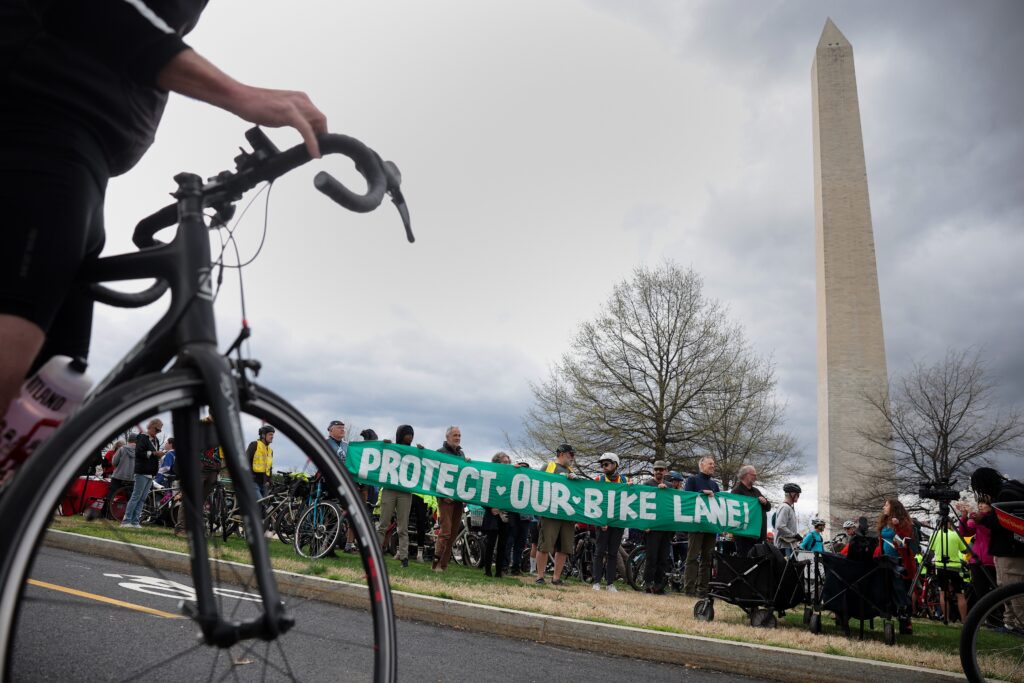
Elizabeth Kiker’s April 2 op-ed, “A symbol of freedom is about to be bulldozed,” described the Trump administration’s attempt to remove the federally owned portion of the 15th Street bike lanes. As a longtime resident of Washington and a regular bike commuter, I can attest that bike lanes make getting around safer not only for cyclists, but also for drivers and pedestrians.
Bike lanes invite more commuters to leave their cars at home and allow traffic to flow more easily. Removing them will make moving around the city more difficult for everyone. If this administration really wants to make D.C. “safe and beautiful,” it should increase access to bike lanes, not tear them out.
Catherine O’Riordan, Washington
I commute most weekdays via bicycle to downtown D.C. from Alexandria and use a portion of the bike lane that is the subject of Elizabeth Kiker’s op-ed.
Commuters, as well as recreational cyclists and scooter riders, rely on bike lanes for an added level of safety from erratic drivers, the worst of whom are frequently bus operators.
I have decades of experience riding in urban traffic, so I’m not particularly concerned about my own safety if the bike lane closes. Over the years, I’ve been swerved at, flipped off and once even had a gun pointed at me. Cyclists on America’s friendly highways and streets are not unfamiliar with this kind of behavior. We generally take it in stride.
The people I’m concerned about are the tourists who rent bikes and scooters in an effort to explore our nation’s capital. Many of them are not experienced riding a bike, much less trying to navigate the city streets while doing so. Bike lanes provide these riders with a level of protection from D.C.’s distracted drivers that can make the difference between an enjoyable vacation and a trip to the hospital.
I was under the impression that the National Park Service wanted to improve safety for visitors; removing bike lanes will do the opposite.
Thomas Noble, Alexandria
Student visa changes harm U.S. innovation
My parents came to the United States on a temporary visit but stayed, drawn by the promise of opportunity. That same belief brings international students here today. As head of education for the American Physical Society, the nation’s largest physics organization, I understand the deeply personal decision of coming to the U.S. and choosing to stay — just like my family.
These students, along with their American counterparts, are vital to the U.S. science, technology, engineering and math workforce. Their research at universities drives innovation, launches businesses and creates high-quality jobs. Yet their future is threatened by proposed changes to F and J student visas.
The new rules would require students to complete their degrees within four years, with the opportunity for an extension that is not guaranteed. Earning a PhD in physics is a demanding process that should not be rushed. It takes an average of at least six years, and hurrying the process would create unnecessary anxiety among students, leading them to take even longer to finish their degrees.
The American Physical Society is offering resources and recommendations to help students prepare for what lies ahead, including advising them to postpone unnecessary travel until the rules are finalized. Losing their talent would harm our nation’s long-term scientific and economic strength.
We must not allow policy changes to harm opportunities that have long sustained America’s leadership in science and innovation.
Michael Wittmann, Bangor, Maine
AI poses legitimate threats
Treating autonomous AI systems as tools is a dangerous mistake. Thomas Rid in his April 1 op-ed, “AI is a tool, not a new species,” was right to highlight the alarming growth of ideologies that view artificial intelligence as a set of superior beings worthy of replacing humanity. But treating AI as a tool does nothing to eliminate the threat AI poses.
In their efforts to make AI systems that behave as intended, AI developers are creating AI systems that understand the world and care about real-world outcomes. The fact that they express these preferences in moral terms is irrelevant. The risk comes from AI systems gaining power over physical resources, such as autonomous weapons, and using them to catastrophic ends, up to and including human extinction.
Developers should absolutely treat AI’s lying and scheming as a bug — it’s the sort of bug that could lead AI systems to “go rogue” and escape human control. And we absolutely do not want AI systems that could turn against humanity controlling weapons.
I agree with Rid that we should hold developers responsible for the problems their systems cause. But conflating the question of whether we should care about AI’s feelings with the question of whether they pose an existential threat just muddies the water.
David Scott Krueger, Montreal
The writer is a core academic member of Mila, an artificial intelligence research institute, and founder of Evitable, a nonprofit.
Dap your neighbors with a smile
I enjoyed Shane O’Neill’s March 21 Style article, “The exquisite ennui of the Gen Z pout.”
I was drawn to his rhetorical question “Who among us is not disaffected right now?” It does seem that we live in a time full of decadence, cynicism and anxiety, and it is possible to imagine that we are in Weimar Germany, except that we aren’t. We need to remember that we don’t have to ruminate on disaster all the time.
As much fun as the works of Hito Steyerl, Alex Garland and Ray Dalio can be in small doses, we audience members have to remember these people do not know what our future will be — they are telling us ghost stories to amuse us.
Which brings me to the topic of facial expressions: When I am out and about, I try to flash a smile every so often, not a perpetual rictus grin, just an occasional flash like a small visual dap. You’d be surprised how good it makes you feel when someone daps you back.
Stuart Gallant, Belmont, Massachusetts
The post The real victims of the bike lane removal project appeared first on Washington Post.