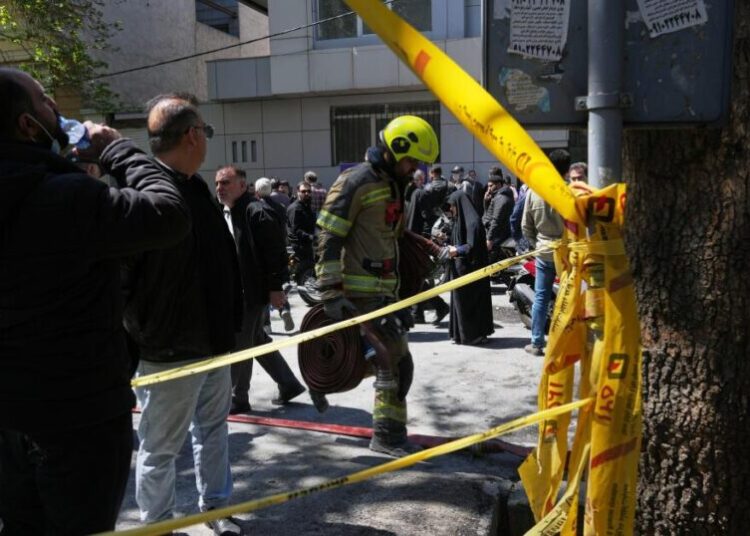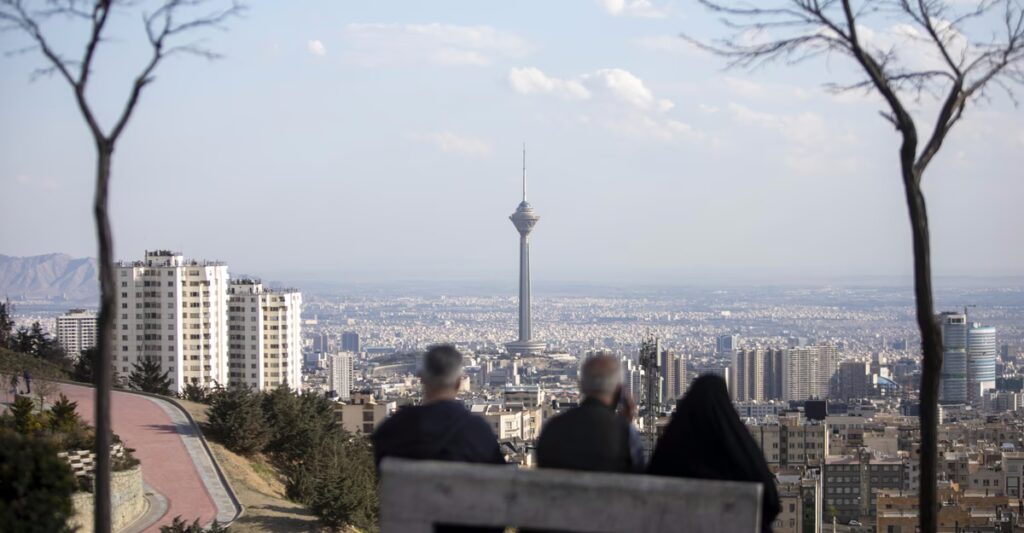
One of the U.S. government’s recurring mistakes about Iran has been to conflate the country’s national interests with regime interests. The two are in many ways opposites. What benefits the Iranian people—global economic reintegration, diplomatic recognition, investment, normalcy—threatens a regime that operates an extensive mafia and thrives in isolation. The carrots that America offers the nation are sticks to the men who rule it. And the sticks that America wields against the regime—isolation, conflict, and chaos—are carrots to men whose power depends on all three.
This is the Islamic Republic’s survival paradox: What makes the regime thrive makes the nation suffer, and what would allow the nation to thrive threatens the regime’s survival. As a result, the most consequential deliberations of the Iran war have been not between Washington and Tehran but between the American president and himself. Donald Trump has vacillated between Neville Chamberlain and Attila the Hun, threatening to walk away one day and to bomb Iran “back to the Stone Age” the next. Tehran, in contrast, has had the benefit of clarity: Its ideology is resistance, its strategy is chaos, and its endgame is survival.
Trump is a president with no fixed foreign-policy principles, facing a regime led by men so loyal to the ideals of the 1979 revolution, most notably resistance against America and Israel, that they call themselves “principlists.” This revolutionary worldview serves as both a glue maintaining the regime’s cohesion and a shackle holding the nation down. The country will never advance while still committed to that ideology. But without it, the regime may not survive.
[Read: The real intelligence failure in Iran]
This is why Trump’s special envoy Steve Witkoff’s repeated suggestion that Iran could rejoin “the league of nations” fundamentally misread the regime he was dealing with. It is why Trump’s threat to bomb Iran back to the Stone Age does not move men who are prepared to burn down their own country and their own people rather than relinquish their power or their ideology. And it is why some Iranian officials have welcomed the war as a distraction from the country’s internal challenges.
As a former real-estate developer who appointed fellow developers as his envoys, Trump has no mental framework for this adversary. In real estate, both sides want a transaction. But the U.S.-Iran relationship is not a negotiation of that sort. It is a cold war in which one side views normalization as a greater threat to its survival than conflict. The late Supreme Leader Ali Khamenei chose martyrdom over normalization. Mojtaba, his son and successor, will likely make the same choice.
Trump’s hope was to turn Iran from an adversary into a partner, as he believes he did with Venezuela. The Islamic Republic is different. For the regime’s remaining leadership, hostility to America is not a bargaining chip; it is the foundation of the regime’s identity and sense of its own legitimacy—what political scientists call “ontological security.” Any deal that requires abandoning it is a greater existential threat than war. You cannot negotiate away the thing that justifies your existence.
Trump speaks about the systematic assassinations of Iran’s leadership with the nonchalance of a mob don. “Leave the gun; take the cannoli,” goes the famous line from The Godfather. “Most of the people we had in mind are dead,” Trump said about political succession in Iran. “Pretty soon, we’re not going to know anybody.” Iran’s leadership, in contrast, is steeped in a Shiite political culture premised on the 680 C.E. martyrdom of Imam Hussein. So long as this regime remains in power, it will mourn, and seek to avenge, the martyrdom of the 86-year-old Khamenei. For Trump, Khamenei’s killing was just business: “I got him before he got me,” he said of the Iranian leader.
The Islamic Republic’s paramount goal is survival. It is willing to destroy the country, and its people, rather than cede power. In the near term, that survival looks achievable: The regime retains enough coercive capacity to hold on. In the medium term, it is far less certain. But men fighting for their lives from bunkers do not think in the medium term. They think about tomorrow.
The assassination of Iran’s top leadership has left no figure with both the power and the will to deliver a major compromise with Washington. But Trump has reportedly pinned his hopes on Mohammad Bagher Ghalibaf emerging as the pragmatist willing to break with the past and partner with Washington.
Ghalibaf is a former Islamic Revolutionary Guard Corps commander, speaker of Parliament, and close adviser to the new supreme leader. He harbors ambitions of becoming Iran’s nationalist strongman—the man who saves the country from ruin. But ambition is not the same as capacity. He is a creature of the IRGC, the institution most committed to the regime’s ideological survival, and the war has narrowed rather than expanded the space for pragmatic maneuvering. His public statements on X—a combination of grandiose threats, anti-Semitism, and calculated appeals to the anti-imperialist left—are those of a man aspiring to lead the regime, not change it. The Islamic Republic is a path-dependent aircraft with neither a captain willing to turn the wheel nor a crew willing to let him.
Khamenei’s lasting legacy was to spend four decades purging pragmatists and filling the upper ranks of the regime with fellow principlists—men whose entire identity and advancement depended on ideological fealty to the revolution. The result is a system that has selected against the very qualities a transition would require. Nobody wants to be the Iranian Gorbachev—and Khamenei made sure there was no one capable of playing the role.
Trump’s—and America’s—predicament has no quick fix. A regime that came to power in 1979 by seizing the American embassy in Tehran and taking its personnel hostage now holds the global economy hostage, effectively controlling 20 percent of the world’s oil exports. Tehran has begun treating the Strait of Hormuz as its own Panama Canal, running a protection racket in which vessel owners are permitted safe passage only by obtaining IRGC pre-approval and paying tolls in Chinese yuan.
In its 47 years of existence, the Islamic Republic has made perhaps two major compromises. The first was its 1988 decision to end the Iran-Iraq war—after eight years of fighting and an estimated 200,000 Iranian deaths. Ayatollah Ruhollah Khomeini famously likened that concession to drinking poison. The second was the 2015 nuclear deal with Barack Obama. In both cases, Iran had come under existential economic pressure, and in both it was offered a diplomatic exit that did not require it to abandon its revolutionary identity. Many of Iran’s people have concluded that this identity is the problem. But a critical mass of true believers has made the regime too rigid to bend and too ruthless to break.
[Read: Why Trump thinks he can walk away from the Strait of Hormuz]
Whenever this war ends, Iran’s leaders will inherit a country in ruins. And they will find themselves reviled both internally and internationally. Tehran’s stated terms for ending the war include reassurances that it won’t be attacked again, and reparations for the billions of dollars in damages it has endured. But so long as the Islamic Republic’s ideology and behavior remain unchanged—namely its commitment to “Death to America” and the destruction of Israel—neither condition is remotely achievable. No American president or Israeli prime minister will credibly promise not to attack a committed adversary, and the U.S. Congress will never vote for reparations to a government that has spent 47 years fighting America. Indeed, so long as Tehran aspires to rebuild its nuclear program, its missile arsenal, and its network of regional proxies, this war will likely have a sequel.
History suggests that an overconfident Tehran will overplay its hand. Its ideology compels it to pursue vengeance over advantage, even when the national interest demands restraint. This is the same regime that held American diplomats hostage for 444 days, extracting maximum humiliation from the United States at the cost of Iran’s own international standing. It prolonged its war with Iraq six years beyond the point when a favorable settlement was achievable. Believing itself the Middle East’s new hegemon, it was the lone country to publicly praise Hamas’s October 7 attack on Israel—leading to the destruction of its regional proxies.
Trump is measuring this war not by what it will achieve but by what it has destroyed. History will judge it by its lasting impact on Iran, the Middle East, and the broader global order, once the bombs have stopped. Ordinary Iranians—many of whom placed undue hopes in swift American salvation—are left to navigate, for now, between two hells: a cruel regime that has spent nearly half a century repressing them, and a war that has so far deepened their despair rather than ended it.
The post The Islamic Republic’s Survival Paradox appeared first on The Atlantic.