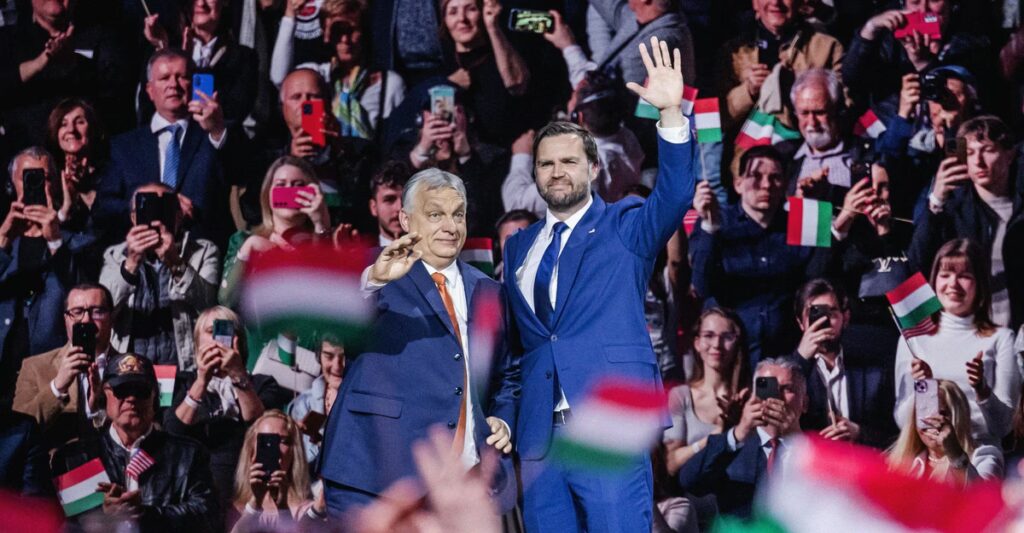
U.S. presidential campaigns usually get started at the Iowa State Fair or some other exalted arena of Americana. J. D. Vance chose Budapest. The vice president visited Hungary’s capital today to align himself in the most visible way possible with the prime minister, Viktor Orbán, who is fighting to hold on to power in parliamentary elections scheduled for Sunday.
The U.S. government’s support for Orbán had already been clear. President Trump had issued a “Complete and Total Endorsement” on social media. Secretary of State Marco Rubio, the most credible threat to Vance’s claim on the Republican presidential nomination in 2028, had traveled to Budapest in February and declared, “Your success is our success.” Vance, not to be outdone, didn’t cloak his endorsement in diplomatic rituals. “I’m here to help him in this campaign cycle,” the vice president said at Orbán’s side. For the prime minister, it was almost too good to be true. He raised his hand to his face as if to stop himself from blushing.
Hungary is of relatively little material value to the United States. It’s a landlocked country of fewer than 10 million people that accounts for about a quarter of 1 percent of U.S. trade. It contributes negligibly to NATO, ostensibly the measure that the Trump administration uses to determine the worth of its European partners. But Hungary matters to Vance because it matters to the MAGA intelligentsia—the think-tank bosses, Substack scribblers, and X influencers who help mold the agenda of the modern Republican Party. Many of the gatekeepers of GOP values view Hungary as a model. In their mind, Orbán shows how to cast aside conservative niceties and seize the institutions of the state to advance a particular vision of the good life, one that claims Christianity as its basis while punishing adversaries including leftists, immigrants, and sexual minorities. And so the Hungarian election has become the first stop of the 2028 presidential contest.
[Read: The MAGA intellectual who prophesied a Queen Melania]
The trip, which took place five days before voting begins in Hungary, couldn’t have come at a better time for Vance, whose self-image as an anti-interventionist is at odds with Trump’s decision to wage war against Iran. In Budapest, he allowed himself some distance from the president’s threats to bomb Iranian civilization out of existence. He was squarely in his comfort zone, conjuring fears of “woke” indoctrination and leading Hungarians in a call-and-response chant opposing multinational institutions and affirming their belief in sovereignty.
Vance’s appearance alongside Orbán in the final days of the Hungarian campaign broke with precedent. American presidents and vice presidents have seldom intervened so overtly in foreign elections. Barack Obama warned against Brexit during a visit to Britain several months before the 2016 referendum, saying that leaving the European Union would place the country at the “back of the queue” for trade talks. But his comments didn’t elevate a particular party or candidate. Bill Clinton visited Israel in 1996 and spoke warmly of Shimon Peres, who was competing at the time against Benjamin Netanyahu. But he didn’t issue an endorsement. There is a long history of covert U.S. influence in foreign elections, especially in Latin America. But part of the reason the activity remained covert was to provide occupants of the White House with plausible deniability.
Vance evidently had no such compunctions. His intervention was made all the more unusual by his accusation that the EU, which has underwritten Hungary’s economic development over the past two decades, was interfering in the vote. “What has happened in the midst of this election campaign is one of the worst examples of foreign election interference that I have ever seen or ever even read about,” Vance said during a joint press conference with Orbán. “The bureaucrats in Brussels have tried to destroy the economy of Hungary,” he said, seeking to reframe financial penalties exacted by the bloc for infringements on the rule of law as attempts at election meddling. “And they’ve done it all because they hate this guy.”
Vance’s willingness to cosign conspiracy theories concocted by Orbán reinforced a new convergence. Orbán’s party, Fidesz, enjoys the support of Washington and Moscow, whereas many of the prime minister’s counterparts in the EU, where he has thwarted efforts to send aid to Ukraine, are arrayed on the other side. They haven’t issued endorsements, but they’re quietly hoping that Europe’s enfant terrible is repudiated in favor of Péter Magyar, a onetime Orbán loyalist who defected two years ago and now heads a new party, Tisza, which is leading in most polls.
American flags raised in Budapest for Vance’s visit added to the city’s echinate landscape, which is studded with neo-Gothic spires and steeples. At the airport, Vance was greeted on the red carpet by Hungary’s foreign minister, Péter Szijjártó, who’d been caught in a recently leaked recording vowing to help Russia navigate EU sanctions. From there, the vice president traveled to a former Catholic monastery that now houses the prime minister’s office.
[Read: America’s future is Hungary]
Vance and Orbán spoke before a press backdrop proclaiming THE DAY OF HUNGARIAN-AMERICAN FRIENDSHIP. Vance breezed through areas of bilateral engagement, including energy, manufacturing, and technology. These were less important, he said, than what he termed “moral cooperation” that ensures that people can have children, and that those children won’t be indoctrinated at school. In his telling, both governments are committed to “the defense of the idea that we are founded on a certain Christian civilization and Christian values that animate everything from freedom of speech to rule of law to respect for minority rights and protection of the vulnerable.”
Vance called Hungary a model for the rest of the EU, but here are some things that the vice president did not say about his host country’s treatment of the vulnerable. In 2023, Orbán’s government approved a pardon for a man convicted of covering up child sexual abuse. A government report publicized by Orbán’s opponent found that more than one in five children in state-run care institutions have been abused. Hungary’s maternal mortality rate is more than twice the EU average. Further comparisons are not kind to Hungary, which used to be about 30 percent richer than its neighbor Romania, according to one measure; now Romania is ahead. Those dreaded EU bureaucrats? They’ve financed nearly all of Hungary’s public-development projects. The source for that statistic is not a woke university; it’s the U.S. State Department. Meanwhile, public contracts go disproportionately to allies of the prime minister.
The culture of clientelism in Hungary is part of the reason some Western officials I spoke with doubt that Orbán can lose, despite polls showing his party trailing the opposition. Large segments of the society have been made dependent on Fidesz for their well-being. Vance also discounted the possibility of a loss. “Of course,” he told reporters when asked whether the Trump administration would work with the opposition if it commands a majority in the election. But he seemed to think there was faint chance of that. “Viktor Orbán’s gonna win,” he said, turning to the prime minister and asking, “Viktor, is that right?”
“That’s the plan,” Orbán replied.
From the prime minister’s office, Vance shuttled to a sports arena on the other side of the city to greet the Fidesz faithful. A retired airport bookkeeper was waiting in line. “He came to Europe just for us,” Marietta Sebestyén gushed. The only better guest, she told me, would have been Trump. Her wish was briefly fulfilled when Vance began his address by calling Trump from the stage and putting him on speakerphone. “Mr. President, you are on with about 5,000 Hungarian patriots,” Vance said. “And I think they love you even more than they love Viktor Orbán.” Trump was flattered. “I can’t believe that,” he said, before offering a succinct account of Orbán’s success. “You have a man that kept your country strong, and he kept your country good,” Trump said. “And you don’t have problems with all of the problems that so many other countries have.”
Trump had a question for the audience: “How did J. D. do? Did he give a good speech, everybody?” Except that the vice president hadn’t spoken yet. That came next, and featured him whipping up fear of an indistinct they. They dismiss the idea of the nation. They reject motherhood. They reject Christianity. They condemn children to mutilation. “They hate one man above all others, and his name is Viktor Orbán,” Vance said. “And if they hate him, it means he’s on your side.”
Halfway through his speech, Vance tried to clarify his views on the continent that he was visiting: “The European press asks constantly, Do Trump and Vance—do they have something against Europe? Let me be clear, we love Europe.” He continued, “We love its people. We love its culture. We love its beautiful architecture. And we love the amazing history of this continent. But because we love this culture and these peoples, we reject the faceless bureaucrats who would drive your energy costs through the roof and open your country to millions of unvetted foreigners in the name of progress.”
[Read: The hardest job in Europe]
Applause ensued. European officials have characterized this as an abuser’s logic: I hit you because I love you. Former Trump-administration officials have explained it differently to me, saying that the animus toward Europe is largely an extension of domestic antagonisms. Trump and Vance associate mainstream European leaders with their adversaries in the Democratic Party, and treat them accordingly.
But if Vance sees political opportunity in appealing to Hungarian nationalism, so does Péter Magyar. On social media, he issued a brief statement in response to Vance’s visit, saying, in part, “No foreign country may interfere in Hungarian elections. This is our country.”
The post The First Stop of the 2028 U.S. Presidential Primary Is Budapest? appeared first on The Atlantic.