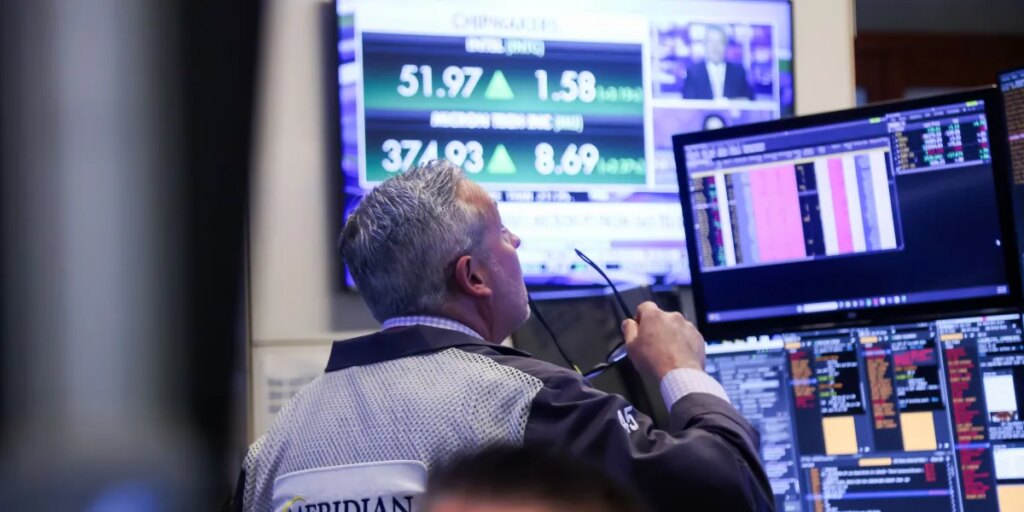
The crash that was widely predicted just last summer hasn’t arrived yet. There was no single day when the AI stock market euphoria buckled, no Lehman moment, no front-page meltdown. Instead, over the better part of a year, Wall Street did something far more methodical—and far more telling: it slowly, deliberately, and almost silently wound down its euphoric investments in AI.
“You know, that’s a really interesting way to put it,” said David Royal, Chief Investment Officer at Thrivent, in a recent interview, when asked if the bubble had already burst and nobody noticed. “I think I agree with that … it came down in a pretty orderly way.”
Royal centered his analysis on Nvidia, the giant that became the face of the AI investment supercycle and yet has seen its stock price stagnate for roughly three quarters even as its earnings continued to grow at a blistering pace. The result: its forward price-to-earnings multiple has compressed from the low 30s to around 20. That’s not a collapse. That’s a controlled descent. New research from Goldman Sachs and Morgan Stanley’s top equity analysts agrees with the emerging pattern in markets: a slow climb-down after the bubble warnings months ago.
The numbers tell the story
Goldman Sachs’ Peter Oppenheimer put it slightly differently from Royal, in a note published Tuesday morning: the technology sector has just endured one of its worst periods of relative underperformance compared to the rest of the global market since the early 1970s. The IT sector now trades at a forward P/E below consumer discretionary, consumer staples, and industrials—a positioning that would have seemed inconceivable just 18 months ago.
The sell-off wasn’t irrational panic. It was a repricing driven by a simple, nagging question: what exactly are the hyperscalers getting for all that capital expenditure? Spending among the largest AI cloud providers has surged to historic levels as a share of cash flow from operations, yet the history of technology breakthroughs—from railways to the early internet—is littered with infrastructure booms that produced meager returns for the builders and outsized gains for those riding on top. Oracle, an extreme example, has had to raise fresh financing and recently laid off workers to manage the load. Investors, apparently, finally started reading the history books.
The Mag 7 splinters
For most of the AI boom, the Magnificent 7 moved in near-lockstep, a monolith of correlated bets. That correlation has now broken down. Goldman notes that the three-month realized pairwise correlation among the major AI hyperscalers—Amazon, Google, Meta, Microsoft, Oracle—has fallen sharply, with rising dispersion between the dominant names. The monolith has cracked, giving way to a market that demands differentiation.
Part of what cracked it was fear of disruption from within. The release of successive generations of large language models—including DeepSeek—raised uncomfortable questions about competitive moats. For the first time in a generation, investors started to seriously question the terminal values of long-duration growth companies. Fears of AI disruption led to a sharp de-rating of software stocks specifically, which fell from a premium market multiple to parity in a matter of months. Investors began hunting for the AI era’s version of Kodak: a dominant company hollowed out by the very wave it helped create.
Oppenheimer framed this as the “technology value opportunity,” calling it a once-in-a-lifetime chance to acquire stocks that have been expensive for decades. This has been one of the weakest periods of relative returns for technology over the past 50 years and a start contrast from most of the post-Great Financial Crisis era, he noted. The air coming out of the AI trade balloon, in other words, is a rare opportunity for investors to buy the dip. Or, perhaps, the fear of a bubble is a healthy thing to have in volatile times like these.
Oppenheimer’s views are aligned with those of Morgan Stanley’s Chief U.S. Equity Strategist Michael Wilson, who wrote in his weekly note the day before that the S&P 500 is “carving out a low” and that the correction is well advanced in both time and price. Wilson’s thesis is built on a critical data point: the S&P 500’s forward P/E multiple has already fallen 18% from its six-month peak—a level rarely exceeded in the absence of a recession or aggressive Fed tightening, neither of which is Wilson’s base case.
Specifically regarding the hyperscalers, Wilson was unambiguous. The Magnificent 7, he writes, now trade at roughly 24 times forward earnings—nearly the same multiple as Consumer Staples at 22 times—yet carry more than three times the forward earnings growth of that defensive sector. “From a relative value perspective,” Wilson wrote, “the group looks quite attractive here after having already been through six months of consolidation and correction for reasons that are now well understood.” Those reasons—falling free cash flow, questions about return on invested capital, and supply bottlenecks tied to the Iran conflict’s disruption of global energy markets—have been thoroughly priced in, in his view.
Wilson’s recommendation is to build a barbell position: pair cyclicals like Financials, Consumer Discretionary Goods, and short-cycle Industrials with quality growth names in the hyperscaler space. The primary remaining risk, he argued, is not AI disruption or geopolitics but central bank policy — specifically, whether Treasury yields push back above 4.50%, a level that has historically triggered multiple compressions.
The orderly unwind
What makes this deflation remarkable is what didn’t happen alongside it. There was no wave of frenzied equity issuance of the kind that preceded the dot-com implosion, when roughly 500 U.S. companies went public in a single year. IPO activity has been a fraction of that. Debt ratios for the tech sector have risen modestly but remain historically low. Earnings, crucially, never collapsed: analysts project Info Tech to grow EPS by 44% in Q1 2026, accounting for 87% of S&P 500 index earnings growth. Goldman estimated that AI infrastructure investment will account for roughly 40% of all S&P 500 earnings growth this year. Wilson’s data corroborated this as S&P 500 forward 12-month EPS growth is accelerating to multi-year highs.
The result is a strange paradox: a sector with record earnings and a deflated valuation. Royal said he sees an opportunity in that gap. “We continue to own most of those big-cap names,” he said, adding that he would consider adding more Nvidia if the price were to come down further.
Goldman’s strategists agree, pointing out that the technology sector’s PEG ratio has now fallen below that of the global aggregate market—a level last seen at the trough following the dot-com bust in 2003–2005.
Royal said that when he polls his own asset allocation team on whether to add or trim equity, the current answer is unanimous: add. But he is careful to separate that conviction from complacency.
The past several years, Royal notes, have produced back-to-back-to-back equity gains that nearly hit 20% three years running—something that has only happened once before, in the mid-1990s. That kind of run is exhilarating for clients, but it creates a quiet danger: portfolios that were targeting 60%–65% equity can drift 5 percentage points overweight without clients noticing. Royal’s standing instruction to Thrivent’s 2,500 advisors is to make sure clients get rebalanced, depending on their goals—take equity gains off the table and rotate into duration, because that is the technically correct move after a multi-year rally, not a further chase into risk.
“It would be very easy, if you’re targeting 65% equities, to be 5% overweight,” he said. “I keep reminding our advisors to make sure people get rebalanced.”
That discipline is the same one that drove Royal to trim his large-cap growth overweight in the first place. The secular story on big-cap tech—the margins, the cash flow, the AI tailwind — was never in doubt. What changed was the math of position sizing. When you are 6% overweight in domestic equities and run the downside scenarios, risk management demands you act, regardless of how much you like the names.
The bubble didn’t pop. Wall Street looked at it, blinked, and slowly exhaled—leaving behind not a crater but a clearing, and, for those paying attention, perhaps the most attractive technology entry point in more than a decade.
The post The AI trade is over. Top Wall Street analysts say the AI opportunity might be just starting appeared first on Fortune.