Senate Democrats are absolutely right in doing everything they can, including holding up funding for the Department of Homeland Security, to impose limits on behavior by U.S. Immigration and Customs Enforcement agents. But it is not enough. There also must be congressional action to address the inhumane conditions in ICE detention centers and the lack of protections for those facing deportation. Unfortunately, the current law is grossly inadequate and many people will suffer as a result.
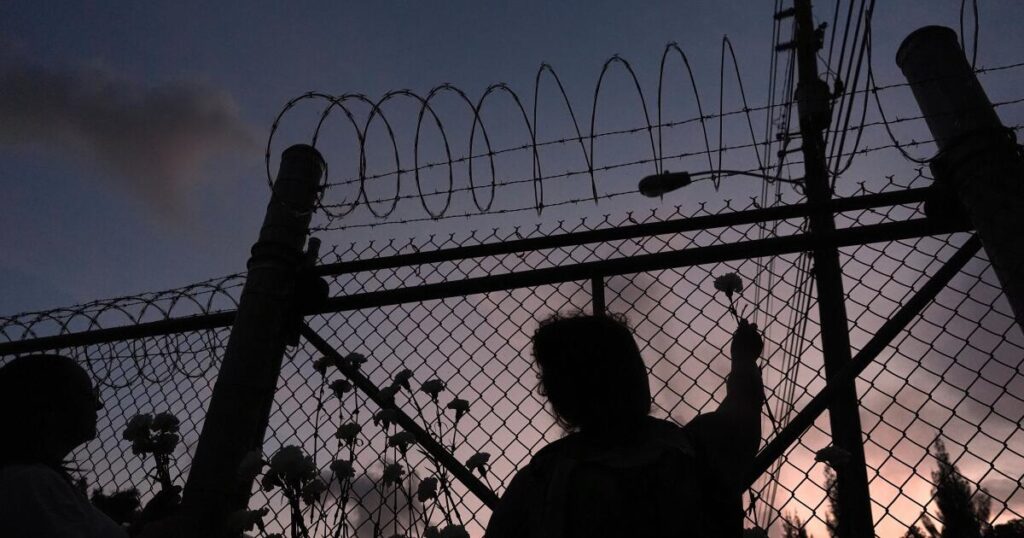
Since October, 23 people have died in ICE custody, already surpassing the total for the prior fiscal year and now on pace to be the deadliest period in two decades. Detainees in ICE facilities report worms in their food, unsafe drinking water, overflowing sewage and weeks without medical attention. Under the Trump administration, ICE has dramatically increased its use of solitary confinement as punishment — isolating more than 10,500 people between April 2024 and May 2025 alone — some just for asking guards their names, or for filing civil rights complaints.
If prisoners were treated this way in federal or state facilities, it would be acknowledged as cruel and unusual punishment in violation of the 8th Amendment. There are countless cases in which federal courts found harsh and inadequate conditions of imprisonment that violate the Constitution. But those in immigration detention cannot invoke this constitutional protection because of the Supreme Court’s decision in Fong Yue Ting vs. United States (1893), where the court held that deportation is a civil, not criminal, proceeding and therefore is not punitive. As a result, the cruel and unusual punishment clause is not deemed to apply at all.
Indeed, because deportation is not considered a criminal matter, the constitutional provisions protecting those accused and convicted of crimes do not apply, including prohibiting unreasonable searches and seizures, providing a lawyer and requiring a jury trial. In INS vs. Mendoza-Lopez (1984), the court declared that, “Consistent with the civil nature of the proceeding, various protections that apply in the context of a criminal trial do not apply in a deportation hearing.”
Quite importantly, unlike criminal defendants, immigration detainees have no right to appointed counsel for their deportation proceedings. They must find and fund their own representation — a near-impossible task for someone being held in a remote detention facility, often far from their home community and sometimes without access to a phone.
The consequences are stark and well-documented. The Vera Institute of Justice has found that detained immigrants without legal representation are deported at dramatically higher rates than those with counsel, even when their underlying legal claims are comparably strong. In one study, represented detainees were 10 times more likely to obtain relief than their unrepresented counterparts. Representation is not merely an advantage — it is usually determinative of outcome. The Vera Institute has also documented that of the more than 550,000 people who were ordered removed in immigration court over the past 12 months, 69% lacked legal representation as of the most recent available data.
Those who are subjected to inhumane treatment by ICE agents rarely will have any remedy. Even if the victims can somehow obtain a lawyer, there is no federal statute that authorizes suits against federal officers who violate the Constitution. A law adopted in 1871 allows suits against state and local officials and local governments, but no similar statute exists that authorizes claims against federal officials. And in the last 45 years, the Supreme Court has made it much harder to sue federal officers directly under the Constitution for their illegal conduct.
Beyond this, the Trump administration has summarily deported individuals to El Salvador, where the Constitution doesn’t apply at all. For example, more than 280 Venezuelan migrants were sent to El Salvador’s notorious CECOT prison, where routine torture has been documented, in defiance of a federal court order.
A CBS News investigation discovered that three-quarters of those migrants had no apparent criminal record, and a federal judge found the men had been “spirited away”before any legal challenge could be mounted. The Trump administration has taken the position that once they are in El Salvador no court has jurisdiction to protect them.
All of this should be unacceptable in a country that believes in the rule of law and that should be obligated to treat every person humanely. Congress can fix all of this if it has the will to do so. In February 2025, Sen. Alex Padilla introduced the Access to Counsel Act, which would guarantee the right to consult with an attorney for individuals detained at ports of entry. In November, the Restoring Access to Detainees Act, which would extend similar protections to individuals held in Department of Homeland Security custody, was introduced by Sens. Padilla, Chris Murphy and Adam Schiff.
Then in December, Sens. Padilla and Richard Blumenthal introduced the Accountability for Federal Law Enforcement Act, which would create a statutory cause of action allowing any individual — regardless of citizenship — to sue federal law enforcement officers and agencies in civil court for constitutional violations. This is a vital change in the law to protect basic constitutional rights.
These bills, and the proposed restrictions on the conduct of ICE agents, should be just the beginning of ensuring that the Constitution applies to the actions of these federal officials. They are crucial as the Trump administration is building vast warehouses across the country to house those apprehended by ICE, with pictures bringing to mind images of concentration camps.
I never would have imagined that in my country we would have masked agents apprehending people, taking them into custody where they are held in inhumane conditions, and where they face deportation without representation and often without any meaningful due process.
Our country can and must do better than this.
Erwin Chemerinsky is the dean of the UC Berkeley Law School.
The post Simply holding ICE agents accountable isn’t enough appeared first on Los Angeles Times.