How do you begin to take account of a school shooting?
There is the crime itself, calculated in minutes of terror and tallies of the dead and wounded. There are the searches for warning signs and sources of blame; the long-tailed trauma of survivors, triggered by the small things of everyday life; the rage that victims’ families carry, years after the media grows weary and political promises come to nothing; the self-flagellation of parents who never thought their child could be capable of such violence.
The list goes on, too much to bear.
Yet it is all taken on, with brutal honesty and abundant compassion, in “Innocence.” An early contender for one of this century’s great operas, it premiered in 2021, two years before the death of its composer, Kaija Saariaho. And on Monday it arrived at the Metropolitan Opera, bringing an atrocity that every American will recognize to the largest opera stage in the country.
“Innocence,” about a school shooting and its aftermath, is the most timely production at the Met this season. But it is also as timeless, taut and ultimately cathartic as a Greek tragedy. The opera is a triumph of drama on every level: the trickled revelations of Sofi Oksanen and Aleksi Barrière’s libretto; the harrowing realism of Simon Stone’s direction; and above all the masterly storytelling of Saariaho’s score, which is impressive at first glance then staggering on closer inspection.
The most astonishing achievement of “Innocence” is how much it communicates in just an hour and 45 minutes. It has the brevity and weight of Alban Berg’s “Wozzeck,” and with touches like a darkly ironic waltz seems to invite comparisons to that classic. Saariaho’s original title for the opera, though, was “Fresco,” and her more substantial debt may be to “The Last Supper.”
Like Leonardo’s famous painting, “Innocence” assembles 13 characters who are quickly but vividly defined, connected by an event that will profoundly change them all and resonate through time.
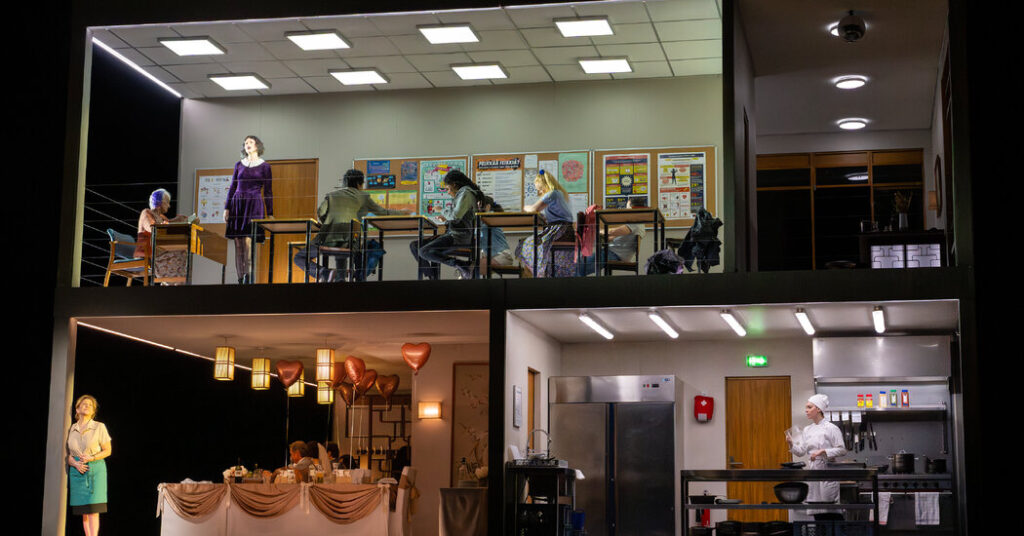
Saariaho’s opera is occupied by the students of an international school in Finland, where the shooting occurs, and by people celebrating a wedding at a restaurant. The two settings, 10 years apart, are linked by chance: A server at the restaurant calls in sick, and the waitress who replaces her ends up pouring drinks for the family of the boy who killed her daughter. With the pace and structure of a thriller, the past and present circle each other, spinning out shocking and painful discoveries.
The music begins elusively, with a droning low C in the basses under bits of melody and texture that emerge and evaporate throughout the orchestra. Susanna Mälkki, who conducted the premiere of “Innocence” at the Aix-en-Provence Festival in France, channeled her Saariaho expertise through the Met players, unafraid of an initial quiet that, with fresh narrative twists, gave way to the unsettling alarm of downwardly sliding strings and shocking eruptions from the full ensemble.
Subtly but effectively, Saariaho also shapes her writing to the nine languages of the libretto. Each is rendered with careful attention to the rhythms of speech, even as she switches among them within a scene. Multiple characters move from a public lingua franca to a private native tongue, like English to Czech for the waitress, sung by the mezzo-soprano Joyce DiDonato, perhaps the biggest star in a show without a starring role.
If “Innocence” has lost some of the wattage it had in Aix, it is because of casting changes that include DiDonato, a wellspring of plush geniality, stepping into a role originally performed with hard-edged passion by Magdalena Kozena. DiDonato imposed her usual sound on the character, rather than letting herself be guided by the role. The waitress is a woman who suffers from unshakable anger and suffering, years after the loss of her daughter and the dissolution of her marriage. At one point, Saariaho writes in an optional spoken plunge of an octave, which DiDonato adopted with gravelly despair. She needed more of that.
As her daughter, Marketa, the Finnish vocalist Vilma Jaa was an enthrallingly spectral presence. Saariaho wrote the part for Jaa’s specialty as a folk and pop singer, with cadenzas that make room for Karelian herding calls and whips of pitch. The freeness of folk music can make it sound as if it’s coming directly from the soul; it’s devastating to hear it from the mouth of a girl as she recounts being shot three times in the heart.
Her classmates are memorably played by five actors whose lines are written with stylized, notated speech and occasional musicality: the stuttering “ich” of German blending with a snare drum, the natural lilt of Swedish smoothly shifting to song, the fricative nuances of French being used to serpentine effect. As their teacher, Lucy Shelton brought her background as an avant-garde soprano to phrases elongated and adrift, punctuated with flashes of bent pitches and sounds like screams.
The wedding party is populated by the shooter’s family, which the bride (Jacquelyn Stucker, intense yet sympathetic) is marrying into with no knowledge of its past. But history resurfaces, dealt with in different ways by the mother (Kathleen Kim, miscast and overblown) and father (the baritone Rod Gilfry, persuasive in his public stoicism and private anguish). Their priest, sung by the bass Stephen Milling, tries to soothe but feels guilt for red flags he ignored. The tenor Miles Mykkanen, as the shooter’s sibling, was most memorable, with a jovial brightness that transformed into shattering fragility, disquieting and sweet, as he admits that he still loves his brother.
Stone’s production, both hyper-real and surreal, traps the characters and timelines within naturalistic architecture, designed by Chloe Lamford, that rotates in a nightmarish void. The building’s many rooms serve as both the school and the restaurant, with coups de théâtre that, for example, turn a dining room with warmly radiant sconces into a classroom under the chill of fluorescent lights with jaw-dropping speed and seamlessness. (At Aix, the backstage crew took a bow; that was missed at the Met, where it was also deserved.)
Eventually, the past takes over. The restaurant’s name, Convallaria (better known as lily-of-the-valley, a flower traditionally associated with renewal), is permanently replaced by the school’s sign. And by the end, the rooms are nearly bare.
Except, that is, for bloodstains. They are a reminder of the pain that lingers and the impossibility of resolution. But the emptiness also leaves space for something else, a future hinted at in the epilogue and Saariaho’s closing measures. She leaves the orchestra with a musical direction that almost feels like a wish for the entire opera: “calm.”
Innocence
Through April 29 at the Metropolitan Opera, Manhattan; metopera.org.
Joshua Barone is an editor for The Times covering classical music and dance. He also writes criticism about classical music and opera.
The post Review: Seeing a School Shooting on America’s Biggest Opera Stage appeared first on New York Times.