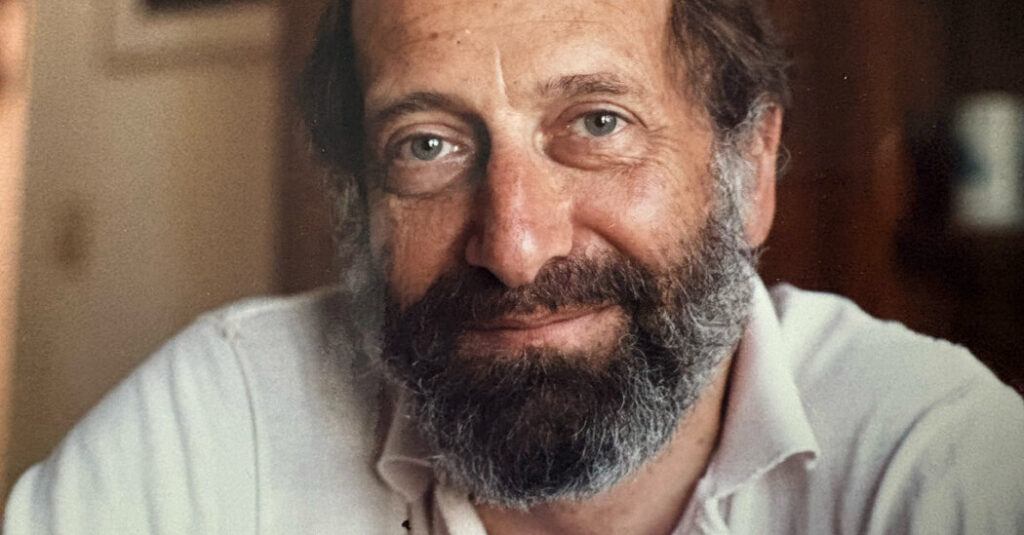
Peter Schrag, a longtime opinion editor of The Sacramento Bee who wrote a well-received book about the conundrum of California governance — a state blessed with extraordinary wealth and opportunity and, in his view, cursed with too much populist democracy — died on March 19 in Davis, Calif. He was 94.
His death, in a hospital, was confirmed by his son David.
Mr. Schrag’s 1998 book, “Paradise Lost: California’s Experience, America’s Future,” argued that the state’s infatuation with voter initiatives — only Oregon has used the process as often — hamstrung the State Legislature and eroded representative government.
While purporting to empower grass-roots Californians, these initiatives transferred power to the older, wealthier voters who turned out at the polls regularly, Mr. Schrag demonstrated. These voters’ abhorrence of taxes hurt working class and minority populations that benefited from the public services that the revenue paid for. He described the state’s retreat from progressive policies, through a wave of initiatives in the 1980s and ’90s, as “Mississippification.”
In The New York Times Book Review, the journalist Nicholas Lemann called “Paradise Lost” an “angry and persuasive book” written “in the voice of an immensely knowledgeable, reasonable man — not an ideologue — who has slowly succumbed to outrage.”
Mr. Schrag’s wide-ranging career in journalism reflected the highs and lows of a journeyman freelancer, one who traded the buzz of national exposure, while in his late 40s, for the security of a gig at a regional newspaper, where he unexpectedly found his greatest success.
In his early decades, he wrote often for Saturday Review and Harper’s when those magazines helped define America’s literary and political culture, and he spun off books from his articles at a steady clip.
A German-born Jewish refugee who was raised in Queens and educated at Amherst College, Mr. Schrag hobnobbed in New York City with the editors Norman Cousins, Willie Morris and Midge Decter before landing improbably in the Central Valley of California. There, he was hired in 1978 as editorial page editor of The Bee, an influential newspaper in the state’s capital, despite never have written a newspaper editorial.
The Bee, which was one of three dailies owned by the McClatchy family in the Central Valley, had long supported the state’s progressive policies that funded freeways and low-cost universities, paid for one of the top K-12 school systems in the United States, and put out a welcome mat to newcomers, who spurred population growth and prosperity.
Around the time Mr. Schrag arrived at the paper, those policies were being challenged by anti-tax, anti-immigrant Californians.
On his watch, the editorial page opposed Proposition 13, which in 1978 capped property taxes and hollowed out school budgets, as well as later initiatives to mandate three-strikes criminal sentencing; prohibit bilingual education; and to shut the doors of public schools and health care services to undocumented residents.
The Bee editorialized against each of these initiatives, and voters approved them all.
(Proposition 187, the anti-immigrant initiative passed in 1994, was blocked by the courts).
“We were liberals as the state was turning conservative and sometimes reactionary,” Mr. Schrag wrote in an unpublished memoir.
His book on the trouble with the initiative system attracted attention from California’s leading newspapers and beyond the state’s borders. News crews from the United Kingdom, Sweden and Germany visited Mr. Schrag for interviews. The New York Times named it a Notable Book of 1998.
Peter Ludwig Schrag was born on July 24, 1931, in Karlsruhe, Germany, to Otto and Judith (Haas) Schrag. His father, a brewer, moved his family to America in 1941 to escape Nazi persecution.
Peter graduated from Amherst with a bachelor’s degree in history in 1953. He spent two years as a journalist at The El Paso Herald-Post before taking a job in the communications department at his alma mater. He remained at Amherst for a decade — “five years too long, probably,” he wrote.
But the experience gave him a knowledge of American education that became the foundation of a broad journalism career. He published a book, “Voices in the Classroom” (1965), about how race and class distorted the promise of an equal education in America’s K-12 public schools, and he became education editor of Saturday Review.
There, he rose to executive editor under Mr. Cousins. He wrote the magazine’s editorial about the life and the loss of the Rev. Dr. Martin Luther King Jr. after his assassination in 1968, and he also covered the riots that year at the Democratic National Convention in Chicago.
Mr. Schrag freelanced regularly for Harper’s when that magazine, under the editor Mr. Morris, published Norman Mailer and William Styron. Mr. Schrag’s Harper’s piece on “The Decline of the WASP” was promoted with posters in the commuter train stations of Westchester County, N.Y. The book editor Michael Korda, at Simon & Schuster, had Mr. Schrag expand the article into a book, in 1971.
Two years later, Mr. Schrag published “The End of the American Future,” a eulogy for the country’s waning confidence in itself and its diminished prospects as the post-World War II boom petered out.
In The Times, the journalist Steven R. Weisman wrote that the book “belongs to the growing literature” of despair about the direction of the country.
“The book’s main problem,” Mr. Weisman added, “is that it’s too complacent with a grab bag of liberal clichés and much too reliant on journalistic impressions, instead of analysis.”
Mr. Schrag was soon hunkered down in Los Angeles covering the espionage trial of Daniel Ellsberg, the leaker of the secret Defense Department history of the Vietnam War known as the Pentagon Papers. His book on the case, “Test of Loyalty,” suffered from bad timing: It appeared in June 1974 and was overshadowed by the Watergate hearings that led President Richard M. Nixon to resign.
By the mid-1970s, then a California transplant, Mr. Schrag called a friend who had become managing editor of The Bee. He was interested in coming in from the cold of freelance writing. Mr. Schrag remained at the paper for 19 years.
His marriages to Jane Mower and Diane Divoky ended in divorce. Besides his son David, from his second marriage, he is survived by his third wife, Patricia Ternahan; two children, Andrew and Mitzi, from his first marriage; another son, Benaiah, from his second marriage; five grandchildren; and two great-grandchildren.
After “Paradise Lost,” Mr. Schrag, then retired from newspapering, had one more California book in him. “California: America’s High-Stakes Experiment” (2006) appeared after the state’s economy had recovered in the early 2000s and voters had repudiated the immigrant-bashing of Proposition 187. That failed law is credited with awakening Latino voters in the state and propelling the long-term erosion of Republican power in California.
Mr. Schrag expressed qualified optimism about the state’s growing comfort with its diversity, as white Anglos — including the WASPs whose decline he had chronicled — ceased to be the majority in 2000. By 2006, the state was firmly headed for a Latino plurality.
“With the population becoming increasingly Latinized,” he wrote in his book, “California’s willingness and ability to accommodate its new residents, and their ability to assimilate to it, could well be important, and perhaps definitive, indicators for the nation.”
Trip Gabriel is a Times reporter on the Obituaries desk.
The post Peter Schrag Dies at 94; Wrote of Dangers of California’s Populist Streak appeared first on New York Times.