Inside a dark cargo container on a recent drizzly morning in Kabul, two dozen people stared at pictures of hundreds of bodies scrolling by on a projector, hoping to catch sight of a missing relative.
Brothers, wives or parents often asked a morgue employee to return to the previous photograph, desperate for an identifiable detail, even though many bodies were barely recognizable.
“I can’t see this again,” said Rokhshana Shah Mohammadi, 60, as she stepped out and into the morgue’s courtyard, falling into the arms of a relative. “I need to know what happened to my son.”
With Pakistan and Afghanistan in open conflict, on March 16 at least two Pakistani airstrikes hit a drug rehabilitation facility in the Afghan capital in the deadliest single attack on civilians in Afghanistan since the Taliban regained power in 2021.
Pakistan’s military says that the strike hit an ammunition site and a drone storage facility, and was launched as part of its military campaign against the Taliban government, which it accuses of supporting terrorist groups.
But Taliban officials say more than 400 people were killed, a death toll that international humanitarian organizations operating in Afghanistan say is credible. The United Nations’ mission in Afghanistan told The New York Times that it had so far confirmed at least 269 civilian deaths and 122 injured, but that the death toll was likely higher.
The center, called Omid, or “Hope” in the Dari dialect, was well known among local communities and had been covered in news reports and documentaries.
“With the technology they have now, they must know that addicts or civilians were there,” said Ali Mohammad, 34, a patient at Omid who was recovering from his injuries at a Kabul hospital. “So why did they bomb it?”
Our reporting and preliminary investigations by the U.N. mission in Afghanistan, Human Rights Watch and other international bodies have reached the same conclusion: Pakistan hit the wrong target — a facility housing civilians and tucked in a military compound.
“I do not know what they kept there,” Lt. Gen. Ahmed Sharif Chaudhry, Pakistan’s military spokesman, said in an interview on Pakistani television. “They were not our target.”
A few hours after the strikes, we saw dozens of bodies on the site; later, we saw hundreds of pictures of the bodies collected from Omid at a local morgue.
The drug center had been operating for a decade on the site of a former NATO base. The Taliban carry out military activities in parts of the compound, some as close as 300 feet from the center, with little more than a blast wall shielding the facility.
The strikes abruptly ended the lives of husbands, brothers and sons who struggled with depression, grief or the shame of unemployment, their families said. Many said their relatives had ebbed for years between erratic behaviors, domestic violence and glimmers of hope shattered by relapses.
The last time Abida Stanikzai saw her husband, Zakaria, he told her he would soon come home, she said. Previous episodes of addiction had made Zakaria so violent that the family subdued him at times by tying his wrists and ankles.
Ms. Stanikzai looked at the photos hoping to recognize her husband, to no avail, then went inside the morgue to look at the remains of a single foot, which she believed may have belonged to him.
Their 15-year-old son, Muhammad, held his mother’s purse as he waited in silence in the courtyard.
Since early 2023, the Taliban have rounded up thousands of drug users and placed them in facilities like Omid, where they face unmedicated, forced withdrawal in conditions that foreign officials have described as arbitrary detention.
Abdul Sabir Husseini, 36, had become addicted to heroin and hashish nearly a decade ago after he lost a son to leukemia, according to his brother, Abdul Latif Husseini. He would often borrow a motorcycle and drive to his son’s grave, Mr. Husseini said. In recent months, his violent relapses affecting neighbors, his wife and three other children pushed the family to send him to Omid.
“He threw himself at me and asked me to take care of his sons,” Mr. Husseini said about Abdul Sabir on a recent morning in the family home. A poster of his brother was folded next to him. “He told me, ‘I have no one else. I’ll be back healthy.’”
In the aftermath of the strike, Pakistani officials suggested that the drug rehabilitation center was something else.
“If they had addicts there, it was likely a training facility for bombers,” said Lt. Gen. Chaudhry, Pakistan’s military spokesman. “Not all drug addicts are suicide bombers, but all suicide bombers are drug addicts.”
Pakistani officials have not provided evidence backing that claim.
“Pakistani authorities need to carry out an impartial investigation to determine why it hit a drug treatment center filled with civilians and who should be held to account,” said Patricia Gossman, senior associate Asia director at Human Rights Watch.
The previous U.S.-allied government in Afghanistan had opened Omid in 2016, with 2,000 beds on the former NATO base known as Camp Phoenix. After the Taliban took control of the country, and the base, in 2021, they continued running the center under the Ministry of Interior. (A second drug center, run by the Ministry of Health, also sits at Camp Phoenix, 1,000 feet from the Omid facility. It was not hit in the strikes.)
Employees of the ministry guarded the camp, according to interviews with survivors of the strike, but most of the chores, from running the kitchen to calling people for prayer, rested on the patients.
One of the Pakistani strikes hit a building that served as a dining hall, kitchen and prayer room, according to patients and guards. A Pakistani military official said at least two other strikes hit two adjacent installations that were used to store drone parts, though he provided no evidence.
Even after an international outcry over the civilian deaths from the strike, Pakistan has maintained that it hit a legitimate military target. It has publicly said that secondary detonations proved it hit an ammunition depot.
Nearly a week after the strikes, fires still smoldered on-site and body parts lay in puddles of blood.
In the burned kitchens, large ovens were covered in soot, and rotting potatoes floated in buckets. A deflated volleyball and a sewing machine sat abandoned in a nearby building, while dozens of syringes and boxes of gloves littered the ground of what Taliban officials described as an emergency ward.
Insinuations by the Pakistani military that the Omid center served as a training center for suicide bombers have angered survivors and families of victims.
Abdul Wasi Noori lost his 26-year-old son, Hekmatullah, a father of two young children who ran a supermarket near the family’s apartment. Mr. Noori said Hekmatullah became addicted two years ago to a popular synthetic drug known as Tablet K.
Hekmatullah had grown verbally abusive and violent with relatives, said Mr. Noori, the owner of a construction company. “But he was not a criminal,” he added, referring to Pakistan’s accusations.
“I tried so hard to give him a new life,” Mr. Noori said. “Now we won’t see him again.”
Still, the Pakistani strikes have shed new light on the Taliban’s use of military facilities to house civilians. Two days before the strikes in Kabul, Pakistan hit an empty military building adjacent to a drug rehabilitation center in the southern province of Kandahar. No civilian casualties were reported.
In Kabul, the Taliban carry out military activities less than 300 feet from the center, according to six officials who were briefed on their operations. Two of them said drone parts were being stored and assembled on-site. They requested anonymity because they weren’t allowed to publicly discuss the military activities of the Taliban.
The Afghan Ministry of Defense did not respond to a request for comment.
But the drug center sites were clearly separated from the military site by blast walls, the officials said, and there was no evidence of military activity in the part of the compound hit by the Pakistani strikes.
One weapons and detonations expert interviewed by The Times said footage of the strike shared by the Pakistani military appeared to show secondary blasts — suggesting the potential presence of explosives or ammunition on site — but that their nature remained unclear.
But Human Rights Watch said in a statement that it “saw no indication of secondary detonations caused by bulk explosives, propellants, or ammunition with tracer elements typically associated with ammunition depots.” Two other experts from a private consultancy and an international body, who requested anonymity to discuss ongoing investigations into the strikes, said they saw no evidence of secondary detonations either.
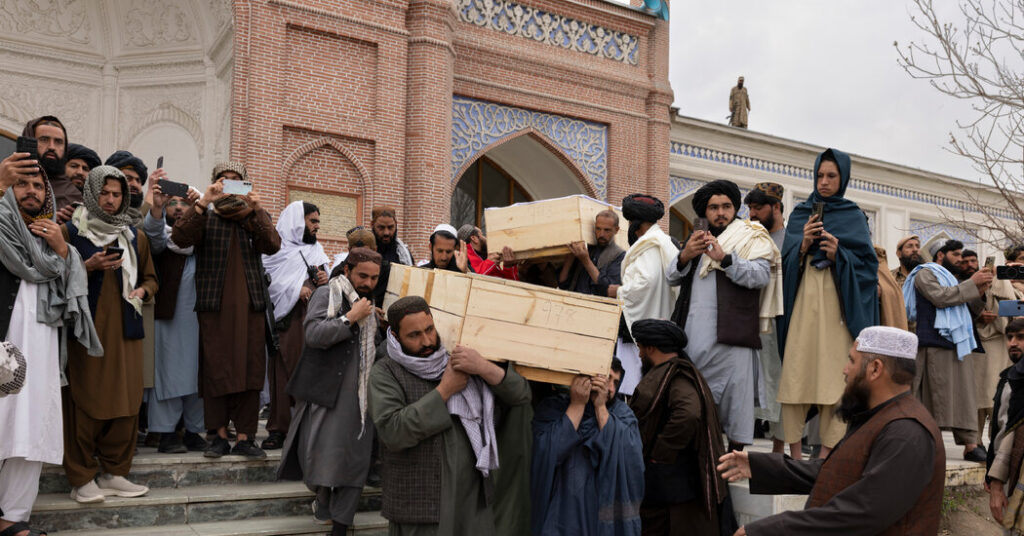
The Taliban have buried nearly 100 victims in mass graves over the past few weeks, including many who were not recognizable or had not been claimed by families.
Sakina Arif, 42, watched as the coffins were taken down from ambulances at one of the mass funerals held on a hill overlooking Kabul. She was overcome with grief at the thought of her missing 20-year-old son, Muhammad Arif. She had brought him beef kebabs at Omid a day before the strike, and had been unable to find him at the morgue or at hospitals.
As groups of men carried the coffins to a mosque, Ms. Arif wailed and said, “Which coffin are you in, my son? Come and call out to your mother.”
Kiana Hayeri, Yaqoob Akbary, Zia ur-Rehman and Ataullah Omar contributed reporting.
Elian Peltier is The Times’s bureau chief for Pakistan and Afghanistan, based in Islamabad.
The post Pakistan Says It Hit a Military Target. Investigations Suggest It Was a Rehab Center. appeared first on New York Times.