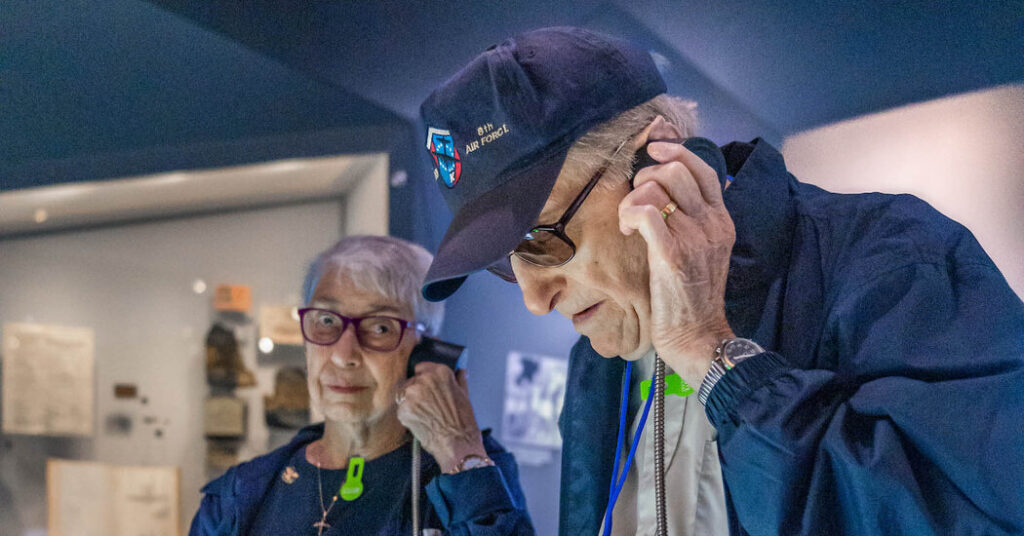
Norman Bussel, who survived the destruction of his B-17 bomber during an air raid over Berlin in 1944, endured a year in a German prisoner-of-war camp and, after retirement, spoke and wrote extensively about the underappreciated trauma experienced by the soldiers, sailors and airmen of the Greatest Generation, died on Tuesday in Peekskill, N.Y. He was 102.
His granddaughter Rachel Kramer Bussel, the essayist, confirmed the death, in a hospital. He lived in Mohegan Lake, N.Y., in northern Westchester County.
Mr. Bussel, having trained as a radio operator, arrived in Britain in early 1944, as America’s powerful 8th Air Force was extending the reach of its bomber fleet deeper into continental Europe.
He had flown two missions over central Germany before embarking on a third, a major raid on the Friedrichstrasse train station in central Berlin involving 751 bombers. They took off early on April 29, 1944.
The sky over Berlin was thick with German fighters and bursts from 88-millimeter flak rounds. The plane took several hits, though it kept flying. Mr. Bussel, a staff sergeant, didn’t hear the pilot’s order to bail out — the intercom had been destroyed.
Finally, he decided to jump. Seven seconds later, in midair with his parachute deployed, the plane exploded above him. As he drifted down toward Nazi Germany, he ripped off his dog tags, which included the designation “H,” for “Hebrew.”
He was captured and interrogated for weeks, part of which he spent in dark solitary confinement. He was eventually sent to the Baltic Coast, where a new P.O.W. camp had opened.
There, Sergeant Bussel and his fellow prisoners endured nearly a year of capricious cruelty at the hands of their German guards. Men were shot dead for the slightest infractions. Red Cross packages, protected by international law, rarely arrived, having been intercepted by desperate German soldiers.
For rations, the men received meager slices of black bread, thin soup and the occasional potato. Sergeant Bussel went from 165 pounds to just over 100.
At one point, the guards ordered the prisoners to form two lines, one for Christians and one for Jews. Sergeant Bussel, who without his dog tags could pass as a gentile, agonized over whether to out himself.
Then, at the last minute, a handful of Christians began moving into the Jewish line. More followed. Then they all did. The guards decided not to press the issue.
As Soviet forces pushed into Germany in early 1945, Sergeant Bussel was moved south to a camp near Nuremberg. There, on April 29, 1945 — one year to the day since his capture — elements of Gen. George S. Patton’s Third Army liberated the camp.
He returned home to Memphis that summer. To look at, he was healthy, if still a little thin. Inside, he was a wreck: He suffered from nightmares, claustrophobia and survivor guilt, all of which he tried to medicate with copious amounts of alcohol.
For former P.O.W.s like Mr. Bussel, not only had they lived through the horrors of combat, but they had also suffered through months or years of inhuman treatment by their captors, leaving them with lasting mental scars if not physical ones. But at the time, there was no real diagnosis for what is known today as post-traumatic stress disorder, the symptoms of which the culture of postwar America largely tried to ignore.
Mr. Bussel buried himself in his career — first at his father’s grocery in Memphis, and later as a magazine editor in New York — but the horrors remained. He feared getting on planes, or being in the subway. Every April 29, he found himself hit by waves of self-loathing. His family suffered.
“Survivor guilt was my constant companion,” he wrote in his memoir, “My Private War: Liberated Body, Captive Mind: A World War II POW’s Journey” (2007).
The book was the culmination of decades spent working with veterans like himself.
In 1984, Mr. Bussel’s wife, Melanie Bussel, saw an ad for a meeting of the group American Ex-Prisoners of War near their home in Mohegan Lake. He joined, and soon he and his wife were certified volunteers with the Veterans Administration (now the Department of Veterans Affairs), helping people navigate the intricacies of government benefits.
In 2007, he testified before Congress about reforming veterans assistance. He also spoke frequently to anyone who would listen — civic groups, local governments, veterans organizations, newspapers — about the inner turmoil of former P.O.W.s
As he told the Westchester County newspaper The White Plains Journal-News in 2001, “Some of us can’t remember what we had for breakfast this morning, but our memory of being in a P.O.W. camp is just as vivid as ever.”
Norman Bussel was born on Oct. 2, 1923, in Memphis to Solomon and Rose (Rosenthal) Bussel, who managed the home while his father ran the grocery store.
After high school, Norman enrolled at Memphis State College (today the University of Memphis) but left when the war began. He tried to enlist, but he was too young to join without the approval of his parents, who refused to grant it. His father had served in World War I and continued to suffer what was then called shell shock.
Instead, the younger Mr. Bussel worked at a factory building B-25 bombers until his draft number came up. Early on, he was chosen for radio training and assigned to serve on long-range bombers.
After the war, Mr. Bussel returned to Memphis State but left, again, to manage his family’s store after his father hurt his back.
Mr. Bussel married Beatrice Shefsky in 1946; they divorced in 1973. He married Melanie Buse that same year.
Along with his granddaughter Rachel, Mr. Bussel’s wife survives him, as do two sons, David and Bob, from his first marriage; two other grandchildren; three great-grandchildren; and his sister, Fay Marker.
Today, society’s increased awareness of war’s psychological devastations can be attributed in part to people like Mr. Bussel.
“Some P.O.W.s say they fought in two wars,” he wrote in his memoir. “In the first, they battled the enemy with weapons; and in the second, they struggled to survive incarceration by using their wits. Most of our physical wounds have healed with time, but the wounds that will never heal are the psychological wounds.”
Ash Wu contributed reporting.
Clay Risen is a Times reporter on the Obituaries desk.
The post Norman Bussel, Who Chronicled Veterans’ Unseen Traumas, Dies at 102 appeared first on New York Times.