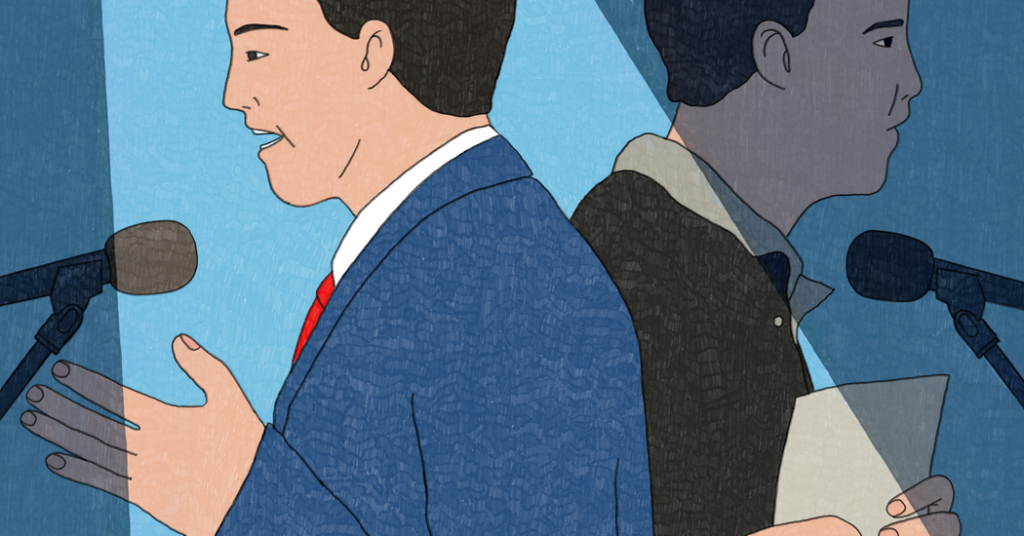
American democracy has a personality problem.
At its core, our political system is a popularity contest. Elections reward those who are comfortable performing in public and on social media, projecting confidence and dominating attention. This dynamic tends to select for so-called alpha types, the charismatic and the daring, but also the entitled, the arrogant and even the narcissistic.
This raises a basic but rarely asked question: Why are we filtering out the quiet voices? And at what cost?
Over the past two decades, my research on collective intelligence in politics, democratic theory and the design of our institutions shows that the system structurally excludes those I call, in my new book, “the shy.” By the shy I mean not just the natural introverts, but all the people who have internalized the idea that they lack power, that politics is not built for them, and who could never imagine running for office. That is, potentially, most of us, though predictable groups — women, the young and many minorities — are overrepresented in that category.
The early-20th-century British writer G.K. Chesterton once offered a striking and unusual metaphor for what democracy should look like. He wrote, “All real democracy is an attempt (like that of a jolly hostess) to bring the shy people out.” What would our democratic institutions look like if we took that metaphor seriously?
One answer — perhaps the most promising one we have at this time — can be found in citizens’ assemblies.
Citizens’ assemblies are large groups of ordinary people, selected by lottery, who come together to learn about a public issue, hear from experts and advocacy groups, deliberate with one another and make recommendations. Picture jury duty for politics. Through random selection, citizens’ assemblies reach deep into the body politic to bring even the initially unwilling to the table. Once seated, participants are given time, structure and support to find their voices and contribute to forming a thoughtful collective judgment.
Citizens’ assemblies are gaining traction around the world. As of 2023, the Organization for Economic Cooperation and Development documented 733 cases of lot-based deliberative assemblies around the world, most of them taking place over the last 20 years, in what the subtitle of an earlier report calls a “deliberative wave.”
Ireland conducted at least five of them at the national level, where they helped break political gridlock on issues ranging from same-sex marriage to abortion and climate policy. In recent years, France convened at least 19 at the regional level and three at the national level, including one on climate policy and one on end-of-life issues. (I sat on the Citizens’ Convention for Climate as a researcher-observer and was later appointed by the French government to the governance committee of the Citizens’ Convention on the End of Life.)
Citizens’ assemblies are now also spreading across the United States at the local level — from Oregon’s Citizens’ Initiative Review model to Michigan’s Independent Citizens Redistricting Commission to Washington State’s climate assembly to Petaluma’s Citizens’ Assembly in California.
I now serve as the director of design and chairwoman of what will soon become one of the largest state-level citizens’ assemblies in the United States. From July to September, the Connecticut Citizens’ Assembly will bring together 100 randomly selected Connecticut residents for several weekends of deliberation about the question of property taxes and how to fund local public services.
So far most citizens’ assemblies worldwide remain single-issue, one-off events and are purely advisory. But the 2019-21 French climate convention was uniquely empowered by the government’s mandate to initiate and formulate legislative measures, leading one of its chairmen to describe it as a “citizen parliament” with a pre-legislative function or even turning it into a full-on de facto citizen legislature. At the local level, the 80,000-person German-speaking region of Belgium has established a permanent citizens’ council of 24 randomly selected citizens, whose task is not only to convene one-off citizens’ assemblies on specific issues but also to help set the parliamentary agenda.
The benefits of these assemblies are striking. Citizens’ assemblies typically produce recommendations that are more nuanced, more pragmatic and more aligned with what the public actually wants than what currently emerges from elected legislatures. When their recommendations are put to voters in polls, as in France on climate, or referendums, as in Ireland on same sex-marriage and abortion, they usually receive overwhelming public support.
Because their members are randomly selected, citizens’ assemblies reflect the underlying values and preferences of the larger population. But what is truly fascinating is that the depolarizing and educational effects of deliberation in this nonpartisan context will sometimes sway liberal majorities toward conservative conclusions and vice versa.
In the 2019 “America in One Room” deliberative poll (a cousin of citizens’ assemblies, except bigger, shorter in duration and with the goal of generating informed policy preferences rather than actionable policy recommendations), deliberation led both Republicans and Democrats to revise their views — often substantially. Republicans shifted on immigration, with support for reducing admissions falling from 65 percent to 34 percent and backing for undocumented immigrants being forced to return to their home country before applying to work legally dropping from 79 percent to 40 percent. Democrats also changed their minds, in some cases moving away from traditionally progressive positions: support for “Baby Bonds” collapsed from 62 percent to 21 percent, backing for a $15 minimum wage fell from 82 percent to 59 percent and support for expanding Medicare dropped from 70 percent to 56 percent. These shifts show that deliberation does not push opinion in a single ideological direction but rather toward the conclusions supported by better evidence and what Jürgen Habermas used to call “the unforced force of the better argument.”
Interestingly, it is also true that where a pre-existing underlying consensus in the assembly survives deliberation, as it did in France on end-of-life issues, the outcome is nevertheless much more acceptable to the minority.
This is so because in citizens’ assemblies, minorities are given time and attention in a way that our competitive, winner-takes-all politics often does not. In the last plenary of the French convention on end-of-life issues, Soline Castel, a member of the ideological minority against assisted dying, made a point of saying: “I want to thank the 75 percent for giving us 50 percent of the final document and 50 percent of the speaking time.”
Beyond their problem-solving and depolarizing dimensions, however, citizens’ assemblies are also joyful and exciting processes that reconcile people with one another and with politics. Participants arrive as strangers; they leave as civic friends.
The main surprise to me from observing these assemblies was indeed the intense bond, often expressed in the vocabulary and gestures of love, that formed between participants over the course of many months of hard work, late-night discussions at the hotel bar and the occasional celebratory event. As Jean B., an older member of the French citizens’ convention on end-of-life put it during the last weekend, “We have become the members of an improbable family born out of the works of chance and necessity.”
When democracy feels this inviting, it transforms people.
Consider Hugues-Olivier Brillouin, who began the process as a self-declared disgruntled citizen and climate-change skeptic. He spent the first day of the French climate convention with a frown of disgust on his face, taking his carry-on bag everywhere instead of checking it at the door because, as he explained, he was leaving any minute now. He ended up staying until the end of the nine-month process and voted in favor of the convention’s proposals. After the convention was over, he went on to run for election in his home region.
Or consider Harry A. (most of the participants did not use their full names) from France’s end-of-life convention in 2022, who came to participate all the way from his native Guadeloupe, one of France’s overseas territories. In a plenary at the end, he said that he had “to be eight hours on a plane every other weekend” but that he was coming out of the experience “a bigger man” with more self-esteem because “with this convention, at least once in your life, you feel useful.”
Bringing out the shy also transforms the confident. They learn to dial their energy back and take pride in others’ accomplishments. During the climate convention, facilitators went around a working group of about 30 people and reached Arlette, a discreet older lady with silver hair. The whole room stood still, patiently waiting for her frail voice to make a few points. After she was done speaking, a man exclaimed: “You are speaking Arlette, you are growing!” The room broke into applause and joyful whistles.
Bringing out the shy, finally, and perhaps most crucially, benefits the quality of the deliberation. When the group is made up of over 50 percent women, performative bravado tends to recede, uncertainty is allowed and the discussion shifts toward problem-solving and collective purpose. Talking about housing reforms in a group that includes young people (the youngest person at the climate convention was 16), renters and people who have themselves been homeless more vividly brings up the risks of eviction. And no one in such assemblies would dream of calling poor people “the toothless ones,” as one former Socialist French president did.
No one is saying that we don’t also need assertive leaders — people whose personalities are so strong and charismatic that they can help persuade other people of something they would not necessarily consider otherwise. But do we need a Congress and a White House full of them?
And contrary to our intuitions, leadership need not be loud. In an experiment with student councils chosen by lottery in Bolivia, Adam Cronkright, a sortition activist with Democracy in Practice and the director of the forthcoming documentary “Goodbye Elections, Hello Democracy,” showed that leadership skills reveal themselves among students who would never have run for elections. Freed from the need to campaign, these students focused less on popularity-enhancing promises (like a cool prom) and more on concrete improvements to student life (like creating a school library, securing computer donations and establishing a student ID system to gain access to half-price bus fares).
In citizens’ assemblies, similarly, it is not necessarily the flamboyant and the know-it-alls who are the most influential or socially rewarded, though they, too, can be right and even appreciated! It’s very often the quiet, serious people who do the real work, without claiming the credit or the limelight.
Critics sometimes dismiss citizens’ assemblies as naïve or impractical, arguing that ordinary people lack the expertise to make complex decisions. But this objection misunderstands both expertise and democracy. Assemblies do not replace experts; they hear from them. Their proponents do not claim that everyone knows everything, only that when placed in the right conditions, everyone is capable of learning, deliberating and exercising judgment. Like voting, but in a more demanding form, citizens’ assemblies institutionalize a fundamental democratic premise: political equality.
Most important, citizens’ assemblies recognize that confidence should not be confused with expertise nor shyness with ignorance. Our current system routinely entrusts complex decisions to elected officials, on the basis of their confidence, ambition and visibility. Citizens’ assemblies create groups in which the shy are on par with the confident, and where the value of humility and listening is privileged. There are reasons to believe that this model is more effective.
If we actually want a democracy that reflects the thoughts of the country as a whole and delivers for everyone, we need to stop designing institutions around the “natural leaders.” Real societies are made up of introverts, listeners, followers and caretakers, too. They have things to say and many contributions to make. Our politics, like a jolly hostess, should make room for — and bring out — all of them.
Hélène Landemore is a political theorist at Yale and the author of “Politics Without Politicians: The Case for Citizen Rule.”
The Times is committed to publishing a diversity of letters to the editor. We’d like to hear what you think about this or any of our articles. Here are some tips. And here’s our email: [email protected].
Follow the New York Times Opinion section on Facebook, Instagram, TikTok, Bluesky, WhatsApp and Threads.
The post No Shy Person Left Behind appeared first on New York Times.