Imagine, for a moment, that you are a gifted midcareer intelligence officer in the Islamic Revolutionary Guards Corps. Because of the nature of your work, you have access to foreign sources of news. Because of your intellect, you preserve a capacity for independent judgment even as you remain loyal to the regime.
How’s the war going? To read various accounts in the Western press, remarkably well — for Iran.
For all the damage the United States and Israel have inflicted on Iran’s leadership ranks and war-making capabilities, the regime remains intact, unbowed, functional. There has been no mass uprising, thanks to the brutal crackdown that followed protests in early January. Closing the Strait of Hormuz, which required minimal military effort by Iran, has exercised maximum leverage over the global economy while boosting your oil revenues. The war is even more unpopular in the United States today than it was at the start; it is also causing more Americans to rethink the wisdom of their reflexive support for Israel. President Trump’s expletive-laden social media posts increasingly sound more desperate than they do fierce. And the I.R.G.C. is more powerful than ever.
One insight, repeatedly cited by Western pundits as evidence that Iran has the upper hand in the current war, has led you to its source, a 1969 critique of U.S. policy in Vietnam from none other than Henry Kissinger.
“We sought physical attrition; our opponents aimed for our psychological exhaustion. In the process, we lost sight of one of the cardinal maxims of guerrilla war: The guerrilla wins if he does not lose. The conventional army loses if it does not win.”
This should bring you comfort. It doesn’t.
Though Iranian military doctrine often resorts to guerrilla-like means, Iran itself is a conventional state, with a government that works out of office buildings, oversees infrastructure projects, pays its bureaucrats their salaries, runs an airline and so on. Nor (until the war) did the regime normally embed and hide itself within the general population, as guerrillas do. On the contrary, it lords over them with a ferocity that, in moments of honest self-reflection, shames you.
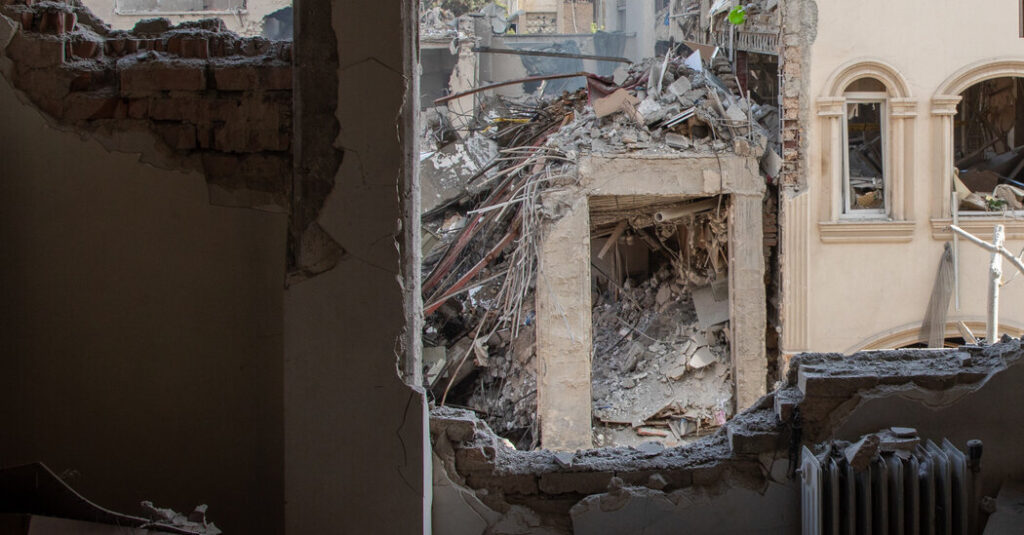
All this means that every American and Israeli bomb that hits its target doesn’t help the regime as it might a guerrilla movement. It merely diminishes the regime’s capacity to govern while highlighting its vulnerability to the people who hate it the most — your own.
Nor does it help that you’ve been losing one boss after another, most recently the I.R.G.C. intelligence chief Majid Khademi on Monday and the intelligence minister, Esmaeil Khatib, last month. Your professional goal is to be promoted. But not unto death.
You’re also unsure of the wisdom of the cornered-rat strategy Iran has deployed in the current war, notably the unprovoked strikes on Arab neighbors. One of the achievements of Iranian diplomacy before the war was that states like Saudi Arabia and the United Arab Emirates were trying to distance themselves from the United States and the Trump administration’s bellicose path. That ended the moment Iran chose to target them alongside Israel.
Worse, the strikes could restart the rapprochement between Jerusalem and Riyadh, a process that was derailed after Oct. 7, 2023, by Israel’s war in Gaza. If the closure of Hormuz persuades Saudi Arabia to pipe even more of its oil to the Red Sea (or, through Israel, the Mediterranean), the “nuclear option” that Iran exercised over the strait may be the last time it ever does so. As it is, the easiest method for the United States to reopen Hormuz is to start seizing tankers carrying Iranian crude once they reach the Arabian Sea, depriving Iran of both the revenue that is its lifeblood as well as the opportunity to easily strike American ships close to the Iranian coastline.
There’s always a chance the Americans and Israelis could blunder militarily in ways that hurt them strategically. It was a shame that the two American Air Force officers shot down over Iran last week were able to evade capture, denying you valuable bargaining chips while again underscoring your military’s relative weakness and incompetence.
More promising is the prospect of American bombs falling on civilian targets, which is why your superiors are now urging young Iranians to form human chains around power plants. You are decent enough to recognize the cruelty of the tactic — and cynical enough to appreciate its potential efficacy. As the war in Gaza made clear, Western public opinion won’t support bombing children, no matter who’s to blame for putting them in harm’s way. And a U.S.-Israeli bombing campaign that kills hundreds of civilians could give the regime the one gift it would not have had otherwise: an Iranian public that’s on its side.
Right now, there’s no telling what will happen. But as you survey where Iran stands now compared with where it stood just three years ago, you are overwhelmed with a sense of loss. Your once-powerful proxies in Gaza, Beirut, Damascus: decimated, deposed or dead. The Arab states: increasingly on side with the Americans and Zionists. Your nuclear program: set back for years or decades, if not forever. Your economy: in even deeper crisis than it was before the war, with no turnaround in sight. Your most capable leaders: dead. Your own people: waiting for the war and the state of emergency to end so they can rise against you again.
It’s a solace of sorts that sophisticated Western commentators think you’re winning this thing. From wherever you are now hiding — since it’s not safe to go to work — it doesn’t feel that way.
The Times is committed to publishing a diversity of letters to the editor. We’d like to hear what you think about this or any of our articles. Here are some tips. And here’s our email: [email protected].
Follow the New York Times Opinion section on Facebook, Instagram, TikTok, Bluesky, WhatsApp and Threads.
The post No, Iran Isn’t Winning the War appeared first on New York Times.