TOKYO — “Wasabeef” potato chips. Instant ramen. Bottled water. K-beauty cosmetics. School uniforms. Rubber gloves. Garbage bags.
Across Asia, far from President Donald Trump’s war in Iran that has driven up fuel prices for Americans and motorists worldwide, companies and consumers are facing or preparing for shortages of everyday goods as the economic consequences ripple across the map. Even snacks aren’t safe from scarcity.
“There is chaos all over the world because of energy issues. Frankly, it’s so serious that I can’t even sleep,” South Korean President Lee Jae Myung said last week.
At the root of the supply chain issues, along with soaring oil prices, is a shortage of key petrochemicals used in nearly every manufactured item. Companies aren’t sure how much longer they can absorb rising production costs. As the war grinds on, supply problems are expected to get worse, analysts say.
Asia is more dependent on the Middle East for crude oil and liquefied natural gas imports than any other region. Countries including Japan, Thailand, South Korea and Sri Lanka have already moved to control oil prices to blunt the blow to consumers, or have asked employees to change work schedules to conserve fuel. So far, three South Korean airlines entered emergency management mode to deal with high jet fuel costs.
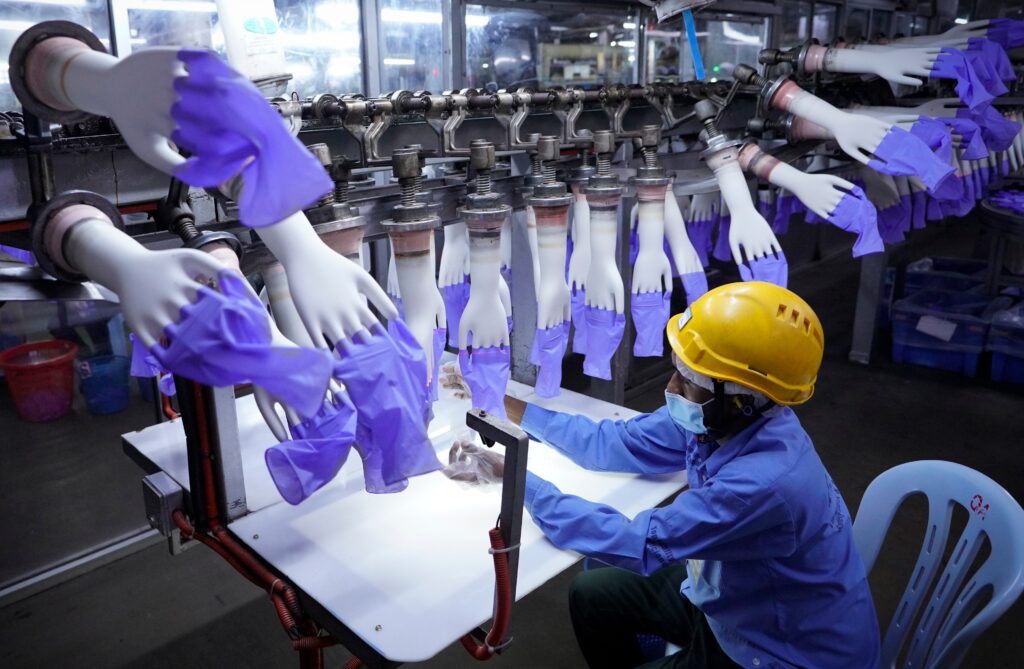
In Malaysia, the rubber glove industry is facing higher costs due to a shortage in a petroleum-based material used to produce the personal protective equipment.
In Japan, snack maker Yamayoshi Seika last month suspended production of six products, including its popular wasabi-and-beef flavored Wasabeef chips, because of difficulties procuring heavy oil for machines. The company has since resumed production, staving off the panic of avid Wasabeef fans, but warned that shipment volumes could be lower than usual for some time.
In Indonesia, bottled water producers are planning to cut spending to deal with the price increase in raw materials.
And in Singapore and Taiwan, it’s becoming more expensive for companies to produce medical devices such as syringes and catheters, largely made of petroleum-related products.
The supply chain disruptions have reached a scale that many manufacturers say is reminiscent of the coronavirus pandemic.
Iran’s effective shutdown of the Strait of Hormuz, a choke point through which a large portion of the world’s oil passes, has rattled many Asian economies and driven up the cost of raw materials — especially naphtha, which is so critical that South Koreans call it the “rice of the petrochemical industry.”
Derived from crude oil, it is vital in the production of chemicals such as ethylene and propylene, which are used to make everyday products including plastic bottles, food packaging, car parts, rubber and more. As much as 70 percent of Asia’s naphtha passed through the Strait of Hormuz last year.
Compared with much of Asia, the United States is less exposed because it relies on ethane, a cheaper alternative to naphtha.
Most industries can lean on stockpiles for now, but those will continue to dwindle as the war goes on. High-tech and critical industries might be spared from the worst shortages, either through government support or simply paying higher prices, but smaller industries could succumb sooner, said Ariane Curtis, senior global economist at Capital Economics, a research firm in London.
“The longer the conflict goes on, the more likely it becomes that some supply chains will actually run into shortages which could ultimately shut down production depending on the extent of the disruption,” Curtis said.
Price increases in March were blunted by some cargo shipments that were able to transit the strait before the U.S.-Israeli attack on Iran started in late February, International Energy Agency chief Fatih Birol said last week. But, Birol warned, “the next month, April, will be much worse than March.”
Some companies, and countries, are bracing for the long-term impact. Japan imports 61 percent of its naphtha from overseas and 73 percent of those imports come from the Middle East, according to the Japan Petrochemical Industry Association.
At a school uniform manufacturing company in Miyazaki prefecture in southern Japan, the cost of cutting fabric is already getting higher. The company uses a polyethylene sheet derived from naphtha to hold fabric in place so it can be cut up for uniforms.
The company, the Kanko Gakuseifuku Minami Kyushu Cutting Center, has received notices from suppliers that there will be a 15 to 20 percent increase starting this month, and possibly as much as 35 percent starting in June, said Yoshitaka Tamari, a manager at the firm. For orders placed after April 1, suppliers might not be able to provide the same quantities as before the war, Tamari said.
“If the situation in Iran continues, we’re concerned about what things will look like six months or a year from now — and especially how it might affect next spring’s school uniforms,” he said.
In South Korea, the government has rolled out 12-point energy austerity plan, which recommends taking shorter showers and charging phones and electric vehicles during the day.
Shoppers are panic-buying government-regulated garbage bags out of fears that a naphtha shortage could make them and other plastic goods scarce. Some stores are limiting the number of bags sold to each customer to deter hoarding.
“There is no need to worry about the supply of standard garbage bags,” South Korean Energy Minister Kim Sung-whan posted on X last week. “You will never be in a situation where you are forced to let garbage pile up at home.”
South Korea imports 45 percent of its naphtha, with 77 percent of that share coming from the Middle East, according to industry figures. It imports about 70 percent of crude oil through the Strait of Hormuz, according to lawmakers.
Supply chain disruptions have hit the country’s plastics makers, including those making packaging materials for instant ramen noodles and plastic containers for “K-beauty” skin care products.
“Due to unstable raw material supply and rising costs, the unit prices of most products will inevitably be increased,” starting this month, reads a statement posted to the website of Luxepack Korea, a cosmetics packaging company.
The cost per barrel of naphtha rose to $1,100 so far this year from about $400 in 2025, said Choi Byung-hyang, head of Korea Prepac, which produces polyethylene packaging film. Choi decreased his operating capacity by about 20 to 30 percent, and is expecting the real crisis to hit starting in the middle of this month.
“Things are getting difficult,” Choi said, adding that his orders are backlogged by about a month because of an increase in speculative buying and decrease in raw materials. He blamed the U.S. for “only looking out for their own national interests.”
One Asian country appears to be less affected by the chaos: China.
Many analysts expect China to emerge relatively unscathed compared to most of its Asian neighbors, in part because Beijing is turning to Russia as an alternative supplier of naphtha. China’s abundant electricity grid relies on coal and renewable energy rather than oil and LNG, like many other Asian nations.
As other Asian petrochemical producers cut their run rates, the “petrochemical sector [could] concentrate in China, giving Beijing yet another leverage point over global supply chains,” according to an analysis published by the Atlantic Council, a Washington think tank.
“China has reserves. China also can diversify. China can buy more gas from Russia,” said Wang Huiyao, founder of the Chinese think tank Center for China and Globalization. “China should be doing fine.”
That’s far from the case in Taiwan. Prices have increased by two to three times in the past two weeks for Ya Ju, a plastics shop based in Taichung, in central Taiwan. The company is absorbing the costs for now but warning customers that supply is tight.
The supply problem has made many plastics companies wary about accepting orders for April, said a manufacturer who spoke on the condition of anonymity to discuss sensitive industry issues. Adding to the uncertainty, suppliers haven’t given price quotations for April, perhaps because they don’t know what they can provide and at what price, this person said.
“If there are no raw materials,” the manufacturer said, “we cannot produce anything.”
Chiew reported from Taipei. Chie Tanaka in Tokyo contributed to this report.
The post Iran war hits supply chains for K-beauty, ramen and clothes appeared first on Washington Post.