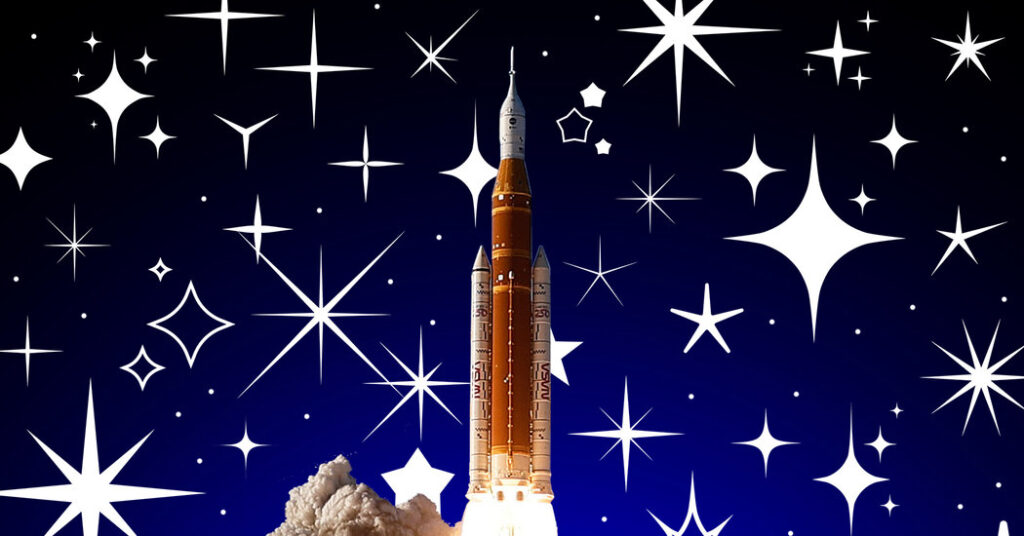
I am a firm nonbeliever when it comes to the cult of John F. Kennedy, but like an atheist admiring the King James Bible, even I can appreciate some of the Kennedy scriptures. So as our latest lunar mission circles back to Earth, I found myself revisiting the speech at Rice University that launched us moonward. In that address, Kennedy declared that America would be ascending to the moon for the same reason that mountain climbers attempt Everest: because “space is there, and we’re going to climb it.”
What’s striking, when you reread the speech more than 60 years later, is how Kennedy tried to have things two ways. The lines that are most remembered portray the Apollo project as self-justifying — a mission undertaken for its own sake, as “one of the great adventures of all time,” valuable precisely because of its difficulty and hardships and uncertain gain.
But Kennedy sold the space program instrumentally as well, in a more familiar politician’s register. Sometimes he used the strategic language of the Cold War, promising to achieve “a position of pre-eminence” relative to the Soviet Union in order to pre-empt scenarios in which space is weaponized against us. And sometimes he defaulted to the language of technocracy and middle-class materialism, promising that the space program would help deliver “new tools and computers for industry, medicine, the home as well as the school.”
There are many reasons the first Space Age faded after the Apollo era, but the failure of the instrumental case for space exploration looms large. Kennedy’s aspirational because-it’s-there argument was vindicated by Neil Armstrong and Buzz Aldrin, but his self-interested arguments ultimately fell flat. Satellites matter to national security but getting to the moon did not win the Cold War and moon bases and colonization plans weren’t crucial to great power competition. Space exploration delivered some technical and scientific knowledge, but not nearly enough to make spacefaring a natural zone of private sector investment, at least until our own era of Ozymandian billionaires came along.
In an ideal world, the aspirational argument alone might be enough to bear us upward. Watching Artemis II, the most ambitious starfaring mission of my lifetime, has been a reminder of the purity of space exploration — the distinctive way it showcases technological mastery, the operatic themes it strikes, the extraordinary aesthetic landscape that’s both discovered and created by sending humans into space.
To read the curriculum vitae of the astronauts, with their Antarctic sojourns and fighter-pilot records, is to encounter a rare kind of human excellence, one that’s been channeled, for this mission, into a purpose that feels free of most political and culture-war entanglements. To take in the imagery of the mission, from the blazing leap of the rockets to the grand shots of celestial bodies to the intimate view of the cocoon that keeps the astronauts alive, is like peering at stained-glass windows dedicated to both the grandeur of God and the triumph of human spirit.
Thus my fundamental reaction to Artemis II: It is good that this mission exists, and it justifies itself.
But we have the record of the last six decades to prove that it can’t justify itself forever. Ambition and idealism are enough to get us into space but not enough to keep us there; at some point, as in every prior period of human exploration, you need self-interest to keep the wheels turning, the rockets going up, the bases and colonies being planted.
That’s why it’s important to pay attention to the economic justifications being bruited for the new space era, the discussion of natural resources that we might find on the moon and elsewhere, the commercial ambitions of SpaceX or Blue Origin, even Elon Musk’s talk of data centers in space.
You can hear some these possibilities discussed in my recent interview with the head of NASA, Jared Isaacman, and find some of them limned by my colleagues in a visual feature on lunar possibilities.
None of them seem, I must say, as if they’re exactly close to generating cash flow. But that’s the quest we’re on: The 21st-century space race is less of a race toward physical destinations and more a quest for commercial discoveries; less of a competition with China than a race against an internal civilizational and cultural clock.
We have a window, as in the 1960s and 1970s, in which the money is present and the technology is ripe to let idealism and courage carry us to the stars. The question is whether this time we can find concrete, material, remunerative reasons to stay up and keep on going, or whether earthbound forces — budgetary constraints, cultural exhaustion or reckless war-making — will once again slam the window closed.
“Ad astra per aspera,” the saying goes — to the stars through hardships. But the hardships will be fully surmounted only by a civilization that also discovers rewards among the stars.
Breviary
Jonathan Swan and Maggie Haberman on a reckless czar and his passive boyars.
Samuel Hammond on think tanks and democracy.
David Bentley Hart on the realm of faerie.
Nate Silver on the social media freak show.
Victoria Moul on poets and religion.
Brendan Hodge on rebounds and revival.
The post Idealism Can Get Us to Space. Only Commerce Can Keep Us There. appeared first on New York Times.