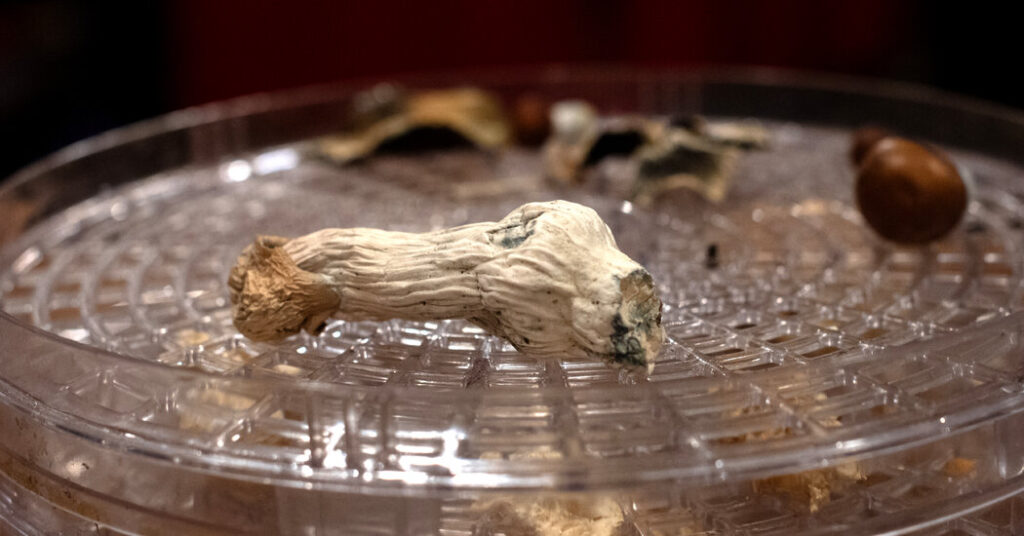
As researchers have sought to demonstrate the therapeutic benefits of mind-altering drugs like LSD and psilocybin “magic mushrooms,” many have struggled to explain exactly how these compounds work on the human brain.
One way scientists have tried to show what these compounds do is by using functional M.R.I. machines to peer into the brains of research participants in the midst of a psychedelic experience. This has produced evocative color images that show a maelstrom of activity as the drugs disrupt patterns of connectivity between brain regions and networks.
But the interpretations of those scans, published in scientific journals, have been inconsistent and even contradictory.
Over the past five years, an international consortium of researchers has tried to make sense of the divergent results by bringing together the data from nearly a dozen brain imaging studies in five countries that have been published since 2012. The studies included more than 500 scans of 267 research participants on five substances: LSD, psilocybin, mescaline, DMT and ayahuasca.
Their findings, published on Monday in the journal Nature Medicine, suggest that psychedelics prompt a welter of activity between regions of the brain that normally operate somewhat independently: the areas that process sensory information like vision, hearing and touch, and those involved with abstract thinking and self-reflection.
The research suggests that psychedelic compounds temporarily reduce the separation between how we think and how we perceive, which could explain the neurological mechanics behind the sensory distortions, mystical experiences and ego dissolution that patients report during sessions.
Understanding these mechanics has become increasingly important as a growing body of research suggests that psychoactive drugs like ayahuasca, ketamine and MDMA can be effective in treating depression, anxiety, post-traumatic stress disorder and other mental health conditions.
Manesh Girn, a neuroscientist at the University of California, San Francisco, and a lead author of the new study, said the results provided a generally accepted reference point for understanding how psychedelics affect the brain and whether these compounds have therapeutic benefits.
“It helps shift the conversation from hype to clarity,” Dr. Girn said. “If psychedelics are going to become part of medicine, we need reliable bench marks for how they actually affect the brain.”
Often described as classic psychedelics because of the way they act on the brain, the drugs have been the focus of hundreds of clinical trials that explored their therapeutic potential.
The researchers found that all five drugs affected regions of the brain involved in coordinating perception and action, suggesting that psychedelics influence not just thought, but the way information flows through core brain circuits.
The findings provide further evidence that psychedelics fundamentally alter how the brain processes information and its relation to the world. The drugs may induce therapeutic change by “breaking people out of ruts and usual ways of perceiving and relating to the world,” Dr. Girn said.
By analyzing existing data under a single framework, the researchers were able to determine which reported brain effects were robust, and which were less certain.
For example, the findings appeared to conflict with previous assertions that psychedelics reliably disintegrated the brain’s networks, including the default mode network, the system of connected brain areas that light up when a person is daydreaming or mulling the future.
Dr. Girn said the study did not find solid evidence to support such claims. The findings, he said, were far more nuanced than previously assumed.
Amy Kuceyeski, a neuroimaging expert at Weill Cornell Medicine who was not involved with the study, called the findings a “tour de force,” but said she would have liked to have seen data on how age and sex might influence the effects of psychedelics on brain connectivity.
“Functional M.R.I. studies offer a powerful window into the working human brain, but the images are often processed and analyzed using different methods, which can lead to seemingly divergent results,” she said.
Joshua Siegel, a researcher at the NYU Langone Center for Psychedelic Medicine and another author of the study, said the findings would be useful for those developing new compounds, including drugs that can deliver therapeutic benefits without the psychedelic experience, the holy grail for some companies.
“For each of these drugs, there are questions like: Is it a psychedelic? What brain networks does it hit? Is it having the same brain effects?” he asked. “Having consensus on the brain biomarkers is going to be useful for the 150 new psychedelic-like drugs that are in development.”
Danilo Bzdok, a neuroscientist at McGill University and lead organizer of the consortium, said one of the biggest challenges was forging cooperation among dozens of researchers on three continents whose positions on methodology and analytics sometimes put them at odds with one another.
Part of that discord, he said, reflects the nascent state of psychedelic research, but also the disparate ways that experts have been using the imaging technology to measure and interpret brain activity.
“It’s a highly fragmented community that doesn’t agree on much so getting everyone to sit at the same table took a lot of work,” Dr. Bzdok said.
Andrew Jacobs is a Times reporter focused on how healthcare policy, politics and corporate interests affect people’s lives.
The post How Psychedelics Affect the Brain appeared first on New York Times.