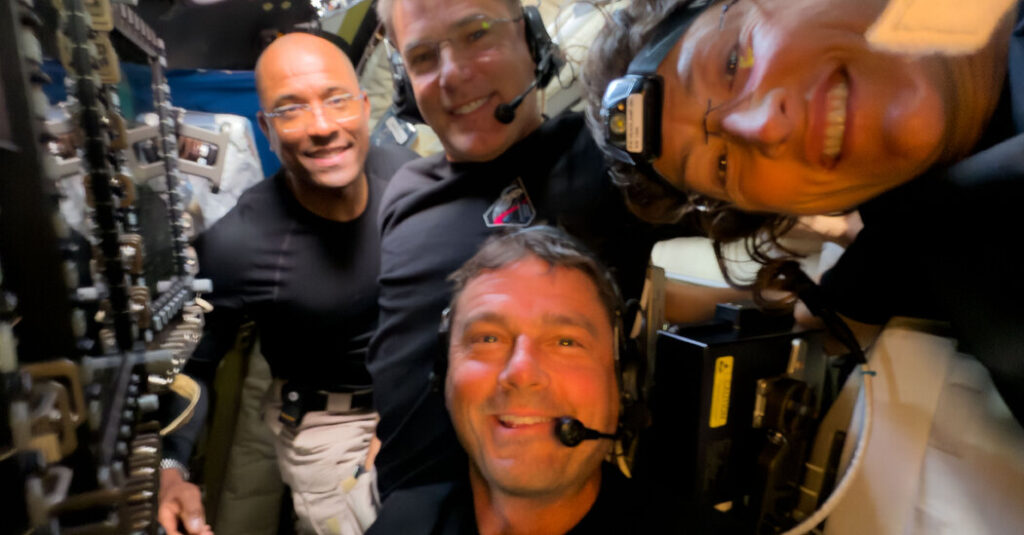
During their historic lunar flyby on Monday, the astronauts of the NASA mission Artemis II were working hard to identify and photograph features on the far side of the moon.
Their accounts went beyond the plain and technical language often associated with science. Instead, they were full of wonder, excitement and reflection.
“I just had an overwhelming sense of being moved by looking at the moon,” Christina Koch, a mission specialist aboard the spacecraft, which the astronauts named Integrity, reported to mission control.
“The moon really is its own unique body in the universe,” Ms. Koch, a NASA astronaut, added. “It’s not just a poster in the sky that goes by — it’s a real place.”
Science is often viewed as colorless and objective, to be conducted with little emotion or expression. But as the Artemis II crew members painted lunar hills, valleys and plains in the minds of listeners back home, they provided a model for a poignant approach to scientific inquiry.
The awe emerged over the weekend as they approached the moon.
Reid Wiseman of NASA, the mission’s commander, eagerly noted impact craters and a swirl on the lunar surface.
“It’s just everything from the training, but in three dimensions and absolutely unbelievable,” he said. “This is incredible.”
Jacki Mahaffey, a NASA officer in mission control, laughed in response. “Copy, moon joy,” she said.
As the lunar surface grew closer, that moon joy intensified.
Jeremy Hansen, a mission specialist from the Canadian Space Agency, described the view from the spacecraft as mind-blowing.
Victor Glover, the pilot, was particularly enthralled by the magic of the moon’s terminator line, which separates its sunlit side from the part shrouded in darkness. He noted islands of light and valleys of black holes along the divider.
“You’d fall straight to the center of the moon if you stepped in some of those,” he said.
Mr. Glover was also struck by how sharp the features of the moon looked through his camera lens.
“It was hard to speak,” he told mission control during the flyby. In between more technical descriptions of the moon, he described where his imagination had gone.
“I was walking around down there on the surface, climbing and off-roading on that amazing terrain,” he said.
Down in Houston, mission control cheered. “We just all went on that moonwalk with you,” said Kelsey Young, a lunar expert who is leading the scientific part of the Artemis II mission.
During a news conference on Saturday, Dr. Young explained that the astronauts underwent extensive training to learn how to give scientific descriptions of the moon, studying everything from flashcards in class to the moonlike terrain of Iceland.
The sentiment in their responses, however, felt unrehearsed. And rather than discourage the emotion, Dr. Young seemed to feel it with them.
That expressiveness came to a height while the crew watched a solar eclipse from space during the final part of their lunar flyby. The sun slipped behind the moon, inducing a halo of light around the lunar rim, while its face shone faintly, lit by the glow from Earth.
“After all of the amazing sights that we saw earlier, we just went sci-fi,” Mr. Glover said. “You can actually see a majority of the moon. It is the strangest-looking thing that you can see so much on the surface.”
The crew described a field of stars surrounding a darkened moon, and identified Mars from its reddish hue as well as an orangy Saturn. Earth also glimmered bright.
Mr. Wiseman and Mr. Hansen reported flashes of light on the lunar surface — meteor strikes in real time — which made Dr. Young rise from her seat.
As the sun emerged on the other side of the moon, the astronauts likened the growing spot of light on the lunar horizon to a flame, and the wispy streams of its outer atmosphere to baby hair.
After a while, words just couldn’t suffice.
“No matter how long we look at this, our brains are not processing,” said Mr. Wiseman said, who jokingly requested that mission control send him a list of new words to expand his vocabulary.
“There’s no adjectives,” he added. “I’m going to need to invent new ones. There’s absolutely no words to describe what we are looking at out this window.”
Katrina Miller is a science reporter for The Times based in Chicago. She earned a Ph.D. in physics from the University of Chicago.
The post Houston, We Have No Problem. But We Do Have a Lot of ‘Moon Joy.’ appeared first on New York Times.