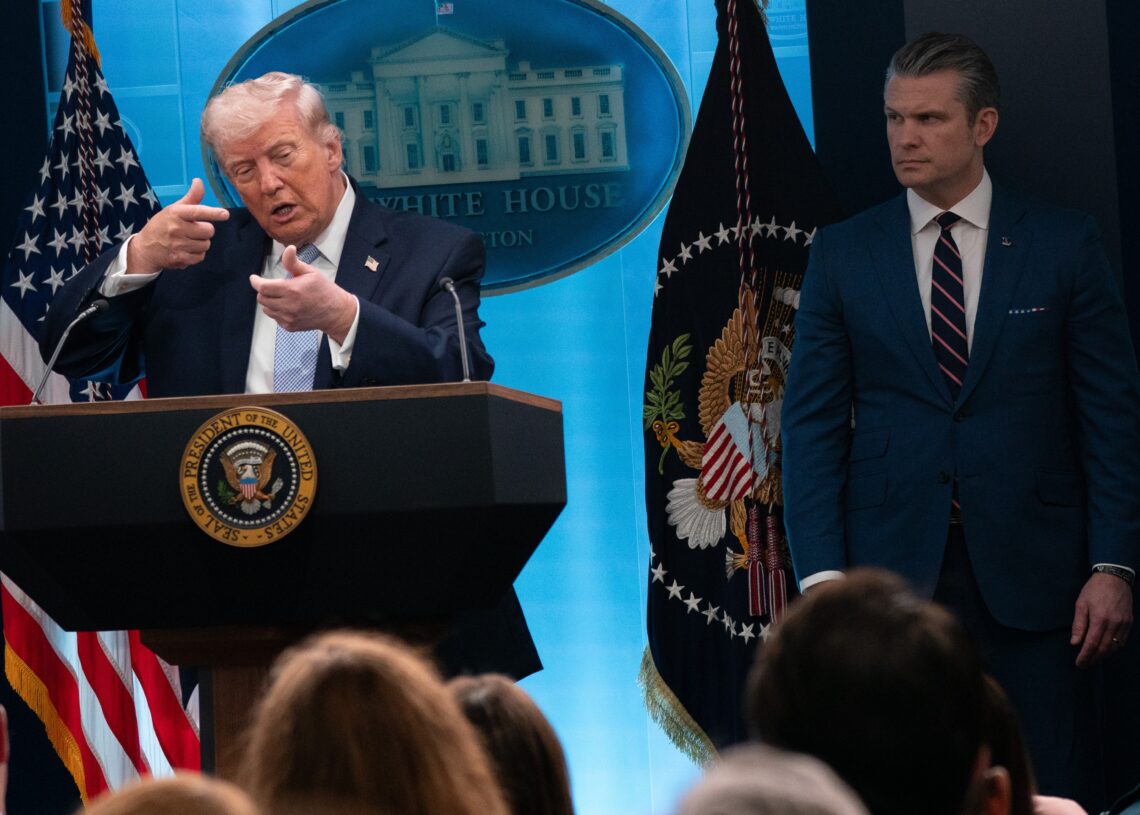
President Donald Trump has continued to describe the war against Iran as an unqualified success, saying as recently as Monday that the United States was doing “unbelievably well,” while Defense Secretary Pete Hegseth said Tehran had been “embarrassed and humiliated” by U.S. forces.
But Iran’s downing ofan F-15E fighter jet and the high-risk rescue operation that ensued showed that Tehran retains the ability to threaten the United States’ military personnel and cast doubt on the statistics Hegseth has promoted in recent weeks, boasting about “complete control of Iranian skies” and “uncontested airspace,” U.S. officials and analysts said.
The chaotic but successful rescue mission has become the clearest indication yet that Hegseth’s repeated claims of air dominance come with serious caveats, and has reinforced concerns inside the Trump administration that his messaging about the war is overly optimistic and risks misinforming both the public and the president.
“Pete is not speaking truth to the president,” one administration official said. “As a result, the president is out there repeating misleading information.”
Though Hegseth has claimed for weeks that Iran has “no air defenses” and could do “nothing” about U.S. air incursions, Trump acknowledged during his White House news conference Monday that a shoulder-fired “heat-seeking missile” downed the F-15 that left two U.S. airmen temporarily stranded deep inside Iranian territory.
“He got lucky. It was a lucky hit,” Trump said.
Iran also shot down an A-10 attack plane Friday, though the pilot of that aircraft managed to fly it back to friendly airspace before ejecting safely, officials said.
Kelly Grieco, a military analyst at the Stimson Center, said that while the Trump administration has significantly degraded Iran’s navy, air force, and fixed missile and radar targets, the F-15’s downing is what happens “when you have air superiority but don’t have air supremacy.”
“Our air superiority is limited geographically to the west and to south but also in terms altitude,” she added, noting that U.S. planes probably have been flying above 15,000 or even 30,000 feet to avoid the type of shoulder-fired rockets that hit the F-15 on Friday.
Hegseth’s triumphant rhetoric has stood in contrast to that of Gen. Dan Caine, chairman of the Joint Chiefs of Staff, who has not suggested U.S. pilots can use Iranian airspace without concern of enemy threats.
Pentagon spokesman Sean Parnell called scrutiny of Hegseth’s public messaging “lies and propaganda.”
“Secretary Hegseth has provided the Commander-in-Chief with decisive military options to achieve our clear, scoped objectives: destroy Iran’s missile arsenal, annihilate their Navy, destroy their terrorist proxies, and ensure Iran can never obtain a nuclear weapon,” he said in a statement. “The Washington Post is pushing a fake story of failure.”
White House spokeswoman Anna Kelly rejected any assertion that Hegseth has misinformed the president and said Trump always knew the Iranians would shoot back. “He has always had the full picture of the conflict. Nothing has surprised him or our military planners, who were prepared for any possible contingency,” she said.
Kelly reiterated that the United States and Israel, its partner in the conflict, have flown more than 13,000 combat flights over Iran, destroyed or damaged two-thirds of Tehran’s production facilities and “wiped out” Iran’s navy.
Concerns about Hegseth’s war messaging, which comes in the form of televised news conferences and grainy videos of airstrikes posted on his X account, go beyond his claims about U.S. air dominance, said American officials, speaking like some others on the condition of anonymity to discuss sensitive national security matters.
A major source of contention, they say, is Hegseth’s characterization of the U.S. effort to destroy Iran’s vaunted missile and drone programs, the regime’s most formidable threat to American, Israeli and Arab assets and personnel in the region.
Last month, Hegseth said during a Pentagon news conference that Iran’s missile and drone programs are being “overwhelmingly destroyed.”
But more than half of the country’s missile launchers are still intact, and thousands of one-way attack drones remain in Iran’s quiver, according to a recent U.S. intelligence assessment, the contents of which were relayed by three people familiar with the product. The assessment was first reported by CNN.
Another source of scrutiny emerged March 31, when Hegseth told reporters the number of Iranian missile and drone launches had fallen to a lower level than any other 24-hour period since the war began. The figure was presented as evidence that “relentless” U.S. and Israeli strikes were degrading Iran’s ability to sustain attacks.
But administration officials said Hegseth’s claim was incorrect and that lower 24-hour periods occurred March 14, 15 and 22. “Documents sent around internally contradict Hegseth’s claims,” one official said.
Parnell did not address questions about the discrepancy.
Open-source data published by Dmitri Alperovitch, co-founder of the Silverado Policy Accelerator think tank, also indicated that lower volumes of drone and missile launches occurred in mid-March as opposed to the end of the month. Alperovitch aggregates reports of launches by governments in the region.
Other U.S. officials said Hegseth’s focus on launch volume is dubious even if his numbers were close to accurate.
“If you judge Iran’s strength or weakness based on their launch numbers, that is a dumb metric. What is their objective? Are they achieving that? That’s what matters,” another U.S. official said.
That view is echoed by analysts who say Iran’s strategy appears to be evolving away from sheer volume of drone and missile strikes toward efficiency and precision.
Seven U.S. troops have been killed in Iranian counterattacks, and six others died in an apparent midair refueling accident that caused their plane to crash. Nearly 375 other service members have suffered varying degrees of wounds, according to U.S. tallies.
Iran’s tactics have changed, said one person familiar with U.S. assessments. “You saw a bunch of missile and drone attacks at the start — and then it dropped off precipitously,” the person said. “That was Iran preserving their magazine.”
“After earlier rounds of attacks by the U.S. and Israel, Iran took actions to protect its missile and drone arsenal to wait out U.S. munition use,” this person said. “Now our magazine is low on our side, and the Israelis are in the same position.”
Grieco, of the Stimson Center, said the focus on Iran’s daily launch counts “makes a good sound bite” but obscures more meaningful indicators.
She said Iran’s “hit rates,” the percentage of projectiles that evade defenses and strike targets, have increased over time, according to her analysis of open-source reporting.
A high-profile example was the recent destruction of a U.S. E-3 surveillance aircraft in an Iranian strike that hit a U.S. military facility in Saudi Arabia.
However, the fact that U.S. forces were able to penetrate deep into Iran for the rescue mission and have everyone come out safe also shows just how much of Iran’s capability has been degraded, another U.S. official said.
“Iran continues to launch ballistic missiles at our partners and allies in the region,” said Sen. Chris Coons (D-Delaware), a member of the Senate Foreign Relations Committee. “It continues to lob hundreds of cheap and lethal drones at civilian targets like oil tankers, airports and hotels, at oil and gas infrastructure, and at our bases and embassies.”
The United States has taken out Iran’s ability to manufacture new ballistic missiles, but it’s not possible to wipe out its drone-making capacity, Coons said. “You can make a lot of capable and lethal drones in garages and basements, and keep firing,” Coons said. “Iran had thousands of drones before the war, and I’ve seen nothing to suggest that that stockpile is going away anytime soon.”
Grieco said Iran appears to be shifting toward a more efficient strategy.
“They’re focusing on smaller, more targeted salvos,” she said. “They’re picking targets and looking for gaps in defenses.”
Last week, Hegseth went back to the statistic, saying in a news briefing that ballistic missile attacks on U.S. forces are “down 90 percent since the start of the conflict,” a metric Trump repeated Monday.
While some officials said the president’s repetition of Hegseth’s rhetoric is concerning, another worry is whether the defense secretary is explaining the evolving complexity of the conflict to Trump.
In particular, the stepped-up activities of Iranian-backed groups in the conflict, including Hezbollah in Lebanon and Shiite militias in Iraq, have increased the burden on missile defense systems in the region scrambling to fend off attack from multiple countries.
“You’re not just fighting the Iranians,” an administration official said. “That hasn’t been hammered home.”
The post Hegseth’s rosy claims about Iran war contradict reality, officials say appeared first on Washington Post.