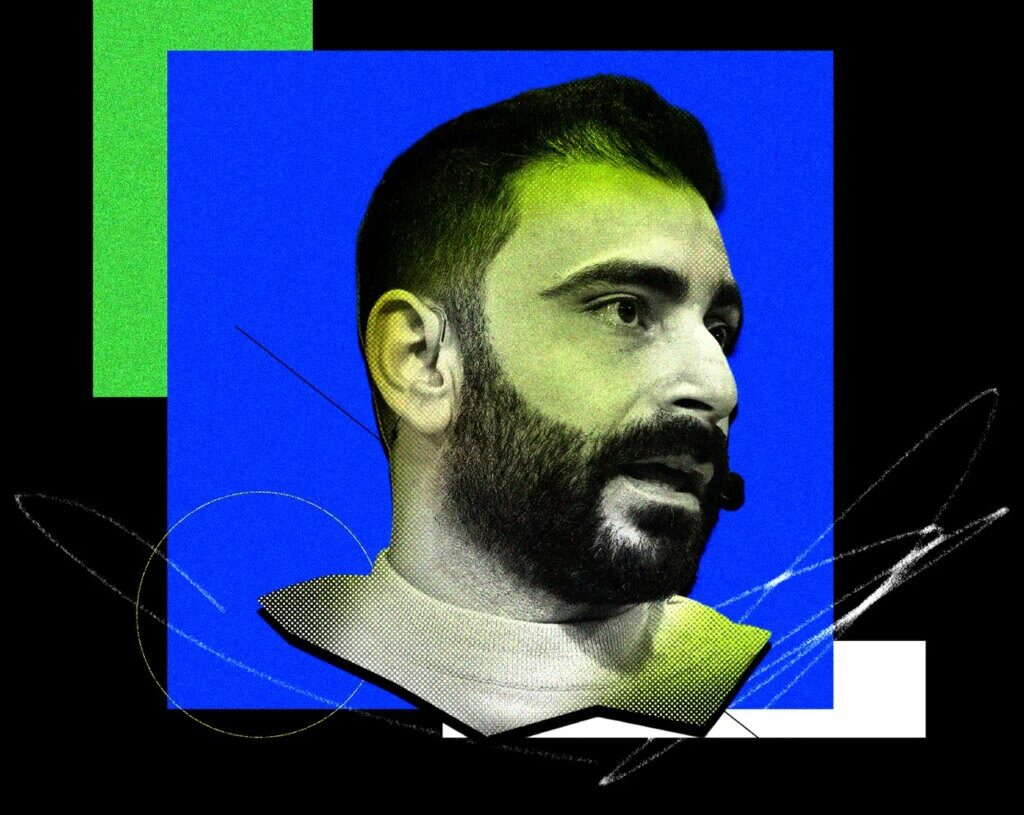
If you haven’t heard of UpScrolled before, a brief primer: It’s a social media platform not too different from, say, Instagram or TikTok. You can share photos or short videos, follow accounts, comment on posts, and amass a following of your own. Nothing too earth-shattering, right?
UpScrolled founder Issam Hijazi would beg to differ. Indeed, his nascent company diverges from most Big Tech platforms in a few notable ways: UpScrolled offers an old-fashioned chronological feed, rather than one dictated by an algorithm ostensibly serving up content you’ll latch onto; the platform also promises not to share user data with marketing firms or other commercial enterprises. And Hijazi, who is of Palestinian descent, founded UpScrolled in response to widespread user allegations that some social media companies were censoring or shadow-banning their posts—particularly pro-Palestinian content. The platform explicitly vows “never” to covertly suppress content, provided it doesn’t violate UpScrolled’s community guidelines.
Aside from breaking with plenty of Big Tech norms, Hijazi’s stance is rare among Silicon Valley types for being uniquely, overtly ideological. (In our conversation, Hijazi told me that he “personally” ensured UpScrolled users couldn’t select Israel as a location when using the platform.) But the approach has resonated: When we first met in February, a mere eight months after Hijazi launched UpScrolled, the platform had rapidly amassed 2.5 million users following freakouts over TikTok’s deal with President Trump to form a US-based version of the company controlled by American investors. Hijazi was, at that time, UpScrolled’s only employee.
Today, as UpScrolled counts more than 5 million users, Hijazi has rushed to scale his team to meet the platform’s growing needs—particularly around content moderation. Recently, his company has found itself in the crosshairs of organizations like the Anti-Defamation League, which alleges it doesn’t do nearly enough to stomp out antisemitic and extremist content. During a wide-ranging conversation last week I asked Hijazi about those claims, and how UpScrolled is catching up with its own rapid growth.
This interview has been edited for length and clarity.
KATIE DRUMMOND: Hi, Issam, welcome to The Big Interview.
ISSAM HIJAZI: Hi, Katie. Thank you for having me.
I’m very happy you’re here. I want to start with your background. It’s a fascinating one. Previously, you’ve worked for big tech companies. You worked at IBM; you worked at Oracle. Tell us about your history with tech and how it shaped your views on the tech industry and on social media more specifically.
I’ve been working in the tech industry for the past 17 and a half years. Prior to that, I started coding when I was 12 years old. So I was pretty involved in IT and technology from a very early stage. Now, within my career, as you mentioned, I did work with the likes of Oracle, IBM, Hitachi, and then small startups.
As a young professional, that is a dream job. That is something that every kid wants to be in. Great companies that have great technologies and there’s a lot of opportunity to learn, but as you get to understand and learn about the mechanics of these companies, you start to wonder: Is this the right place to be at? This is a feeling I started to have in the past three years, and that made me shift my focus on wanting to start something new.
These companies have been complicit in bad things that are happening around the world. Things like genocide in Gaza, for instance, by supplying technology, infrastructure, knowledge, et cetera, to countries like Israel. And allowing them to do surveillance. Personally, I felt complicit just working for them, and I wanted out.
Talk to me then about that moment you threw up your hands and said, “That’s it. I’m starting something new. I’m starting UpScrolled.”
This happened when I started to see this genocide unfolding on our screens in real time. I started to see things differently.
I was affected deeply, not only because I’m a Palestinian, Katie, because I’m a human being. In addition to that, I’ve got family members in Gaza, from cousins to extended family members, who got killed. So it affected me deeply. It changed my perspective on how I see life, how I see career, how I see people, and it dropped a lot of the masks around me.
At that moment I felt I needed to do something, because I was fortunate enough not to be in Gaza, not to be in Palestine, and just to give something back to those people in general. I looked around and noticed a lot of people trying to post and talk about what’s happening on social media platforms, but they were shadow-banned. They were selectively censored. That was happening across multiple social media platforms.
At that moment, I felt it was time to give people back control into how they want to express themselves. I did research and I noticed people were looking for alternatives, but there was a lack of ethical or reliable alternatives. So at that point, I decided to put in every waking hour of my days, all my resources, including financially, to build that platform.
That sounded crazy back then. It still sounds crazy today if you ask me. But I was still determined to try this out and give it a shot. Back in 2025 in July, we launched UpScrolled and we started to see people coming onto the platform and willingness from users to switch or completely stop using other platforms such as Instagram or X or TikTok.
Talk to me about designing UpScrolled and how you thought about the user experience. People can post text, they can post photos, they can post videos, they can comment and repost content. When you were designing it, what were you most focused on?
I wanted to create an experience that feels familiar. I didn’t want to create something unique or have an interface that’s different. So when they switch from Instagram or they switch from X, for example, they will feel that the app is pretty much the same in terms of functionality or the things that they do. That’s intentional.
It’s crazy to think of trying to create a new social media just for the sake of it. I knew the users that would join UpScrolled would want to join it for a reason. That reason is that they have been suppressed, they have been oppressed, or they want out from the existing tech that they’ve been using for the past two decades, really.
We do have all kinds of functionalities that allow them to engage with one another. Nothing really new from a functionality perspective, but behind the scenes there are a lot of differences.
I’m curious about that, because I think you’ve said that UpScrolled doesn’t use AI or algorithms to determine what content people see. What informs the content that I would see when I open UpScrolled and start looking through my feed? What’s behind that?
What’s happening behind the scenes is a very chronological feed.
I love chronology. I think too many social media apps have lost the plot when it comes to the chronological feed.
The fact is, 20 years ago these things existed and we loved them. But then they started to introduce algorithmic feeds, thinking that would give us a better experience, but in reality it just made us addicted to something that has no value.
All you need is to follow the people that you like, people that you’re interested in, news agencies, organizations, and stay up-to-date with them. You don’t want an algorithm to decide what you want or what you like, or influence you or change the way you think.
How have you handled the kind of exponential growth you’ve experienced? What’s the good, what’s the bad? What’s been the hardest thing you’ve had to deal with?
Let’s go back to about nine months ago, when we launched in July. I haven’t slept properly since then.
Oh no.
It was a one-man show, and that’s me. And Katie, when you run a social media platform, there’s a lot of things that you need to manage: infrastructure; you need to manage users’ expectations; you need to manage support; you need to manage content moderation; you need to make sure the app actually works on Chinese devices, Japanese devices, American devices.
You need to do some sort of marketing. And you need to do fundraising, you know, put money into your company so you can raise capital and hire people.
My wife and my new baby girl—she’s now 21 months old—we were in Sydney, and I told them, “I’m going to be very busy for the next few months. How about you go and spend the summer vacation in Jordan with the family? Come back in September and hopefully things will be better by then.”
That never happened. I needed to travel to the US and other countries to present UpScrolled to different people and conferences and things like that. Up until the point I told her, “Hey, how about you stay in Jordan and I’ll come to Jordan and see you both?”
That was a period of about six months. So there was a personal sacrifice of me not being with my family, especially with my daughter, for the best six months of her life, let’s put it that way.
Aw. Yeah.
Now, moving into January, things did not really get any easier. I knew about the TikTok deal, but did not really anticipate what was about to happen. I thought that we’d get some additional thousands of users. Until the 20th of January, we had approximately 150,000 users, and up until then it was still me running everything, and it felt like a small community. I knew almost everyone on the platform.
At the time of the official signing of the TikTok deal, I was in the US and I was at some event in the Bay Area. Before going onstage I was looking at the dashboards for the platform, and I started to see something strange happening. Then I started to check other resources, like the stats on the app stores. I started to see UpScrolled jumping from, I dunno, 150 to 80 to 60 and crawling its way to the top.
I was like, “OK, something is happening.” It wasn’t too scary. We had tens of thousands of new users. I was excited. I was gonna announce it on the stage. But then after that specific event, things got more crazy. I started to see hundreds of thousands of people signing up to the platform.
I started to get phone calls, emails from people telling me, “Hey, your app is number 10 in Australia, your app is number 10 in the UK.” I was checking like, this is unbelievable. This is surreal. I did not really anticipate any of that. I think by the end of January we had about 2.5 million users, and it was still me running the show.
Oh gosh.
I was getting invited by different news outlets to talk about what was happening. People I’ve never met in my life talking to me, sending me messages. Web Summit people invited me to Qatar to have one of the keynotes on the first day.
Then we had the announcement of the 2.5 million users, and it’s been growing since then. But as you can imagine, with that kind of growth comes a lot of challenges, and I needed to do a lot of firefighting during that period. So yeah, I haven’t slept a lot.
The fact that you have slept at all sounds like a miracle. I mean, how many people have you hired?
We have about 25 people working at UpScrolled, and that’s between engineering, brand comms, and strategy, as well as content moderators, obviously HR, and people helping with the management of the projects that we have internally.
I had to spin up that team really quickly, so I relied on my connections, referrals. I was extremely lucky in finding many people who love the mission of UpScrolled.
What’s been the most brutal learning experience from all of this? What’s been the hardest thing, the moment of failure? Has there been something that stands out as a nightmare day or a nightmare hour?
What we’ve had is one of those good problems to have. It’s one of those problems that you wouldn’t anticipate: the growth itself. It’s great because it’s growth, but with growth of course comes a new set of challenges. You need to suddenly manage millions and millions of users.
You need to suddenly manage bad actors, who want to intentionally bring the system down by attacking it from a technical perspective, but also posting all kinds of nasty content intentionally, and then taking screenshots and then sending that to reporters and saying this and that about the platform mission and what we’re trying to build here.
So I guess that was the biggest problem or challenge that we had within UpScrolled when it comes to managing all these users as well as the content. Now you wouldn’t face these kinds of issues with different businesses, but when you’re dealing with user-generated content, that is going to be something to expect.
How do you imagine UpScrolled making money? How do you eventually plan to monetize what you’re doing?
Currently we’re not making any money. We’re backed by certain angel investors who are aligned with our values as well as VCs who are aligned with our values. I’m personally extremely picky when it comes to who wants to put money into UpScrolled, for obvious reasons. I want to continue to have this platform be an ethical platform, always standing on our values moving forward.
When it comes to monetization, there are a lot of ways to monetize existing social media platforms. They have done many of those things, and we will maybe do some of them. For example, verified users and verified organizations. You get the blue check mark after you verify your identity, you pay a subscription fee, for example, and that’s one way to generate money.
We can open up a marketplace kind of feature. So if you’re a small business and you want to sell items, you can do that. We’ll take a commission. If you’re a producer, content creator, and the people are interested in your content, they can subscribe to your content. They pay you, you set the price, and we take a small commission out of that.
The last thing will be something related to ads that we can run on the platform. But even with ads, we are going to be selective in who would be able to advertise on the platform itself. We will ensure that ethical businesses will be given that opportunity, but businesses that we believe have been complicit in bad things around the world don’t get that opportunity. I think that’s a great place for small, medium-sized businesses to find the right audience. We already have them.
You mentioned a bit earlier the issue of content moderation. Critics earlier this year flagged extremist and antisemitic content on the platform. The Anti-Defamation League put out a very heated statement alleging that UpScrolled lacks enforcement protections. Can you respond to that?
We’re a new social media platform, and if you look at the existing landscape, you’ll notice existing social media platforms that have been there for the past 20 years or so still have problems when it comes to content moderation. You’ll find a lot of hate speech, which I would love to believe that these platforms don’t allow, but you still find it if you open these apps today.
So it’s a problem that all social media platforms have, and we are no different. User-generated content can have that risk, and it needs to be addressed. Now, regarding the organization that you’ve mentioned, and the content that has been reported in articles about UpScrolled, it has been removed from the platform.
We do not allow hate speech. We do not allow Islamophobia, antisemitism, or any kind of hate on the platform. We want to build a platform that is safe for everyone to exist and to speak freely. But within legal boundaries, with respect for one another, and where people don’t have fear speaking about what matters to them.
We are continuing to strengthen the mechanisms on how we detect certain bad content internally. We have definitely had a bigger moderation team over the past couple of months. Currently we’re sitting at zero backlog in terms of bad content or nasty content on the platform. They’ll still continue to try to post this kind of nasty content on the platform, and we will continue to fight it and remove it.
Are you mostly pursuing a human-led approach to moderation, as opposed to AI, for example, that would potentially be able to automate some of that function? How are you thinking about content moderation in comparison to some of the other social media companies that have automated a lot of that?
Currently it’s a manual process. We have content moderators. They receive reports, they look into them, and according to the policies they take action. Users are able to report any content that they see, and they tend to do that quite fast. So we’re able to catch any bad content on the platform quite quickly.
Now, to scale we are doing some internal R&D and integration with AI models that are able to detect but not make decisions. We want to be able to detect anything before it is widespread and on the platform itself, and then allow a human in the loop to make a decision.
There’s a lot of content that can be identified easily—pornography, et cetera—and that can be with high confidence, and the algorithm can give you that confidence. Probably for this specific kind of content, we can have a quarantine queue where this content has first to be reviewed by a human. And if it’s not really against the policy, then it can go.
This is for sensitive material. We’re talking things related to CSAM, pornography, explicit hate speech, and similar content. But we will always ensure that a human will make the final decision, not an algorithm, and allow our users to appeal for any decision that is made and explain to them why certain things happen.
Users have noticed on UpScrolled that they cannot actually select Israel as a location for their posts. I’m curious about how you are thinking about Israel and Palestine given how the company was founded and formed, and whether it was a deliberate decision not to recognize Israel from a company point of view.
I personally coded that function for you as a user not to see Israel on the dropdown. Katie, I’m a Palestinian, and I know a lot about what happened. My ancestors, my grandparents, were living in Palestine. They were living in Ṣafad before 1948, and they were forced to move out and become homeless and roam from one country to another in order to find a new place.
They went to Lebanon, they went to Syria, they went eventually to Jordan. They tried to return to Palestine to other cities. That didn’t work out. They returned to Jordan eventually, and now we do not have the right of return. I’m not able to go to Palestine. I’m not able to go back to my hometown ever and see it and visit it.
Israel continues to kill people on the ground. They continue to do bad things in the West Bank, outside of Gaza where there’s no Hamas.
You know, I want to ask you this question, and it’s a hypothetical question.
Sure.
Would you hang a picture of your perpetrator in the living room knowing all the things that they have done?
Would I hang a photo of someone who had done terrible things to my family in the living room of my home? No, I would not.
That’s a very personal thing to me. Israel is exactly that, and this is an app that I’ve built. We are building now in response to a lot of things, including the bad things that Israel has done and continues to do, and having them be on the app on that dropdown is not gonna happen.
The more important question is: Is Israel responsible, or should it be held responsible, for all the bad things that they’ve been doing for the past 70 years, and especially in the past two and a half years? And not really fixate on a silly dropdown where the word Israel is not there.
What kind of feedback do you get? What kinds of emails do you get? I think to take that kind of stance overtly, publicly, loudly, unapologetically, is a very unusual thing. Especially for the CEO of a for-profit company.
I do receive nasty comments, nasty messages from people, and as a company we receive similar communications. That’s expected. But we also receive a lot of communication from users who are extremely excited, extremely proud, and want to be part of the vision and the work that we do. That’s what matters.
I know for a fact that people around the world have changed in the past two years for a lot of reasons. They started to see things differently, and they started to choose things differently. They see us as a way out from all the big tech that is happening, and they want us to become bigger. That’s exactly what we’re focusing on, and we’re relying on their trust.
They are like every other user. They still tell us, “Hey, how about you introduce this new feature? We like this. We don’t like that.” That’s exactly what we want to hear from them. So it’s healthy, I would say, in a much bigger way than it’s unhealthy or negative.
What do you want for UpScrolled over the next few years? If I talk to you again in two years, what do you want to be able to say you’ve accomplished?
That we are the mainstream social media platform. Everyone uses UpScrolled and everyone is welcome on UpScrolled and we are not creating this platform for specific groups or anything.
We’re pro-humanity, so everyone is welcomed with their views. The only difference that we have is we’re not gonna shadow-ban or censor anyone for their thoughts or their views.
This is the first step in my personal vision. I want UpScrolled to become big enough, and start to build independent digital infrastructure at the same time. And start offering that infrastructure for other communities and other people who are seeking ethical alternatives.
So hopefully we’ll get there.
One thing I wanted to make sure to cover with you was this idea of social media that is scaled. One that is used by millions and millions and millions of people as opposed to social media platforms that are much more community-oriented and that attract a certain subset of like-minded people, right?
Bluesky comes to mind for me as one example, where I think you have a certain cohort using Bluesky. Then you have certain people on X, you have some people still using Facebook. But what I see is social media continuing to fragment and for these bubbles to exist as opposed to a free exchange of ideas, which I think was one of the great promises of social media overall.
How do you see that? Are you optimistic about the possibility for there to be a broad, free exchange of ideas?
I believe people want a place where they are able to express themselves without the fear of being censored or having their content removed without justification, and as other social media platforms continue to impose these actions, I believe people will start looking for alternatives organically.
The other thing that is important to highlight here is the network effect. When certain people start to populate a social media platform or social network, that will attract the other people. So that’s the thing that will happen organically, even if they don’t agree with the principles or the vision, or even the founder of the company, they’re there because they want to hear what the other people are saying.
An example of that is X. I don’t think a lot of people are big fans of the CEO of X, but they’re still there.
I think that’s probably true.
Yeah, but they still want to be there to hear what everyone else is talking about.
It can be hard for me to wrap my head around it, but you’re right, they do still participate on X.
We’re trying to create something ethical. So we’ll probably attract the ethical mindset first and that’s OK. But then the other side wants to see what we’re talking about and they will start coming and joining the platform, and that’s OK. They’ll continue to use multiple platforms for different purposes because each of them will allow them to express things differently, according to their policies. But it’s OK to have multiple platforms.
We don’t want to limit people to one platform or space. They should be able to move between them. There should be no monopoly. But I believe also, from a technology perspective, at some point there will be some sort of openness between all these platforms where our users are able to interact from one platform to the other.
Your Elon Musk comparison is apt. People don’t have to like you, they don’t necessarily even have to like why you founded the company to use the app, which I think is certainly true in the context of him. So you would essentially say UpScrolled is for anyone.
Absolutely.
We like to close each show with a little game that we think is very clever. It’s up to you whether you agree, but it’s called Control, Alt, Delete. So I want to know what piece of tech you would love to control; what piece would you love to alt, so alter or change; and what you would delete, what would you vanquish from the Earth if given the opportunity.
You can be very broad in your definition of tech. I’ve had some truly irrational answers to this question, so go for it.
When you say control technology, I think that’s a big thing. I’m not a person who wants to control anything in the world. I think it’s wrong for anyone to control anything really. Because once a person controls something, then that creates a risk.
So I wouldn’t personally be interested in controlling anything and be responsible for not doing it right. I’d like people to participate in the process.
That is as good an answer as any. Completely fair. If you could change something about technology, what would it be?
I would change how AI is being used nowadays and try to put some guardrails around using it. I think it’s an extremely dangerous technology. It’s a great technology, don’t get me wrong, but I think it’s extremely dangerous. I think it makes people less smart.
You know, kids use those technologies nowadays to do things. They don’t research. They don’t have an opinion. I mean, our generation, my generation, we used to go to Google and that was like an upgrade from going to the library.
Now kids don’t go to Google in the first place. They go to ChatGPT or Claude or something and they ask that question and they take for granted that it’s a hundred percent correct answer. They’ll tell you, “Hey ChatGPT said that.” It’s scary and dangerous.
Would you put an age limit on AI, or would you go even further than that?
I would change the way AI is designed, and have guardrails, and have people audit the way it’s built. Currently people, everyday users, don’t understand how OpenAI, how Anthropic are building their models. They’re just taking it for granted.
I think we should hold them accountable and tell them to show us exactly how they build these models. And how or why they answer the way they answer, which is a very black box at the moment.
What would you delete? Would you get rid of anything?
It’s an interesting question. I don’t want to sound controversial here.
I like that this is where you draw the line.
Yeah. What would you delete?
What would I delete?
Yeah.
Wow, the interviewer becomes the interviewee. Oh, there’s so many things I would delete. I mean, just as one example, I have a daughter and I would probably delete YouTube Kids. We made such a mistake when we started letting her watch YouTube Kids, and then we had to pry that iPad out of her clammy little hands, and it was a nightmare. I might get rid of that. There are lots of things I think I would probably delete. I might delete X. I understand why you can’t say that. I might delete Facebook.
So it could be an app?
It could be an app. You could also delete, say, a function on your phone.
I will delete autocorrect.
Oh, that’s a good one.
I hate autocorrect. It doesn’t correct me. It makes me sound wrong all the time. And sometimes they’re extremely bad words. I’m like, “Mom, sorry, I did not mean that, I meant something else.”
Oh, that’s funny. Whenever I try to write, “fuck” it always autocorrects to “duck.” That’s very specifically not what I meant.
How to Listen
You can always listen to this week’s podcast through the audio player on this page, but if you want to subscribe for free to get every episode, here’s how:
If you’re on an iPhone or iPad, open the app called Podcasts, or just tap this link. You can also download an app like Overcast or Pocket Casts and search for “Uncanny Valley.” We’re on Spotify too.
The post He Started a Social Network Alone. Then 5 Million People Signed Up appeared first on Wired.