For over a month, Democrats insisted they would not reopen the Department of Homeland Security unless Republicans agreed to new limits on immigration enforcement. When a deal finally emerged to end the longest partial government shutdown in American history, party leaders moved quickly to frame the outcome as proof that Democrats can force concessions simply by holding the line.
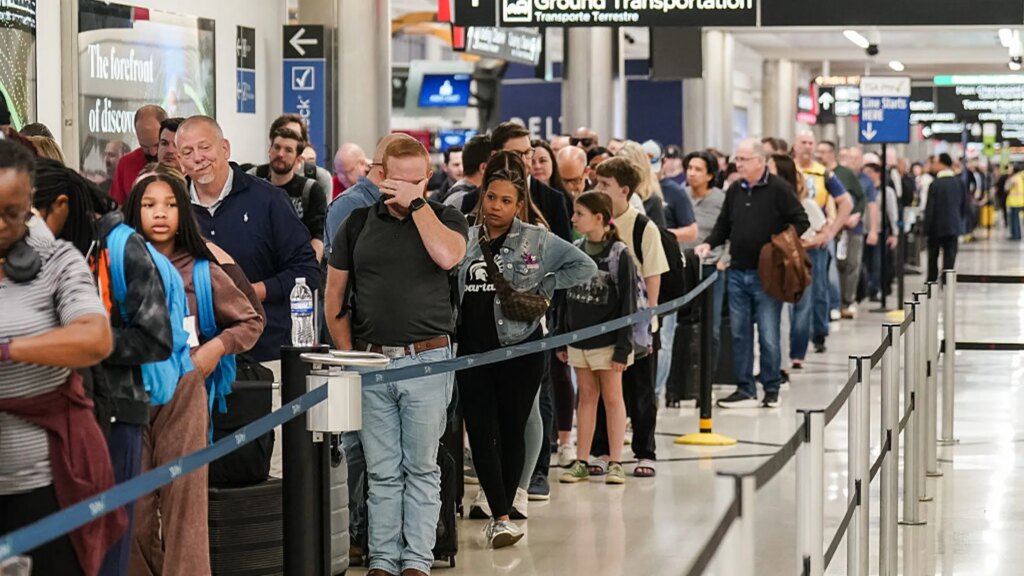
Yet as part of the deal to restore funding for most of DHS, Democrats agreed to forgo the reforms they had been demanding for nearly two months, winding down a shutdown that has inconvenienced thousands of travellers and prompted resignations by hundreds of TSA workers. There is still no ban on masked agents, no requirement that immigration officers obtain judicial warrants to enter homes, and no new use-of-force standards.
The episode has raised a central question that cuts through the party’s claim of success: What, exactly, did Democrats win?
Party leaders and allies argue that, even without tangible legislative gains, the shutdown effort was successful because it pressured the Trump Administration to soften its immigration enforcement tactics and showed voters that Democrats know how to put up a fight.
“We held the line on not giving additional money to ICE until we win those reforms,” Rep. Greg Casar, the Texas Democrat who chairs the Congressional Progressive Caucus, tells TIME. “To me, this is a vindication of the stand-and-fight wing of the Democratic Party.”
To be clear, the shutdown isn’t over as the Republican-led House has yet to approve the deal. But President Donald Trump has signed orders to pay much of the Department of Homeland Security out of other funds, and Republicans are largely coalescing around the bipartisan plan to fund the department except for Immigration and Customs Enforcement and Border Patrol, both of which can operate off funding Republicans secured separately last year.
Read more: Are the Long Airport Waits Over?
The murky resolution has prompted both Democratic and Republican leaders to accuse the other side of having “caved” in the standoff. “They got zero of the reforms that they were advocating for,” Senate Majority Leader John Thune told Fox News last week, adding that ICE and Border Patrol are likely to receive more money through the budget reconciliation process that Republicans are now pursuing to fund them. “We didn’t cave.”
Outside of Congress, public perception may be more aligned with Democrats’ framing. Multiple polls throughout the shutdown suggested that most voters blamed Republicans for the impasse, and that ICE enforcement was largely unpopular, dynamics that Democrats have seized on as evidence that the political risks of confrontation may be shifting in their favor.
As the Iran War has dominated the country’s attention in recent weeks, the Trump Administration began to soften its immigration enforcement tactics. Trump replaced the two most visible faces of the immigration crackdowns—Kristi Noem and Greg Bovino—and withdrew hundreds of federal agents from Minneapolis. To some, it was a sign that Democrats’ tactics were working.
Whereas progressives have long been the strongest critics of how Democrats have handled Trump’s second term, their view of how party leaders Chuck Schumer and Hakeem Jeffries oversaw the shutdown has been far more measured.
Joseph Geevarghese, the executive director of Our Revolution, the political group launched by progressive Senator Bernie Sanders in 2016, described the outcome as “a mixed bag,” noting that Democrats “didn’t get the fundamental ICE reforms” they sought. But he argued that the confrontation produced subtler shifts, including “a change overall in the leadership of DHS and how ICE conducts operations, at least optically,” as well as a more aggressive negotiating posture from Democratic leaders who had previously been criticized for capitulating too quickly.
“I think maybe, in this particular instance, Democrats played their cards as well as they could,” he says. “We saw Democrats dig in and draw lines, and I think we won the narrative battle. And I say, despite the final result, what they saw was Democrats fighting.”
Joel Payne, the chief communications officer of MoveOn, one of the groups behind the ‘No Kings’ rallies, says the episode had reassured a skeptical base that Democrats were beginning to function as “a real opposition party.”
“Nobody’s satisfied with anything,” he says, but voters were “encouraged and buoyed by the fact that Democrats are learning the lessons of the last 15 months, they’re adjusting accordingly, and they’re showing more spine.”
By agreeing to reopen the government without securing policy changes, however, Democrats may have surrendered the most powerful tool available to a minority party: the threat of continued disruption. With Republicans controlling both chambers of Congress and the White House, future funding for immigration enforcement could be approved along party lines through reconciliation, which bypasses the Senate filibuster.
Even some Democrats acknowledge the risk. The shutdown, they argue, was always an imperfect instrument, one that could elevate an issue and shift public sentiment but not necessarily deliver immediate legislative wins. In that sense, the outcome mirrors the party’s last shutdown fight, when Democrats demanded an extension of expiring Affordable Care Act subsidies but ultimately reopened the government without securing them, prompting frustration within their ranks.
The difference this time, Democrats insist, is in how the fight unfolded. Rather than capitulating early, they prolonged the standoff, absorbed political pressure, and forced Republicans to accept a deal they had previously rejected. In doing so, they believe they changed perceptions about their willingness to confront the Administration.
Casar argued that the party’s leverage has not disappeared but merely shifted. Democrats, he said, will continue to withhold support for future immigration enforcement funding bills unless reforms are enacted. “If the Republicans won’t do what the American people want, I expect we’ll have the majority, and that will be our leverage,” Casar says.
Republicans themselves remain divided over how to proceed, with some hard-right lawmakers already rebelling against the shutdown deal. It is not yet clear whether Speaker Mike Johnson can muster the votes to pass either the current agreement or a broader funding package, especially as members are currently on recess.
“Of course Leader Thune and the Senate RINOs caved to Democrats who refuse to fund ICE and CBP,” wrote Republican Rep. Greg Steube of Florida. “The American people gave us the House, Senate, and White House and we still can’t pass a bill to fund ALL of DHS. Unacceptable.”
The post Democrats Cast Shutdown Fight as a Win. But What Did They Actually Get? appeared first on TIME.