For more than two centuries, tourists have descended beneath the streets of Paris to visit the catacombs, a dank and macabre labyrinth filled with the remains of up to six million Parisians. From floor to ceiling, they are lined with bones, femur by femur, skull by skull, that draw 600,000 visitors a year to the dimly lit tunnels.
Parts of those gloomy passageways have now been given a much-needed face-lift.
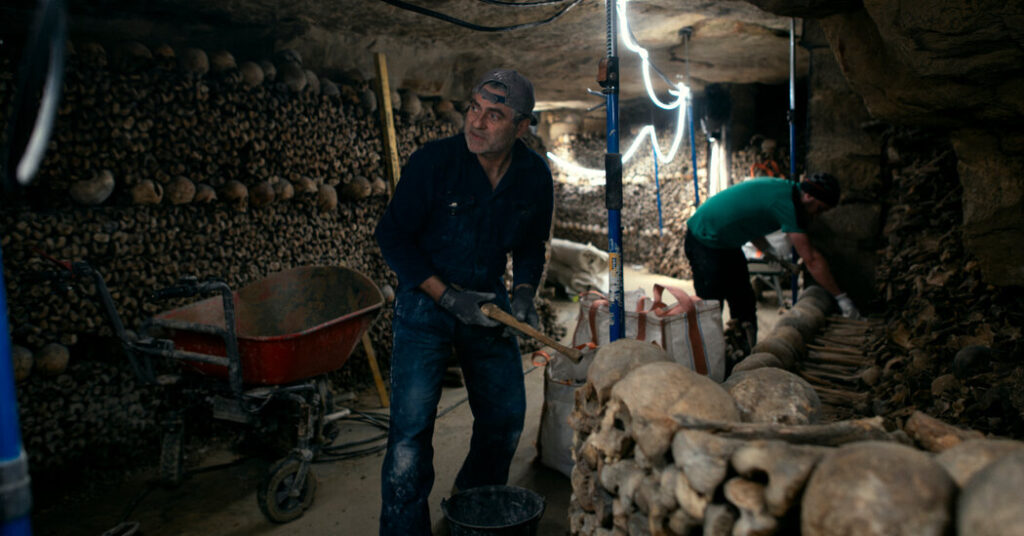
Over the past five months, architects, designers, technicians and masons have been renovating this vast tomb — installing new lighting and ventilation systems, restoring the bone walls, and preparing new audio guides. Some elements of the labyrinth, previously unlit, will now be visible to visitors.
The goal, curators say, is to preserve the site and make it more accessible while still maintaining its somber, spooky appeal.
“The goal isn’t to turn it into Disneyland,” said Isabelle Knafou, the catacombs’ administrator.
The labyrinth extends for hundreds of miles, and the mile-long section that the public can visit will reopen on Wednesday. The “galleries” are essentially the tunnels of quarries, first excavated in the Roman era. The network was converted in the 18th century to provide a novel remedy to a gruesome problem: The city’s cemeteries were overflowing, causing sanitation issues.
In 1785, the authorities began to move the dead underground, dumping the bones of people who lived from the 10th to the 18th centuries in parts of the abandoned tunnels, which became known as the ossuary, or tomb.
In the 19th century, Louis-Étienne Héricart de Thury, a senior official who oversaw the quarries, turned the piles of bones into an underground museum. Under his watch, workers rearranged the remains into decorative walls and pillars of femurs, tibias and skulls — and the catacombs officially opened to visitors in 1809. Messages, chiseled into the stone, invited onlookers to reflect on their own mortality. “Where is death?” reads one. “Always ahead or behind, the moment it arrives, it is already gone.”
The setting was never meant to be sensationalist, Ms. Knafou said. “On the contrary,” she noted, “it was to emphasize solemnity and create an atmosphere of respect.”
Two centuries of visitors brought humidity and carbon dioxide, both of which contributed to falling walls and molding bones. A dilapidated electrical system, almost untouched since 1974, hardly helped.
The restorers’ primary challenge was to ensure that the renovations did not compromise the site’s haunting essence, Ms. Knafou said.
“The first priority is, above all, to preserve the site and maintain a balance between the visit and the conservation of the remains,” she added.
Mélissa Cayralat, the project’s lead architect, said that it had also been challenging to find workers who were fit enough and willing to work 60 feet underground, traipsing up and down stairs repeatedly each day, working in cramped and damp spaces, surrounded by bones.
“At the start of the project, some people said, ‘We’re leaving,’” she said.
Florian Robin, a lighting technician, said that the project’s historical stakes had motivated him to overlook the logistical challenges. Mr. Robin, who helped restore the Cathedral of Notre-Dame after a catastrophic fire in 2019, said that he saw the catacombs’ renovation as another contribution to Paris’s legacy. He is “bringing them back to life,” he said, by installing lighting that better showcases the space.
Surrounded by buckets of skeletal remains, the head stonemasons Loïc Dollet and Florent Bastaroli were restoring the walls by wedging bones back into place without using cement or other materials that could cause damage.
The idea is to create rows of femurs and tibias that alternate with lines of skulls, creating walls behind which the remaining bones are piled up, many out of sight.
Eyeing the ghoulish mosaic, Mr. Bastaroli said, “It puts us back in our place as mortals.”
Mr. Dollet acknowledged that working with human material had caused him some angst.
“If you really think about the task, it’s inhumane work,” he said. “You shouldn’t handle your ancestors that way.”
After three years working in the catacombs, Mr. Dollet added, he is still shocked at some of the things he sees. Twisted bones that suggested they once belonged to deformed limbs. Punctured skulls that indicated they had been treated for brain swelling or other maladies.
“You think to yourself, damn, life wasn’t easy for everyone,” he said.
The post Can a Renovation Breathe New Life Into Paris’s Home for the Dead? appeared first on New York Times.