1935
A ‘Fountain’ for a Doll’s House
This three-inch replica of Duchamp’s “Fountain” has a giant presence: It was the first time the artist publicly acknowledged having turned a urinal into art. The tiny toilet was conceived as one of 69 miniatures he made of his artworks, packaged in 320 copies of the portable retrospective he sold as his “Box in a Valise.” Duchamp lovingly crafted a prototype from papier-mâché, then had that cast by a porcelain artist. Ann Temkin, the chief curator of paintings and sculpture at the Museum of Modern Art and one of the organizers of its Duchamp retrospective, noted that Duchamp’s copy required “immensely more time than the time he spent on the thing it’s reproducing.” Not at all one of his “readymade” sculptures, it was a very traditional work of the hand, riffing on a very untraditional work of the mind.
1950
A ‘Fountain’ Remake That Was Also New
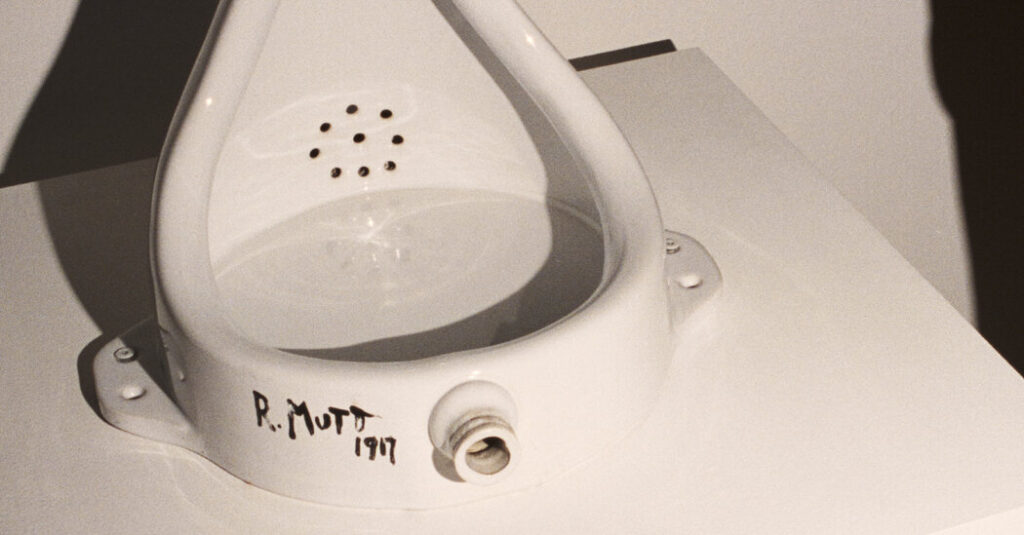
In 1950, the New York dealer Sidney Janis mounted a show on the most extreme modern art of all eras and asked Duchamp to lend him “Fountain.” The 1917 original had vanished, so Duchamp got Janis to buy an old urinal at a Paris flea market. That made the Janis “Fountain” less a replica of the original “readymade,” which had involved showing a brand-new purchase as art, than a new piece we might call an alreadymade. “I think he was very afraid of ever repeating himself,” said Matthew Affron, co-curator of the Duchamp retrospective. “So I think it sat well with him that it was the same and not the same.”
1963
A ‘Fountain’ That Needed Scrubbing
In 1963, Duchamp let the Stockholm critic Ulf Linde replicate his works for an exhibition. For “Fountain,” Linde pulled a new model urinal from a local restaurant. (It needed much scrubbing.) Michelle Kuo, a co-curator of MoMA’s Duchamp survey, said that Linde’s urinal is far more sleek and “machinic” than the original. Whereas the original was deluxe and had traces of Victorian ornament, Linde’s “Fountain” was abject and modern — closer to how people have always imagined the 1917 version.
Temkin pointed out that Duchamp delegated the making of most artworks to others in what she calls his lifelong “breakdown of the monolithic artist.” That process had begun in 1917, when Duchamp and two colleagues came up with the idea for “Fountain” and shopped for it together. And maybe the supplier, the J.L. Mott company, deserves some credit too, as perhaps does the fictional “R. Mutt,” a pseudonym Duchamp scrawled on the sculpture and then on all of its replicas.
1964
‘Fountain’ as Commodity
In Milan in 1964, the dealer Arturo Schwarz got Duchamp’s permission to produce a full-sized replica of “Fountain,” cast in an edition of eight for sale to collectors. Schwarz’s urinal was hand crafted by artisans — that’s clear from its wobbly surfaces — and Duchamp certainly saw the irony in that: A commonplace object whose artistic importance lay in its having been found, being turned into an elite, artisanal commodity.
The post A Brief History of 4 Urinals appeared first on New York Times.