In the two and a half weeks before the United States began a major military campaign against Iran, a small circle of advisers gathered in the White House Situation Room for a series of pivotal meetings. Previously undisclosed details of that period drawn from reporting for a forthcoming book, “Regime Change: Inside the Imperial Presidency of Donald Trump,” show how President Trump’s alignment with Prime Minister Benjamin Netanyahu of Israel and a lack of sustained opposition from all but one member of the president’s inner circle put the United States on a course to war.
Here are six takeaways from that reporting.
Netanyahu made a detailed pitch for war to Trump and his team in the Situation Room.
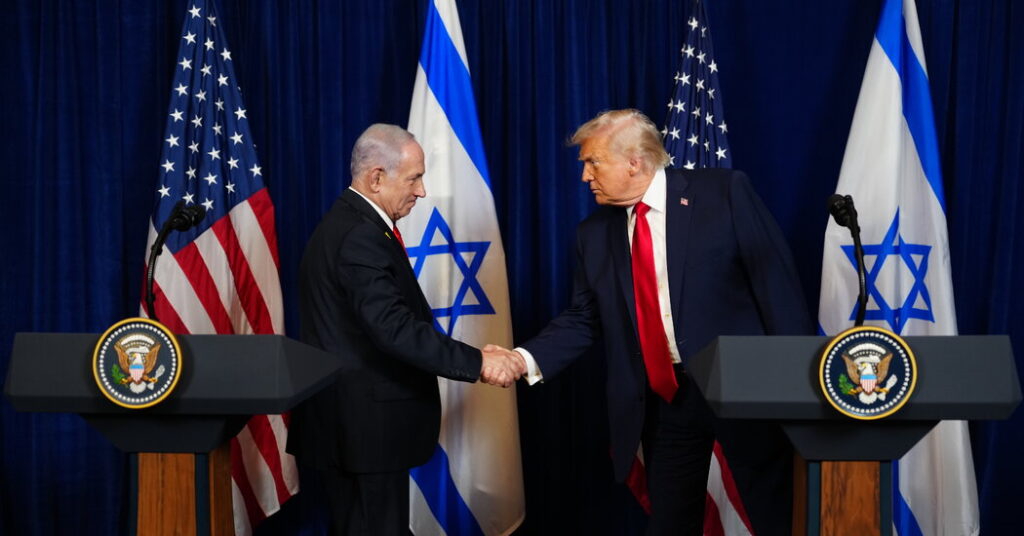
Sitting across from Mr. Trump in the Situation Room — a venue rarely used for in-person sessions with foreign leaders — Mr. Netanyahu made an hourlong presentation to the president and his top aides on Feb. 11. He argued that Iran was ripe for regime change and that a joint U.S.-Israeli campaign could bring down the Islamic Republic. At one point, he played a video that included a montage of figures who could lead Iran if the theocratic government fell. Among them was Reza Pahlavi, the exiled son of Iran’s last shah.
The Israeli leader and his advisers laid out what they portrayed as near-certain victory: Iran’s missile program destroyed in weeks, the Strait of Hormuz kept open and minimal retaliation against American interests. Mossad, the Israeli intelligence agency, could help foment an uprising inside Iran to finish the job.
Mr. Trump’s response was swift and appeared approving to most in the room. Sounds good to me, he told the prime minister.
U.S. intelligence officials called Netanyahu’s regime-change scenarios “farcical.”
U.S. analysts scrambled overnight to assess what Mr. Netanyahu had presented. Their conclusions, delivered the next day in another Situation Room meeting, were blunt.
The first two objectives laid out in the Israeli pitch — killing the ayatollah and crippling Iran’s ability to threaten its neighbors — were achievable, U.S. intelligence officials concluded. The second two goals presented by Mr. Netanyahu and his team — a popular uprising inside Iran and the replacement of the Islamic government by a new secular leader — were not. The C.I.A. director, John Ratcliffe, used a single word to describe the regime-change scenarios: “farcical.” Secretary of State Marco Rubio translated, “In other words, it’s bullshit.”
Mr. Trump absorbed the assessment — and moved past it. Regime change, he said, would be “their problem.” His interest in killing Iran’s top leaders and dismantling its military remained undimmed.
Vice President JD Vance was the strongest opponent of the war — and the only one to make a forceful case against it.
Of everyone in Mr. Trump’s inner circle, Mr. Vance did the most to try to stop the march toward war. He had built his political career opposing precisely this kind of military adventurism, and he told colleagues that a regime-change war with Iran would be a disaster.
In front of the president and his other advisers, Mr. Vance warned that the conflict could cause regional chaos and untold casualties, break apart the president’s political coalition, and be seen as a betrayal by voters who had supported the promise of no new wars. He stressed the depletion of U.S. munitions and the risk of outsized and unpredictable retaliation given that the regime’s survival was at stake. He also warned about the Strait of Hormuz and the likelihood of soaring gasoline prices.
His preference was for no strikes at all. But knowing Mr. Trump was likely to act, Mr. Vance tried to steer him toward more limited options. When that failed, he argued for overwhelming force to end things quickly. At the final meeting on Feb. 26, his message to the president was blunt: You know I think this is a bad idea, but if you want to do it, I’ll support you.
Some Trump advisers had serious private concerns but deferred to the president.
The positions in the inner circle fell along a spectrum, but with one thing in common: Nobody other than Mr. Vance mounted a forceful argument to change Mr. Trump’s mind.
Defense Secretary Pete Hegseth was the most enthusiastic. We’re going to have to take care of the Iranians eventually, so we might as well do it now, he told the group on Feb. 26, the day before Mr. Trump gave his final order. Mr. Rubio was more ambivalent — his preference was for continued maximum pressure rather than full-scale war — but he did not try to talk the president out of it. Susie Wiles, the White House chief of staff, worried about the United States being dragged into a conflict in the Middle East on the eve of midterm elections but did not see it as her role to share her concerns about a military decision in a large group setting with the president.
Gen. Dan Caine, the chairman of the Joint Chiefs of Staff, had serious concerns about the war and persistently flagged risks: weapons depletion, closure of the Strait of Hormuz, the difficulty of predicting Iran’s response. But he was so careful not to take a stand, repeating that it was not his role to tell the president what to do, that he could appear to some to argue all sides simultaneously. Mr. Trump, in turn, would often seem to hear only what he wanted to hear.
Trump believed it would be a quick war, like in Venezuela.
The president’s confidence that a conflict with Iran would be brief and decisive was deep-rooted and largely impervious to contrary evidence. He had been emboldened by Iran’s muted response to his bombing of its nuclear facilities in June and by the spectacular commando raid that had captured the Venezuelan leader Nicolás Maduro from his compound on Jan. 3, in which no American lives were lost.
When advisers raised the possibility that Iran could shut down the Strait of Hormuz — a choke point for vast quantities of global oil and gas — Mr. Trump dismissed the possibility, assuming the regime would capitulate before it came to that. When told the campaign would significantly deplete American weapons stockpiles, including missile interceptors already strained by years of support for Ukraine and Israel, Mr. Trump appeared to weigh the warning against a more appealing data point: The United States had an essentially unlimited supply of cheap, precision-guided bombs.
When the anti-interventionist commentator Tucker Carlson privately asked Mr. Trump how he could be so sure everything would be OK, the president replied, “Because it always is.”
For Trump, it was a gut-driven decision enabled by an echo chamber that did not exist in his first term.
Mr. Trump’s decision to take the country to war was not driven by intelligence assessments or a strategic consensus among his advisers, which did not exist. It was driven by instinct — the same instinct his team had watched produce improbable results again and again.
Unlike his first-term team, many of whom regarded him as a danger to be managed or obstructed, Mr. Trump in his second term is surrounded by advisers who view him as a great man of history. After his improbable comeback in 2024, after indictments and assassination attempts, and after ordering the flawless operation that captured Mr. Maduro in Venezuela, the people around Mr. Trump had developed an almost superstitious faith in his destiny and instincts, and in his power to will new realities into existence. In making this high-stakes and high-risk decision, almost everyone deferred to the president’s gut.
Surrounded by people trying to execute on Mr. Trump’s desires, and with so much having gone his way to that point, almost nothing stood between the instinct and the act.
Maggie Haberman is a White House correspondent for The Times, reporting on President Trump.
The post 6 Takeaways From the Story of Trump’s Decision to Go to War With Iran appeared first on New York Times.