For someone who claims to be unconcerned about the Strait of Hormuz, President Donald Trump seems increasingly desperate to open it.
In a Truth Social post over the weekend that was extreme even be his standards, Trump instructed Iran to “open the fuckin’ strait” by this Tuesday or he would make good on earlier threats to destroy bridges and power plants across the country. He has threatened attacks against Iran’s desalination plants and the oil export facility on Kharg Island as well.
Asked Monday by reporters at the White House whether this would constitute a war crime, Trump replied that the Iranian leaders who had killed “45,000 people in the last month” were “animals.”
Trump’s renewed threats to target Iranian infrastructure that supplies civilians with basic necessities like power and water, and his increasingly harsh rhetoric — like threatening to send Iran’s government “back to the Stone Ages where they belong” — have led to accusations that he’s violating domestic and international laws of war. Senate Minority Leader Chuck Schumer warned Sunday that Trump was “threatening possible war crimes.”
To this point, most of the US strikes in Iran appear to have followed a pre-determined target set and focused on degrading the country’s nuclear, missile, and naval capabilities — all legitimate military aims. The killing of a head of state like Ayatollah Ali Khamenei is probably also lawful, even if extremely unusual, though Israel’s apparent targeting of diplomatic officials involved in negotiations is harder to justify. The strike on a girls’ school in Tehran that killed around 150 students on the first day of the war appears to have been the result of negligence rather than intent.
A shift toward the deliberate targeting of Iran’s civilian infrastructure, however, could mark a hard turn into deliberate lawbreaking, as well as a dramatic escalation of a conflict the president has been promising is close to over. And while not every attack on energy or bridges is inherently a war crime, the scale of destruction Trump is threatening, if carried out, would have dire implications — sending a signal that the nation that helped institute and police the modern rules of warfare is now proudly and openly flouting them.
What makes a bombing illegal?
Under international law, also codified in US military regulations, a military target is legal if it meets a two-part test: The target must “make an effective contribution to military action” and its destruction or capture must “offer a definite military advantage.”
Legal experts who spoke with Vox said that while there are definitely cases in which a power station or bridge, and possibly even a desalinization plant, could be a legitimate military target, those determinations would need to be made on a case to case basis, as opposed to Trump’s threat to destroy them en masse in order to pressure Iranian leaders into concessions. On Monday, Trump specifically threatened to destroy every bridge and every power plant in Iran if his demands were not met.
“The targeting is not being driven by considerations of military advantage, but to politically coerce the opposing party and inflicting pain, things which would not be legitimate aims,” said Brian Finucane, a former State Department legal adviser now with the International Crisis Group.
The United States targeted electricity grids in previous bombing campaigns in Iraq during Desert Storm and Serbia in 1999. In both cases, it used specially designed graphite bombs designed to cause short-circuits without permanent damage. There was a deadly and controversial bombing of a civilian bridge in the Serbia campaign as well.
But “indiscriminate attacks” like the ones Trump is describing not only be a violation of the laws of armed conflict by the US but could arguably be considered “war crimes by those who are involved in the strikes,” said Michael Schmitt, a former US Air Force judge advocate who now teaches at the University of Reading in the UK. Though the two terms are often used interchangeably, “war crimes” are violations serious enough that the political leaders and military commanders involved could face criminal charges.
By the prevailing standards, many of Iran’s own strikes — from hitting gas fields, desalination plants, and data centers in the Gulf to using cluster munitions in Israel — are also illegal, clearly meant to impose economic costs or terrorize populations rather than gain military advantage.
Enforcing violations is a more complicated story. Neither Iran nor the United States recognize the authority of the International Criminal Court — and in fact the Trump administration has imposed sanctions on it — but Schmitt notes that war crimes are matters of universal jurisdiction, meaning any country could theoretically launch a prosecution for them.
For his part, he is hopeful that whatever the rhetoric coming out of the White House, “at the military level, cooler heads will prevail, and there will be a very surgical by the numbers assessment of every target meant to be struck to ensure that it’s a military objective, that harm to civilians is justified under the rule of proportionality, and that every effort that’s feasible has been taken to avoid civilian harm.”
Collective punishment
Thus far, Trump has generally made a distinction between the Iranian population and its regime. The escalation toward this war began, after all, when Trump threatened strikes against the Iranian government for its mass killing of protesters in January. And while it’s nearly impossible to gauge public opinion in Iran right now, it’s clear that at least a significant segment of the population is hoping these strikes, regrettable as they might be, could still bring down the regime.
Trump had made a point in the first few weeks of the war of saying he was avoiding targeting Iran’s power infrastructure. After Israel bombed a major gas field, spiking global energy prices, Trump promised it would never happen again. In his public statements, Trump appeared to be hoping to allow a more pliant and militarily-weakened new Iranian government to rebuild its economy after the war.
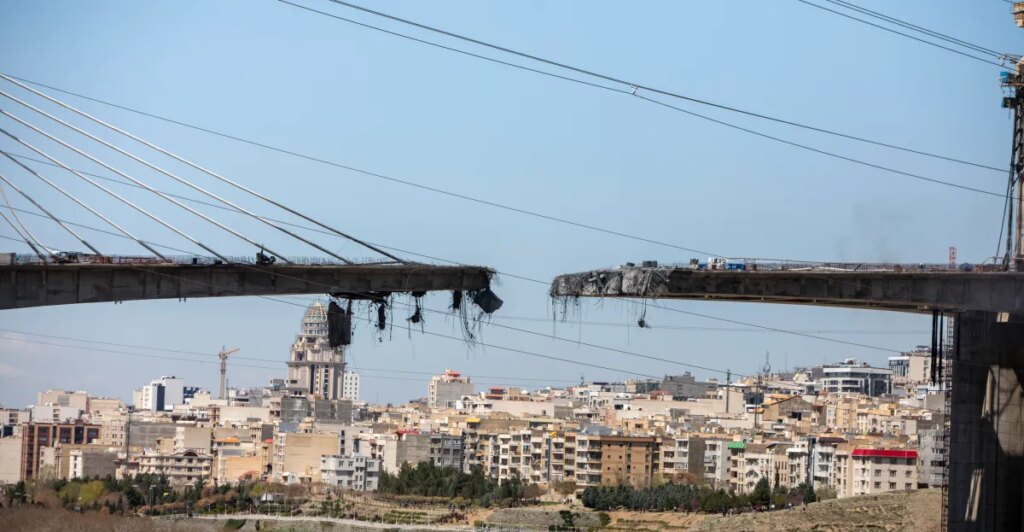
More recent strikes, however, have begun to test these boundaries. Last week, a US airstrike destroyed a major Iranian highway bridge. US officials suggested it was used to transport drone and missile parts, though other reports suggest it was still under construction and hadn’t been opened to traffic. The United States and Israel have also, in recent days, been stepping up attacks on nonmilitary targets, including steel and petrochemical plants.
Trump appears, in his rhetoric at least, to be shifting toward a strategy of collective punishment of Iran as a whole for the actions of its government. When he threatened to bomb Iran back to the “Stone Age” in his address last week, that did not sound like just a reference to its nuclear enrichment facilities.
Intentionally or not, Trump’s description of Iranian leaders as “animals” evokes Israeli Defense Minister Yoav Gallant’s 2023 description of Hamas as “human animals” to justify the “complete siege” of Gaza. The consistent Israeli government justification for the harm inflicted on civilians was that it was the result of the actions of Hamas.
This is not to say that the level of physical destruction in Iran will come anywhere close to Gaza. But aside from questions of legality and morality, the comparison raises troubling strategic questions for the US.
Trump often appears to be vacillating between a plan to simply pack up and leave Iran once a certain set of military objectives are complete, and continuing the war until Iran’s leaders agree to concessions. The latest threats seem to suggest the latter, but there’s little to indicate that Iran’s leaders are close to making concessions, particularly on the Strait of Hormuz, which has emerged as their main form of deterrence and leverage in this conflict.
A government that, as Trump noted, is willing to kill tens of thousands of its own people to stay in power, is probably not one that is likely to surrender because its people are suffering without power.
The post Why Trump’s latest threat against Iran could be a war crime appeared first on Vox.