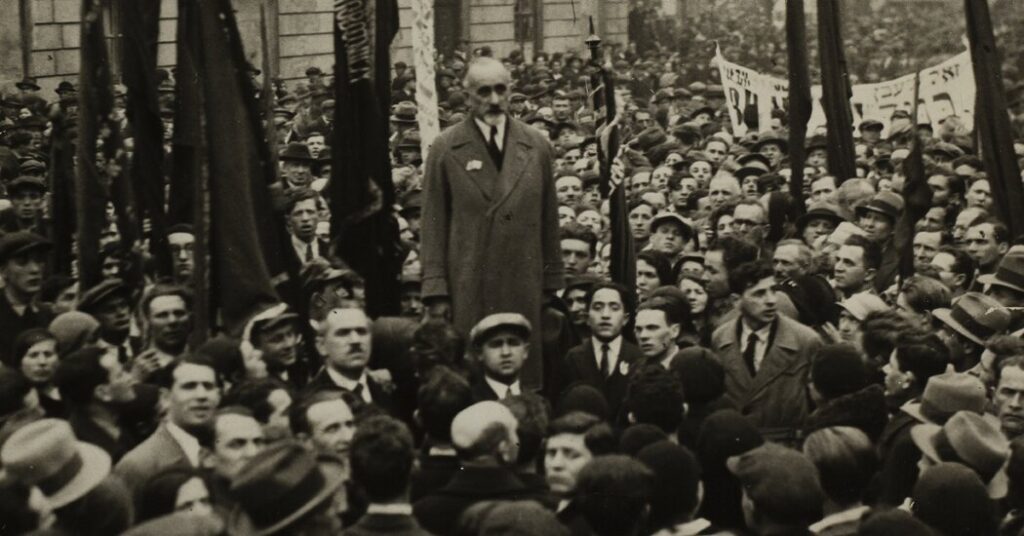
HERE WHERE WE LIVE IS OUR COUNTRY: The Story of the Jewish Bund, by Molly Crabapple
Has the entanglement of Jewishness and Zionism ever felt more fraught? As Israel, fresh off the wholesale destruction of Gaza, drops more bombs across the Middle East, a Michigan synagogue is attacked by a Lebanese American man whose brother was killed in an Israeli strike half a world away. Noxious conspiracy theories about Jewish power and Zionism bubble up from far-right YouTube shows and even, according to some readings, in the resignation letter of a national security official.
This conflation of Jews and Israel is dangerous antisemitism. And yet it’s harder to fight back as the mainstream Jewish establishment insists that Zionism is nearly as integral to Jewish identity as circumcision. Increasingly, though, many Jews are searching for another point of view: Feelings about Israel are wobbling within the community — and disapproval is rising among the young; pro-Palestinian Jewish groups are growing, and more and more Jews view “Zionist” as a toxic label.
In this muddled moment Molly Crabapple’s terrific “Here Where We Live Is Our Country” unearths the story of a Jewish political movement that opposed ethnic nationalism of all stripes and that fought antisemites head-on — sometimes literally beating them on the head. It’s an authoritative history of the Jewish Labor Bund, better known simply as the Bund, the early-20th-century socialist movement that broke with the Bolsheviks, fought the Zionists and tried to resist the fascists.
Today, the Bund is largely forgotten. A century ago, though, a reader of this newspaper likely would have heard of it. It was, as Crabapple proves, the kind of movement leftists today dream about — political party, social movement, mutual aid group — with tens of thousands of members. The Bund published newspapers and ran soup kitchens and summer camps; its athletes competed in a socialist version of the Olympics. Bund activists organized across Eastern Europe and beyond — they helped elect a congressman on the Lower East Side.
From the group’s founding on the outskirts of the Russian Empire in 1897 through its painful disintegration, first in the Nazis’ ghettos and gas chambers and then with Israel’s rise, the Bund stood not just for socialism, but for do’ikayt — Yiddish for “hereness.” It meant, Crabapple writes, that “Jews had the right to live in freedom and dignity wherever it was they stood. They would fight for a better and more beautiful world, even alongside people they had been raised to see as enemies.” Working-class solidarity and a pride in cultural particularity. She calls it a kind of identity politics avant la lettre.
Crabapple comes to this fascinating material by way of a familiar device. It’s a bit of a trope in Jewish books to begin with a shoe box of grandma’s old papers that send the author racing backward into the 20th century. The point of departure here is a watercolor: “Itka the Bundist, Breaking Windows.” The painter was Crabapple’s great-grandfather Sam Rothbort, an artist born in Volkovysk, a small town in the Russian Empire’s Pale of Settlement. Down the rabbit hole she went.
And how deep. Crabapple is best known for her talents as an artist and illustrator. “Here Where We Live Is Our Country” is her first work of history. To write it, she didn’t just travel the blood-soaked lands where the Bund once held sway, or interview its members’ descendants. She even learned Yiddish. Her footnotes are dense with obscure pamphlets, newspapers and letters from Warsaw and Minsk.
“Here Where We Live Is Our Country” is thrillingly energetic. She peppers the text with delightful anachronisms, as when she compares the Bund’s co-founder Arkady Kremer to the “mean, Derrida-quoting grad students” that her left-wing friends in New York unfortunately like to date. She also offers vivid renderings of fractious meetings in smoky halls and exiles fleeing on trains. Picture Warren Beatty’s “Reds,” but with a script from Isaac Bashevis Singer, the acerbic Yiddish novelist who captured prewar Jewish life.
Crabapple makes the case that the Bund was an important actor in many of the great dramas of Eastern Europe in the first half of the 20th century. When the crew of the Potemkin mutinied against the imperial Russian order in 1905 and docked in Odesa, it was the 22-year-old Bundist Anna Lipshitz who roused the city’s working-class protesters to support the cause. The 1917 revolution that overthrew Czar Nicholas? There’s the Bundist leader Henryk Erlich helping to form the new Congress of Soviets. And in the most legendary resistance to Nazi murder, the Warsaw Ghetto Uprising of 1943, it was young Bundist cadres who charged the SS machine guns.
The Bundists lost, of course. Not just to the Nazi gunners, but also to the Bolsheviks and, crucially, to the Bund’s chief rival in early-20th-century Jewish political life, the Zionists. “Hereness” was a much harder sell for the European Jews who had escaped the death pits dug by their Christian neighbors.
Crabapple has a leftist’s love of losers, the idealists with moral clarity on their side but who never really stood a chance. She admits as much: “So why did I write this book about the Bund — who lost?” she asks at the end of the book. “Because I am sick of monsters.”
But she also admires these losers’ foresight. She finished her book at the height of Israel’s onslaught in Gaza, and the backlashes that it has engendered. Crabapple quotes Erlich, one of the Bund’s last leaders during the party’s heyday, before his death in Soviet custody in 1942. “Zionism, in point of fact, has always been a Siamese twin of antisemitism,” Erlich wrote. “Zionism has always regarded the law of force, of nationalistic action, as the normal law of history, and on this law has based its perspectives on Jewish life.”
A quote from the same 1938 article by Erlich appears early on in another recent, and similarly urgent, book: Mark Mazower’s “On Antisemitism.” Mazower, a historian at Columbia, forensically reconstructs how the meaning of antisemitism transformed from its origin as the name of a 19th-century German political movement to a label largely applied to critics of Israel. The reasons are manifold, Mazower writes, but central among them — though he hardly articulates it as such — is that Jewish politics went in the opposite direction of Bundism, embracing nationalism in the Middle East and integrating Jews into the elite elsewhere.
Should those seeking an alternative return to Bundism? That might not be as easy as it sounds. Scarsdale and the Upper West Side in 2026 are not Bialystok and Minsk in 1906. There are, of course, working-class Jews — too often erased in the popular imagination — but they are too much in the minority to try to build a Jewish politics around labor as the Bundists did.
Yiddish language and culture, maybe? There’s a burgeoning revival among a subset of Jews who embrace “diasporism,” but for most, “Seinfeld” and bagels remain the real common language. The Bund was proudly secular. “At a Bundist gathering, the pastries might be fried in pig fat, just to prove a point,” Crabapple writes. Today, though, left-wing Jews wear prayer shawls to protests and organize Palestinian liberation Seders. Would Erlich turn in his grave — or would he find familiar the attempt to marry Jewish identity and solidarity with the oppressed?
Ultimately, Crabapple wants to offer inspiration, not prescription. In an epigraph that she returns to at the end of the book, she quotes Gustav Mahler, a Jew who converted to Catholicism to gain entry to the highest levels of Viennese music society: “Tradition is not the worship of ashes. It is the preservation of fire.”
HERE WHERE WE LIVE IS OUR COUNTRY: The Story of the Jewish Bund | By Molly Crabapple | One World | 453 pp. | $32
The post What Does Judaism Look Like Without Zionism? appeared first on New York Times.