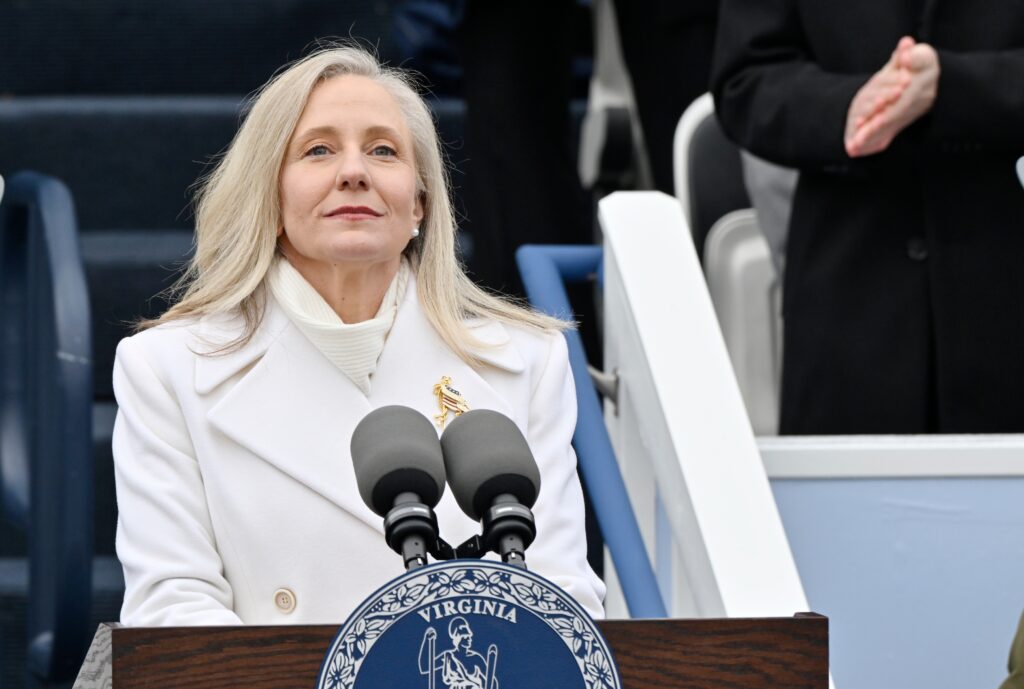
Virginia Gov. Abigail Spanberger’s approval rating stands at 47 percent two months into the Democrat’s term, with 46 percent of voters disapproving and 7 percent expressing no opinion in a Washington Post-Schar School poll.
Spanberger won in a 15-point landslidelast year after touting her reputation for bipartisanship built on three terms representing a conservative-leaning district in Congress. But her current ratings reflect sharp polarization among Virginia voters in their views of the state’s first femalegovernor.
The approval mark for Spanberger is 13 percentage points lower than the average for Virginia governors in Post polling since the 1990s. Her near-even split between approval and disapproval is a worse net approval rating than the early-term scores of her predecessors in previous Post polls. It is also slightly weaker than ratings of her immediate predecessor, Glenn Youngkin (R), in a Post-Schar School poll last fall, showing he ended his term with 50 percent approval and 46 percent disapproval. Unlike Spanberger, Youngkin had come into office with a very narrow victory.
In a positive sign for Spanberger, elements of her affordability agendascore well with voters, suggesting room to improve her image after a rocky start. The governor also continues to be more popular than President Donald Trump among Virginia voters, 40 percent of whom approve of his performance while 57 percent disapprove.
A larger share of voters expressed strong disapproval of Spanberger’s performance than of her predecessors. Two-thirds say they either strongly approve (29 percent) or strongly disapprove (38 percent). Fewer than 6 in 10 felt strongly about Youngkin’s performance at any point in his tenure, with 28 percent strongly approving and 25 percent strongly disapproving in Post-Schar polling last September.
“Some amount of polarization is baked in, but this is unusual at this early stage of her administration and given that she had long cultivated a centrist image,” said Mark Rozell, dean of George Mason University’s Schar School of Policy and Government, which co-sponsored the poll.
While she has maintained the support of her Democratic base — more than 8 in 10 Democrats approve of her performance — Spanberger has not made inroads with Republicans, nearly 9 in 10 of whom disapprove. In addition, Spanberger gets more strong disapproval from Republicans — 78 percent — than strong approval from Democrats, 62 percent.
Independent voters are split, with 45 percent approving and 46 percent disapproving of Spanberger. Last fall, she won 59 percent of independent voters, according to network exit polling.
Spanberger has largely kept promises to pursue pocketbook-minded legislation such as improving access to health care and investing in affordable housing, and has worked with Democratic leaders in the General Assembly to quash talk of tax increases. But Rozell noted that her moderate image has been complicated by several factorsthat provided fodder for intensely negative campaigns from the right.
She condemned Trump’s immigration operations and ended controversial partnership agreements between state law enforcement and federal immigration authorities. She has grudgingly supported efforts to redraw the state’s congressional districts to heavily favor Democrats — again, resisting Trump, who has pushed Republican states to redraw districts to preserve the GOP majority in the U.S. House. The Trump administration has routinely excoriated Spanberger in public statements and news releases, and the Post-Schar School poll found strong partisan sentiment about redistricting.
In addition, “multiple tax proposals in the General Assembly, even though not enacted and not championed by Spanberger, drove a narrative of Democrats in Richmond lurching way left, which likely affected perceptions of the governor,” Rozell said.
Gregory Roddy, a self-described independent voter from Fairfax County who leans conservative, said he was always skeptical of Spanberger’s pitch as a bipartisan candidate. Once she was elected, Spanberger “switched over,” he said, citing her swift move to curtail Virginia’s cooperation with federal immigration authorities.
“Now, she’s just a bot for the Democratic Party,” Roddy, 69, said.
But Spanberger’s quick actions on issues such as immigration enforcement won her praise from voters like Marcus Shaw, who describes himself as left of center but wary of Democrats. Shaw distrusted Spanberger when he voted for her, but said her boldness could prove useful for Virginians in the long run.
“I really appreciate somebody that takes up the mantle, goes in and says ‘Okay, we’re doing XYZ,’” said Shaw, 30, of Hampton.
The poll finds 45 percent of Virginia voters think Spanberger’s views are “too liberal,” while 42 percent think they are “just about right” and 7 percent say she is “too conservative.”
The scope of her image problem is apparent in the disconnect between voter impressions of her actions and her specific affordability policies.
Spanberger has cautioned that there is no automatic strategy to improve cost of living, but more voters think Spanberger’s policies will make Virginia less affordable (41 percent) than more affordable (31 percent), while 23 percent don’t think her policies will make a difference.
Even among Democrats, 63 percent think Spanberger’s policies will improve affordability but more than 3 in 10 think they either won’t make a difference (25 percent) or will make the state less affordable (8 percent). About 8 in 10 Republicans predict her policies will make the state less affordable.
Independents are skew negative on Spanberger’s actions, with 41 percent saying they will make the state less affordable versus 27 percent who say they will make the state more affordable.
Mason Necci, a self-described independent voter in rural Culpeper County, said he did not vote for Spanberger but hoped she would improve the cost of living.
Instead, he feels, she has been trying “to make herself into a Democratic icon.”
“I don’t see anything that makes me think I’ll be able to own a home again one day in this state,” said Necci, a 44-year-old car parts salesman.
Spanberger has requested and signed a host of legislation aimed at housing affordability, lowering energy bills and boosting resources for low-income households. Asked about specific Spanberger policies, Virginians are more optimistic, believing that six of the eight priorities mentioned in the poll will make living in the state more affordable. Those include reducing regulations on small solar panel systems, encouraging mixed-income housing development and requiring electric companies to help lower-income residents improve their home energy efficiency.
“Affordability is a great campaign theme, but almost an impossible governing one given the limited tools that a governor has to affect prices,” Rozell said. “The public may like the particulars of some of her proposals, but as long as the overall environment on affordability remains unchanged, there is inevitable disappointment.”
Voter perspectives change based on income level, however, with Spanberger’s approval rating slightly higher among families making under $100,000.
Her support from Black Virginia voters appears shaky, with two-thirds saying they approve of Spanberger’s performance, compared with the 93 percent of Black voters who supported her last fall, according to network exit polls.
Spanberger maintains an edge with women voters, 52 percent of whom approve of her performance, while 54 percent of men disapprove.
This poll was conducted by The Post and George Mason University’s Schar School of Policy and Government from March 26-31 among a random sample of 1,101 registered voters in Virginia drawn from a statewide voter database. Live caller interviews reached respondents on cellphones (62 percent) and landlines (16 percent); 22 percent of respondents were reached via text message and invited to take the survey online. The overall margin of error is plus or minus 3.4 percentage points.
Isabelle Gibson contributed to this report.
The post Virginians deeply divided on Spanberger months after her landslide win appeared first on Washington Post.