Johan Norberg is a senior fellow at the Cato Institute.
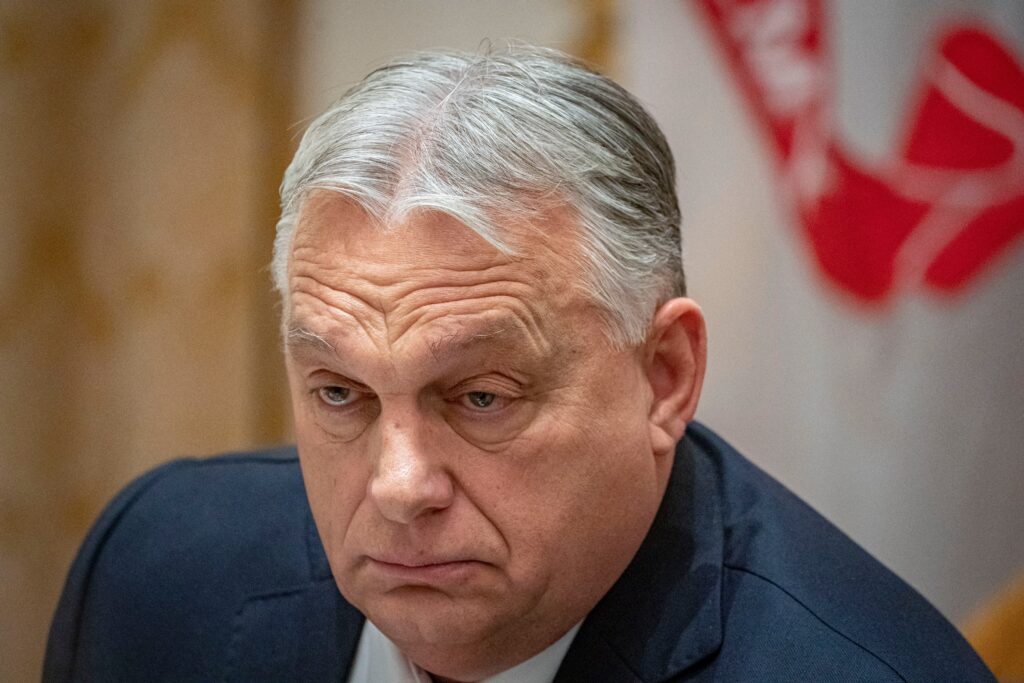
Last month, Donald Trump offered Viktor Orban his “complete and total endorsement” in a video message ahead of Hungary’s April 12 election. The statement continued the president’s habit of boldly weighing in on the internal politics of other nations. But in this case, he would have been wise to first check the sell-by date of the prime minister and his creaking project of illiberalism.
After repeatedly winning reelection since 2010, Orban and his ruling party, Fidesz, now face a genuine electoral challenge from Peter Magyar and his center-right Tisza Party, which has led in the polls for more than a year while running on an anti-corruption platform. The result will allow the world to gauge Hungarians’ discontent with Orban’s brand of politics. It will also provide an answer to whether it’s possible for an opposition with broad support to win after 16 years under a government that rewrote election laws to its benefit while bringing much of the media under its influence.
The president’s interest in Orban’s political survival is certainly due in part to their rapport, but there’s a deeper nexus, too. Many of Trump’s supporters and allies — including Vice President JD Vance — see Hungary as a bastion of conservative and Christian values in a liberal and secular European Union.
For them, the election carries added significance. Hungary has served as a laboratory for policies promoted by many self-described national conservatives in the United States who want government to positively promote conservative values.
But regardless of the outcome, Orban has already shown that his vision of illiberal nationalism is a dead end that made Hungary poorer and less free.
The project began in 2010, when Fidesz won a two-thirds majority, giving it the power to change the constitution. As Orban put it before coming to power, “We have only to win once, but then properly.” Since then, he has spoken proudly of his ambition to build an “illiberal state,” pointing to countries such as Russia and China as models for the future.
And follow their model he did. To remove checks and balances on Orban’s power, Fidesz upended the judiciary and government agencies. It forced many judges into retirement and packed the constitutional court with loyalists. Key institutions were filled with partisans on unusually long terms, ensuring influence well beyond any single election cycle, and electoral laws were rewritten to hamstring the opposition.
It didn’t stop there. The organization Reporters Without Borders ranked Hungary 23rd in the world for press freedom in 2010. Today, it is 68th, thanks to the Orban government’s efforts to undermine independent outlets through punitive advertising taxes and by withdrawing permits and broadcast licenses.
In 2013, with the media and government firmly under Fidesz control, a takeover of civil society began. Hungary’s central bank gave the government roughly 900 million euros to set up a network of formally independent foundations that fund pro-Orban institutes and networks. In 2021, the government further entrenched itself by transferring universities, businesses and billions in assets to “public interest foundations” controlled by allies, placing this parallel power structure beyond democratic accountability.
The free-market economy, too, turned into a system of political favoritism. Through expropriation and selective taxes and regulations, independent businesses were pushed out. Private pension savings were seized, and foreign landowners lost key property rights. The government, meanwhile, steered public procurement, contracts and credit to a group of aligned oligarchs.
Lorinc Meszaros, a childhood friend of Orban who is the country’s richest man, symbolizes Hungary’s transformation into a state where economic success depends on proximity to power. He famously credited his fortune to “God, good luck and Viktor Orban.” Unsurprisingly, Transparency International’s Corruption Perceptions Index now ranks Hungary on par with China and Cuba.
This kleptocracy is Fidesz and Orban’s legacy. By their own stated goals — to make Hungary great, Christian and pro-family again — their model of governance has failed.
Despite receiving more E.U. funds per capita than almost any other country, Hungary’s economic growth rate has been slightly below several regional peers. Spending as much as 5.5 percent of gross domestic product on family support produced only a temporary uptick in the fertility rate to 1.61 births per woman in 2021, before falling to an estimated 1.31 in 2025, far below the 2.1 required to maintain a stable population. Religious affiliation has declined during Orban’s tenure, too, suggesting that politicizing religion through subsidies and legal privileges for favored denominations actually hurts religious adherence.
Today, Hungary is the only member of the European Union not classified as “free” on the Freedom House index.
After 16 years as a laboratory for post-liberal nationalism, the result in Hungary is clear: Sweeping aside institutional constraints on government in pursuit of grand visions of the common good unshackles the smallest, most sordid ambitions of rent-seeking and corruption.
As the scriptures Orban is so fond of quoting say: “Every tree is known by its own fruit.”
The post Viktor Orban’s illiberal nationalism has failed Hungary appeared first on Washington Post.