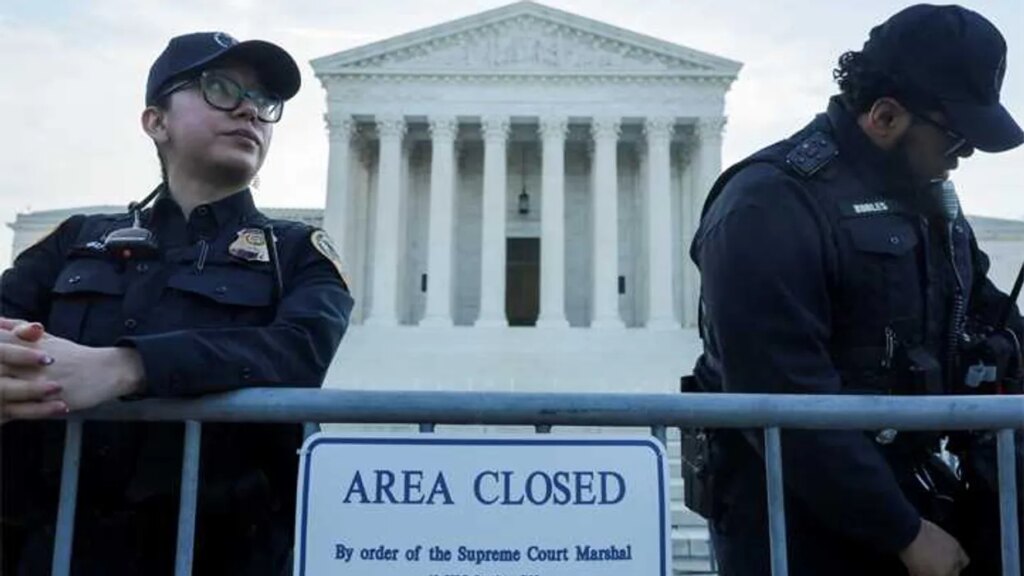
As the U.S. Supreme Court heard arguments last week about the constitutionality of President Donald Trump’s executive order to end birthright citizenship, Justice Sonia Sotomayor seemed skeptical.
The order as written applies only to babies born in the future, and the Trump administration has asked the court to exclude current citizens from any decision. Still, the court’s senior liberal justice wasn’t so sure it would work out like that.
“But the logic of your position, if accepted, is that this president or the next president or Congress or someone else could decide that it shouldn’t be prospective,” Sotomayor told U.S. Solicitor General D. John Sauer, the government’s top advocate at the court. “There would be nothing limiting that, according to your theory.”
The birthright citizenship case, Trump v. Barbara, is forcing the Supreme Court to confront the prospect of the United States becoming a much different kind of nation — one where Americans risk losing their citizenship and babies could be born effectively stateless. It’s also a nation that would more closely resemble its past, when broad swaths of people were excluded from the coveted title of American.
A majority of the court, including several conservative justices, appeared unpersuaded by the Trump administration’s argument that the 14th Amendment to the Constitution, ratified during Reconstruction, doesn’t guarantee citizenship to nearly everyone born on American soil. The court may very well strike down the order, which has never taken effect, later this year.
But whatever the decision, the case has prompted a high-stakes debate over who is an American — and the consequences of that definition — that’s playing out in the courtroom, in court documents, and on the steps of the Supreme Court.
“Birthright citizenship is not just a legal principle,” Norman Wong said at a demonstration outside the Supreme Court last week.
Wong is a grandchild of Wong Kim Ark, who was born in San Francisco but denied entry back into the country after visiting China more than a century ago. Officials at the time argued he wasn’t a citizen, but he took his case to the Supreme Court and, in a 1898 decision, the justices affirmed that virtually all children born in the United States were guaranteed citizenship.
“It’s a statement about who we are as a nation,” Wong said of birthright citizenship. “It affirms that America is not defined by bloodlines or exclusion, but shared values and equal rights.”
A different view
Trump and some Republicans view birthright citizenship differently.
The 14th Amendment says “all persons born or naturalized in the United States, and subject to the jurisdiction thereof, are citizens of the United States and of the State wherein they reside.”
The Trump administration, which has worked to carry out mass deportations, contends that children born to parents in the country illegally or temporarily are not subject to the country’s jurisdiction. Most historians and legal scholars repudiate that position.
The executive order, signed on Trump’s first day back in office, calls citizenship a privilege — not a right — that’s a “priceless and profound gift.”
During a recent Oval Office event, Trump told reporters that birthright citizenship was intended to extend citizenship to formerly enslaved people and their children following the Civil War.
“The reason was it had to do with the babies of slaves,” Trump said.
Some Republicans have embraced a conception of the U.S. as a nation bound by a distinct cultural heritage — sometimes in language that celebrates European settlers — as opposed to a people brought together by the idea of America or a set of common principles. Like Trump, they advocate for a restrictive approach to immigration.
At a conference last fall on national conservatism — the name sometimes given to this perspective — U.S. Sen. Eric Schmitt, a Missouri Republican, called America a “a way of life that is ours, and only ours, and if we disappear, then America, too, will cease to exist.”
Schmitt filed a brief with the Supreme Court in January, along with Republican Rep. Chip Roy of Texas, in support of the executive order.
“The Citizenship Clause applies only to those who have been allowed to adopt our country as their permanent and lawful home,” the brief says.
Revoking citizenship?
At the Supreme Court last week, Sotomayor pressed Sauer on a 1923 Supreme Court decision, U.S. vs. Thind. In that case, the justices ruled that a Sikh man from India, Bhagat Singh Thind, wasn’t eligible for citizenship.
Thind argued that he was a “free white person,” a category of person allowed to naturalize under federal law at the time. The court found that Thind didn’t meet that definition under the common understanding of the phrase. The federal government revoked the citizenship of dozens of South Asian Americans following the decision.
Sauer reiterated that the Trump administration was only asking for “prospective relief,” prompting Sotomayor to interject.
“No, what I’m saying to you (is), yeah, that’s what you’re asking for relief right now,” Sotomayor said. “I’m asking whether the logic of your theory would permit what happened after the court’s decision in Thind, that the government could move to unnaturalize people who were born here of illegal residents.”
Sauer responded no, before concluding that “we are not asking for any retroactive relief.”
The exchange spotlighted the scenario that many advocates for immigrants fear if the Supreme Court strips away birthright citizenship.
In a court brief, the Fred T. Korematsu Center for Law and Equality at the University of California, Irvine School of Law, which uses litigation to advance racial justice, and more than 70 other nonprofit groups warned that upholding the order would invite efforts to revoke the citizenship of countless Americans.
While the order is styled as only forward-looking, the groups said it threatens much deeper harms. To uphold Trump’s order, the Supreme Court would need to conclude that birth on U.S. soil doesn’t guarantee citizenship. Once that happens, they argue, “it is all too easy” to imagine the government retroactively removing citizenship.
“In that scenario, without further intervention from Congress, the affected individuals would become undocumented, with many or most becoming stateless,” the brief says.
American Civil Liberties Union national legal director Cecillia Wang, arguing against the order at the Supreme Court, said the 14th Amendment has provided a “fixed, bright-line rule” on citizenship that has contributed to the growth and thriving of the nation.
She cautioned that the order would render whole swaths of American laws senseless.
“Thousands of American babies will immediately lose their citizenship,” Wang said. “And if you credit the government’s theory, the citizenship of millions of Americans — past, present and future — could be called into question.”
Ariana Figueroa contributed to this report.
Colorado Newsline is part of States Newsroom, a nonprofit news network supported by grants and a coalition of donors as a 501c(3) public charity. Colorado Newsline maintains editorial independence. Contact Editor Quentin Young for questions: [email protected].
The post Trump case forces US Supreme Court to confront prospect of Americans losing citizenship appeared first on Raw Story.