The energy shock caused by the war in the Middle East caught China, the world’s top buyer of oil, by surprise. But Beijing has been preparing for a crisis like this for years.
China has stockpiled increasingly large amounts of oil. It has pursued renewable sources of energy like solar, wind and hydropower so aggressively that its demand for refined oil, diesel and gasoline is falling. And it has harnessed technology to reduce its reliance on the foreign-sourced raw materials that go into the massive output of its factories.
China’s ruling Communist Party has long viewed its industries as the foundation of its national security strategy. It has sharpened — and expanded — that approach since President Trump’s first term. China has doubled down on policies to build up local industries, in turn strengthening its global dominance over resources and supply chains.
“You have seen more top-down industrial policy, more guidance from the central government to develop certain strategic sectors that China believes they need to strengthen in order not to be controlled by a Western power,” said Heiwai Tang, director of the Asia Global Institute at the University of Hong Kong.
Energy was the linchpin.
A decade ago, China was the world’s biggest market for internal combustion engine cars. Today, it is the top market for electric vehicles. China used to be the largest buyer of foreign-sourced petrochemicals, the raw materials derived from oil that are used to make plastic, metal, rubber components and other crucial ingredients in the goods its factories churn out. Now it uses mostly domestic coal to make certain chemicals, like methanol and synthetic ammonia. Government planning and investment were crucial to those advances.
As the Strait of Hormuz, the passageway for virtually all of the oil that flows to Asia, remains largely shut off, China has so far proved more resilient than much of the rest of the world.
China can now power many of its cars and trains with electricity, greatly reducing its reliance on oil. China has also honed the use of coal — and not oil — to produce its own petrochemicals. This technology, developed by Germany and used to sustain its economy during World War II, gives Beijing an alternative to oil to make the raw materials its factories need.
Vietnam and the Philippines, facing severe shortages of oil and other energy sources, appealed to China for help last month. “China stands ready to strengthen coordination and collaboration with Southeast Asian countries and jointly address energy security issues,” a spokesman for China’s foreign ministry said.
Beijing has long been fixated on addressing its reliance on foreign sources of energy and materials.
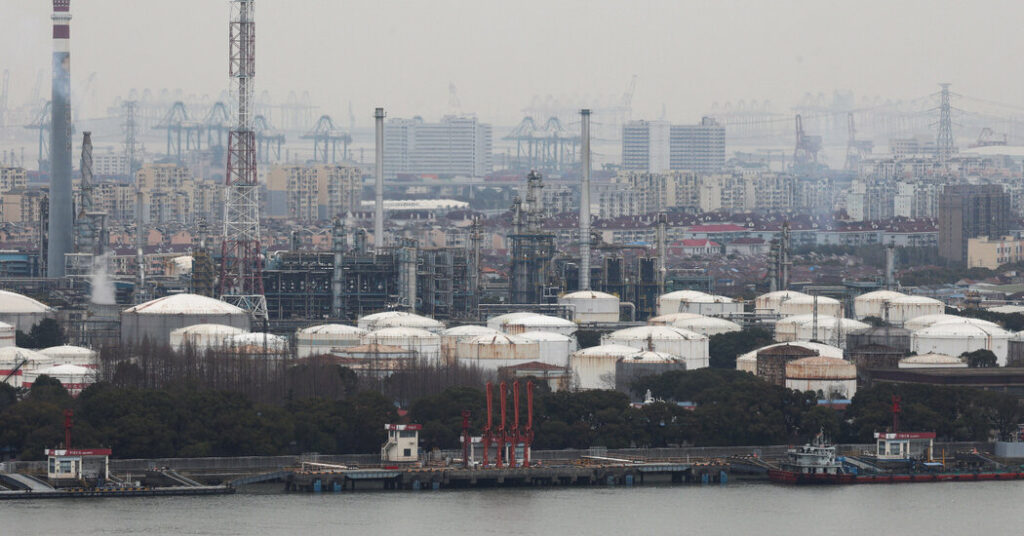
At the turn of the century, officials worried about another narrow passageway through which oil traveled to China: the Strait of Malacca, which separates Indonesia and Malaysia from Singapore. In 2004, China created an emergency petroleum stockpile to address those concerns. In recent months, it has been expeditiously adding to its stockpile.
As China was becoming a factory powerhouse for the world in the late 1990s, it needed foreign chemical companies like DuPont, Shell and BASF to set up plants to supply the chemicals its factories needed. In recent years, Chinese companies have come to dominate much of the world’s chemical supplies. Three-quarters of the world’s polyester and nylon, for example, are made in China.
China is still the world’s largest buyer of oil and gas, and three-quarters of its oil is imported. While Beijing does not disclose the size of its reserves, its crude oil imports increased 4.4 percent in 2025 over the previous year, while its consumption grew 3.6 percent, according to the Chinese government. But after billions of dollars in direct subsidies to electric vehicle makers and hundreds of billions invested in renewable sources of energy, China’s efforts have paid off. Demand for refined oil, gasoline and diesel has fallen two years in a row, prompting experts to forecast that China’s oil and gas consumption has peaked.
At the same time, China’s oil consumption is growing in the petrochemicals industry as it further secures its supply chains.
China’s industry boomed as the government invested heavily, provided cheap loans and encouraged universities to cater to chemical engineering, said Joerg Wuttke, who served as the chief representative in China for BASF, the German chemical company, for 27 years.
These efforts accelerated under Xi Jinping, China’s top leader, and during Mr. Trump’s first presidency.
“Everything that Trump does triggers even more self-reliance from Beijing,” said Mr. Wuttke, who is now a partner at DGA-Albright Stonebridge Group, a consultancy firm.
During his first term, Mr. Trump confronted China on economic and business issues, setting off a trade war and a technology showdown.
Mr. Trump’s confrontational approach to China set off alarms.
Chinese leaders began to send out signals. In 2019, Li Keqiang, the premier at the time, called for China to use coal to make both electricity and chemicals as part of an effort to reduce its dependence on seaborne oil. It was a deviation from China’s focus on eliminating coal.
By late 2020, as the pandemic raged, causing major disruptions to shipping and global trade, and tensions with the United States reached new heights, China put out an official road map, attributed to Mr. Xi, for how to get through the period of turbulence.
Published in Qiushi, the Communist Party’s leading theoretical journal, the text was a call to arms for Chinese industries to hunker down. They were told to develop technologies faster than competitors overseas to achieve self-reliance and insulate China from supply chain disruptions.
“Trump 1.0 was a very clear rupture that changed China’s geopolitical calculus, and it reactivated old fears,” said Lauri Myllyvirta, a co-founder of the Center for Research on Energy and Clean Air, an independent research organization, who has tracked China’s growing use of coal to make petrochemicals.
“Xi himself had spoken about supply chain resiliency,” Mr. Myllyvirta said. “All of this just enabled a petrochemicals boom to gain steam.”
The signals from the top allowed the industry to expand and build plants to use coal instead of oil to make petrochemicals.
In 2020, China used 155 million tons of standard coal equivalent to make chemicals. By 2024, it was using 276 million tons. By 2025, that figure increased another 15 percent, eclipsing the total coal consumption in the United States of 230 million tons.
Chinese officials have said using coal is a temporary bridge to being more reliant on renewables, and they have also invested in technology that uses electricity to make petrochemicals. But using coal as an alternative to oil for now is paying off as shortages of oil and gas have sent prices surging.
Take nitrogen fertilizer. China produces a third of the global supply, and 80 percent of it is made with coal instead of oil. Since the war in the Middle East began, international prices for urea, the main chemical in fertilizer, have surged by over 40 percent, while China’s domestically produced equivalent has stayed at less than half of the global rate.
Even before the American and Israeli militaries started exchanging combat fire with Iran, threatening one of the world’s most important regions for resources that power countries, China had a dominant position, said Johanna Krebs, an analyst at the Mercator Institute of Chinese Studies, a German think tank.
“The Chinese,” she said, “most likely will see this as encouragement on the path to self-sufficiency.”
Alexandra Stevenson is the Shanghai bureau chief for The Times, reporting on China’s economy and society.
The post This Is Not China’s War, but Beijing Started Preparing for It Years Ago appeared first on New York Times.