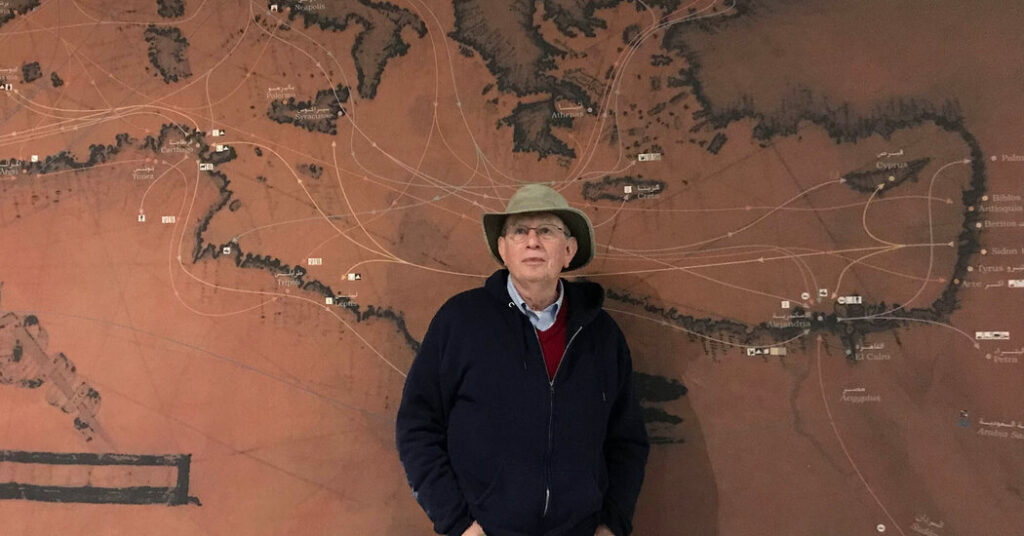
Ronald H. Spector, who was among the first academic historians to grapple with the Vietnam War, and who did so by pioneering a hybrid of military and social history from both the American and the Vietnamese perspectives, died on March 26 at his home in Annandale, Va. He was 83.
His son Jonathan said the cause was cancer.
In 1967, right after he received a doctorate in history from Yale University, Professor Spector also received a draft notice. He joined the Marine Corps and spent more than a year in South Vietnam as a combat historian.
The experience gave him special insights when, over the next decade, he moved into an academic career. Many of the first accounts of the war, which ended in 1975, were journalistic or memoirs, and what few historians’ accounts there were looked at the war strictly from the American side. He took a different tack.
His first book on the Vietnam War, in 1983, “Advice and Support: The Early Years of the U.S. Army in Vietnam, 1941-1960,” blended traditional top-down military history with accounts drawn from low-level figures on both sides of the conflict, a bottom-up method influenced by the trend toward social history popular in other parts of the discipline.
“He was so committed, so passionate about doing military history with the focus on the home front and ordinary soldiers, and not just sort of the great general, great man history that used to dominate the field of military history,” Lien-Hang Nguyen, an associate professor of history at Columbia University, said in an interview.
In that book and in later works, Professor Spector argued that when it came to Vietnam, the top-down approach was especially limited because the United States had entered the conflict in the middle of what was in reality a decades-long anticolonial war.
“One wonders,” he wrote in 2017 in Politico, “how anyone could have believed that a complex and intractable war that began 14 years before President Kennedy came into office and continued for six years after Johnson left it could have been won or lost by presidential decisions in Washington during the four years between 1961 and 1965.”
“But,” he added, “that is what most Americans believed then, and what they continue to believe.”
Perhaps his best-known book was “After Tet: The Bloodiest Year in Vietnam” (1993), a sweeping assessment of the 12 months following the surprise launch of a major offensive by the North Vietnamese during the festival of Tet in 1968.
While covering major battles like Hue and the siege of Khe Sanh, Professor Spector delved into what it was like for soldiers — American, South Vietnamese, guerrillas and North Vietnamese regulars — fighting in them, as well as the political and military decisions made up and down the chain of command.
Whereas previous scholars had focused on the morale and motivation of American soldiers, Professor Spector gave equal weight to their Vietnamese opponents, giving readers a novel look into just how formidable an enemy the United States was up against.
“In 390 pages devoted only to the year after the Tet offensive of 1968,” the journalist Morley Safer wrote in The New York Times Book Review, “Mr. Spector achieves what forests of memoirs and post-mortems of Vietnam have failed to accomplish.”
Professor Spector’s contribution was valuable not only because he was a veteran, but also because he spent a large amount of his later career helping to shape the military’s own account of Vietnam as a leading figure at several Defense Department academic and history centers.
He taught at the National War College and the Army War College, worked at the United States Army Center of Military History and, from 1986 to 1989, served as the first civilian to direct the Navy Department’s Division of Naval History.
In those roles, as well as in his teaching history and international affairs at George Washington University for over three decades, he challenged students and colleagues to look for sources and perspectives outside the American point of view.
“They were asking what did Vietnam do to America,” Gregory A. Daddis, a historian at Texas A&M University, said in an interview. “Historians like Ron began by asking, What did America do to Vietnam?”
Ronald Harvey Spector was born Jan. 17, 1943, in Pittsburgh, the son of David and Ethel (Barsky) Spector. His father was an HVAC contractor, his mother a secretary.
He received a bachelor’s degree in history in 1964 from Johns Hopkins University and a doctorate in the same subject from Yale just three years later, one of the fastest graduate careers in the program’s history.
He married Dianne Frank in 1970. Along with their son Jonathan, she survives him, as do another son, David; a sister, Carol Spector; a brother, Richard; and four grandchildren.
After his service in the Marines, Professor Spector taught at Louisiana State University and the University of Alabama before joining the faculty at George Washington in 1990. He retired in 2020.
His books about World War II also brought him acclaim, including “Eagle Against the Sun: The American War With Japan” (1985), widely considered the best single-volume account of the Pacific Theater during World War II; “In the Ruins of Empire: The Japanese Surrender and the Battle for Postwar Asia” (2007); and, in 2022, “A Continent Erupts: Decolonization, Civil War, and Massacre in Postwar Asia, 1945-1955.” (2022).
The last book was a fitting finale to his life’s work: A wide-ranging account of the collapse of European colonial influence in East Asia following World War II, it drew on sources in English, French, Dutch, Chinese, Vietnamese and Malay, and it demonstrated what the era looked like to those at the pinnacle of leadership and to men and women on the street.
“He was just this great blend of someone who did the high level military history analysis,” Professor Nguyen said, “but with the sensitivities of someone who was a social historian at heart and cared about how everyday people experience these conflicts.”
Clay Risen is a Times reporter on the Obituaries desk.
The post Ronald H. Spector, Who Traced Social History in Books on War, Dies at 83 appeared first on New York Times.