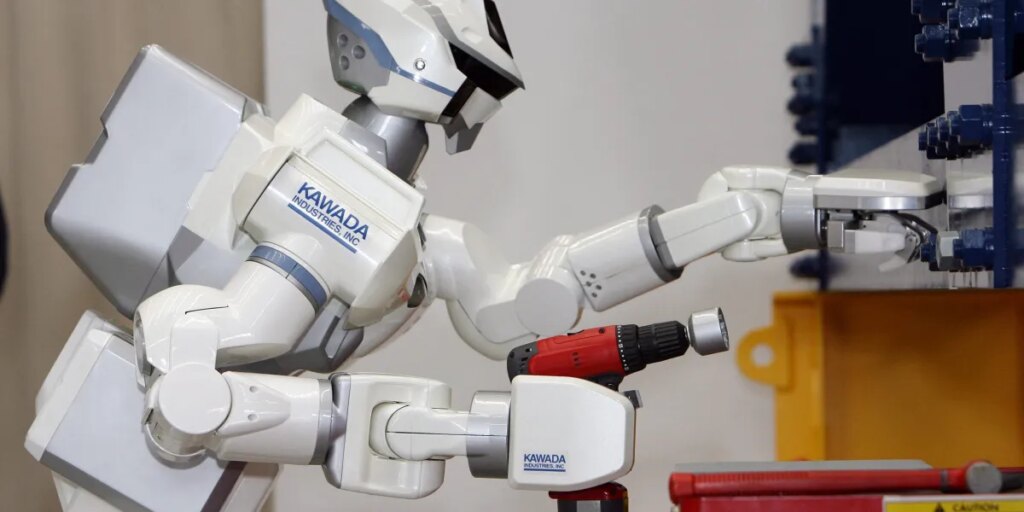
Japan is running out of workers. Its population declined for a 14th straight year in 2024, its working-age population is projected to shrink by nearly 15 million over the next two decades, and a 2024 Reuters/Nikkei survey found that labor shortages are the primary force pushing Japanese firms toward automation and AI adoption.
Last month, the Ministry of Economy, Trade and Industry said it was looking to build a domestic physical AI sector, with hopes of holding 30% of the global market by 2040. The idea is to employ robots in logistics warehouses, on factory floors, and inside data centers—where they’re not taking people’s jobs, but filling the ones no one wants.
Ally Warson, a partner at UP.Partners, a venture firm focused on transportation tech and the physical world, has been telling investors this for years. Japan’s labor shortage is one prime example of where it’s becoming evident.
That’s all the more accentuated in fields where there’s a large demand for labor and few people to fill those roles. For example, Japan is looking to employ robots to take care of its aging population in home health scenarios and in other domestic sectors.
In fact, they’ll become so ubiquitous that a recent Bank of America report predicted people will soon own more humanoid robots than cars by 2060.
“The reality is, no one wants to do these jobs,” Warson told Fortune. For example, “there are something like 600,000 unfilled jobs in the industrial space. No one’s raising their hand and signing up for it.”
Robots are building walls
The UBS Global Entrepreneur Report 2026, which surveyed 215 business leaders with a combined $34.3 billion in revenue, found that 47% of entrepreneurs with industrial businesses see automation and robotics as the biggest commercial opportunity.
The UBS researchers spoke with the head of a Luxembourg construction and property firm who drew a distinction between AI and the physical potential of robotics. “In the construction industry, AI has limited uses. This is a physical business, and AI can’t build a wall. There’ll be robots at some point in time, but not yet,” the firm’s leader told the UBS researchers.
Warson agrees. Although robots are not there yet, she said, there are plenty of jobs where the risk to a person’s life makes it a prime target for robotics automation. In tunnel construction, “you can just have a robot keep boring” instead of possibly sending a manned crew to hazardous conditions. Or something as visible as window-washing: “even hanging someone off the side of a building hundreds of feet in the air to window wash. Why is this still a thing?”
For Warson, the most compelling case for physical AI has never been efficiency or cost-cutting. Rather, it’s keeping people alive.
“I think the economics works the most for jobs where human lives are at risk,” she said. “If you’re talking about replacing a person who’s walking through a construction site at midnight where there are nails sticking out of the ground, or you’re asking someone to go to an offshore oil and gas site because there’s a leak, that’s a million-dollar-plus life insurance claim on top of any sort of lawsuits.”
Preparing for a robotic future ahead
UP.Partners has put real money behind these ideas. The firm backed Noble Machines, a construction robotics company engineered specifically for the chaos of real job sites. The robots are capable of navigating stairs, stabilizing under pressure, and operating in unstructured environments that earlier industrial robots couldn’t handle. It also invested in WakeCap, a hardware-software platform that monitors construction workers, and has seen a 91% drop in safety observations.
“WakeCap is helping humans be safer on construction sites,” Warson said, describing the company’s sensors that are built into hardhats and track real-time activity. “That goes back to insurance. You could even take the lens of: AI is helping humans be safer, in a lot of different provocative ways.”
Combining AI with robotics is the fastest sure-fire way to achieve real, tangible results. This is reiterated by Japan’s $6.3 billion investment in robotics under Prime Minister Sanae Takaichi, according to a report by Franklin Templeton.
According to the economy ministry, the country already controls about 70% of the global industrial robotics market, and the country looks to accomplish even more by its 2040 deadline by adding AI to the mix.
But none of this means the robot apocalypse is imminent. Warson said the underlying infrastructure for physical AI has finally caught up with real-life use cases. Internet-connected sensors are now ubiquitous on job sites. Compute is powerful enough to run sophisticated models at the edge. And AI models are giving machines the ability to generalize across physical environments in ways that would have been unthinkable five years ago. “AI has unlocked the potential for robotics as an asset class,” Warson said.
The post ‘No one’s raising their hand’: Japan’s labor crisis is making the case for robots taking the jobs that you don’t want appeared first on Fortune.