Almost immediately after an immigration agent shot and wounded a Venezuelan immigrant in Minneapolis this winter, the federal government cast the injured man as an attempted murderer and the agent as the victim of a brutal beating.
That version of events began unraveling when prosecutors dropped felony charges against the injured man, Julio C. Sosa-Celis, and one of his housemates, Alfredo A. Aljorna, who had fled from immigration agents.
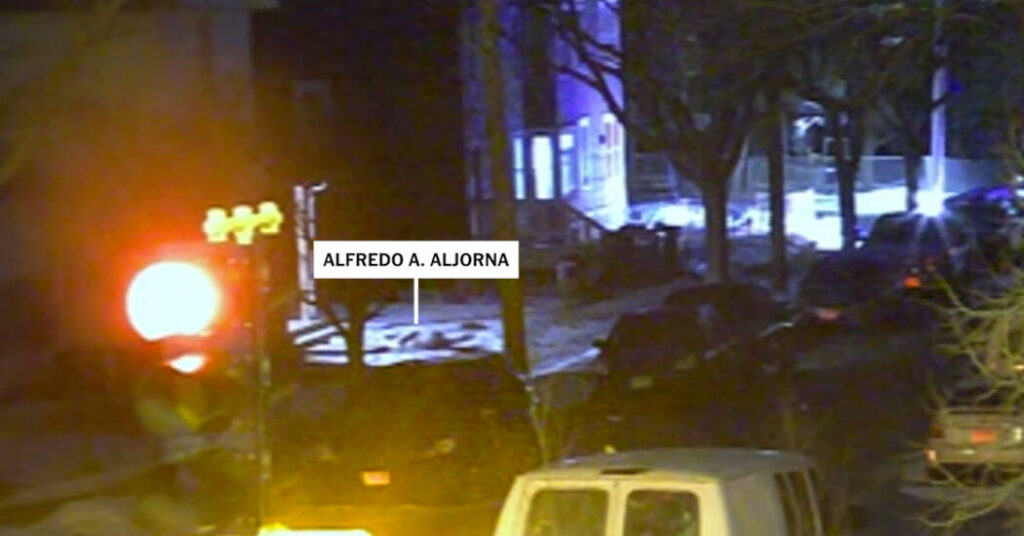
Yet video footage of the shooting, newly obtained by The New York Times, raises questions about why it took weeks for the government’s case to fall apart.
The video contradicts the agent’s claim that three assailants had beaten him with a shovel and broom for roughly three minutes before he opened fire. Instead, the confrontation depicted in the video lasts about 12 seconds and shows two men struggling with the agent. It shows no sustained attack with a shovel.
The federal government had access to that video within hours of the shooting on Jan. 14, the Minneapolis police chief said. Yet prosecutors did not watch the footage, an official said, until nearly three weeks after they filed charges against the two men.
“Bare due diligence would have shown that the agents were lying,” Mayor Jacob Frey of Minneapolis said in a recent interview, shortly after he watched the video for the first time.
The shooting was a rare instance in which U.S. Immigration and Customs Enforcement under the Trump administration ultimately acknowledged a serious lapse. The agency’s acting director, Todd Lyons, said after the charges were dropped that two agents had appeared to have lied under oath about the events, adding that they had been placed on leave and could end up facing criminal charges.
The Department of Homeland Security did not answer written questions about the video, including whether it reviewed the footage before describing the incident publicly. The video, which The Times obtained after filing an open records request, was recorded on a city-owned camera at a nearby intersection.
The shooting of Mr. Sosa-Celis came during the height of the Trump administration’s deployment of thousands of immigration agents to Minnesota.
From December to February, those agents made thousands of arrests, clashed with residents, shot three people and engaged in conduct that alarmed federal judges. The administration said the crackdown was necessary in part because of policies that limit state and local cooperation with immigration enforcement.
In the hours after Mr. Sosa-Celis was shot, protesters responded with fury. Some ransacked the vehicles of federal agents and threw fireworks at officers. The scene became so tense that investigators left before they had finished collecting evidence.
Still, Mr. Sosa-Celis’s case received far less attention than the two other shootings, which left American citizens dead at the hands of federal agents. In those killings, of Renee Good on Jan. 7 and Alex Pretti on Jan. 24, video footage also undermined the federal government’s version of events.
‘They Are Coming’
Valentina Tiapa told a 911 dispatcher that her partner, Mr. Aljorna, was being chased on Interstate 94 by ICE. He had called and said he was trying to make it home.
“They are coming,” Ms. Tiapa told a dispatcher through an interpreter, as she pleaded for the Minneapolis police to intervene. “They are just five minutes away.”
For weeks, as ICE agents swarmed Minnesota, two Venezuelan couples had hunkered down inside a duplex with faded white paint on the North Side of Minneapolis. They kept the blinds drawn, rarely venturing outside in daylight.
The couples, Mr. Aljorna and Ms. Tiapa, and Mr. Sosa-Celis and Indriany Mendoza-Camacho, did not have legal status in the United States.
“I kept thinking, ‘What if they catch us?’” Mr. Sosa-Celis said.
But the $950 rent payment for their shared two-bedroom unit was still due each month, and there was no end in sight to the ICE deployment. So Mr. Aljorna, 26, and Mr. Sosa-Celis, 25, kept going out in the evenings, when it seemed safer, to work as food delivery drivers.
The two men had grown up in the same small town in Venezuela, where they were acquaintances. They came to the United States separately during the Biden administration and made their way to Minnesota.
In Minneapolis, the two men reconnected and started dating their partners. Ms. Tiapa and Ms. Mendoza-Camacho, both 19, were also from Venezuela and said they had crossed the border as minors during the Biden years. Ms. Mendoza-Camacho came to the United States with an infant from a prior relationship. Ms. Tiapa gave birth to a boy in the United States in the summer of 2024.
It was a modest existence, bouncing between jobs and struggling to pay debts. Yet it was an improvement, they said, over what they had fled. When Mr. Aljorna and Mr. Sosa-Celis were granted temporary protected status in 2024, they found a measure of stability with the ability to work legally.
But Mr. Trump’s administration revoked that status for Venezuelans last year, and the couples’ future in the United States felt more tenuous once again.
“Trump had said he was going to launch the biggest deportation crackdown in history, and we were left thinking we needed to hide,” Mr. Sosa-Celis said.
Around dinnertime on Jan. 14, two ICE agents were checking license plate numbers when they ran the tag on the Ford Focus that Mr. Aljorna was driving. The agents found that it was registered to another man, who they believed was in the country illegally.
The agents described being led on a chase for 15 to 20 minutes, saying that Mr. Aljorna “recklessly zigzagged through traffic.” Inside the Ford, Mr. Aljorna had called Ms. Tiapa, telling her that the agents appeared to be trying to provoke a collision.
Minutes later, Mr. Aljorna steered the Ford into a snowbank at the end of the block and took off running toward the duplex, the video obtained by The Times shows.
Mr. Sosa-Celis, who had been standing outside the home holding a snow shovel, tossed the shovel aside, the video shows. An ICE agent is seen chasing Mr. Aljorna on foot.
The video was taken from about half a block away from Mr. Aljorna’s duplex, and it shows a view of the street. That video footage, filmed by a city security camera mounted on a traffic signal pole, was recorded shortly before 7 p.m. Some of what it shows is hard to make out.
Mr. Aljorna was a few feet from his front door, the video shows, when he slipped and fell, giving the agent time to catch up with him.
After Mr. Aljorna landed on the ground, a struggle took place near his front porch. The silhouettes of all three men can be seen in the scrum, though it is difficult to discern exactly what each of them did.
The struggle lasted for about 12 seconds, the footage shows. The second agent who had been involved in the car chase pulled up to the duplex moments after the physical confrontation ended.
Key points remain unclear from the video. After Mr. Sosa-Celis and Mr. Aljorna are no longer visible in the video, a long, thin shape can be seen at one point, swinging from the direction of the porch; it is not clear from the video what the object is or whether it hit the agent. At another point, the agent is seen standing with his arms extended toward the duplex and his feet squared in an apparent firing posture. But the video has no audio, and it is uncertain exactly when the agent fired a single shot, striking Mr. Sosa-Celis in the leg.
The footage conflicts in several ways with the encounter initially described by federal officials, who said the ICE agent fired his weapon after three residents attacked him with a shovel and broom for several minutes.
A shovel was tossed aside before the struggle began, and only Mr. Aljorna and Mr. Sosa-Celis could be seen in the video, along with the agent.
In a court filing, a lawyer for Mr. Aljorna said that his client had thrown a broom in the direction of the ICE agent, but that the broom did not strike the agent. Lawyers for the two men said that the agent had beaten Mr. Aljorna, and that Mr. Sosa-Celis was shot through the closed front door just after he went inside.
The bullet that hit Mr. Sosa-Celis’s upper leg ended up lodged inside the house, near a playpen used by a child in the downstairs unit, according to court records and photos shared with The Times. The bullet also left a hole in the front door. Mr. Sosa-Celis was not seriously hurt.
Just after the shooting that night, ICE officials used tear gas to force the couples to leave the house. The adults were taken into custody. The two children went to stay with family members.
A Troubled Investigation
Mr. Aljorna and Mr. Sosa-Celis were described in a federal news release as “violent criminal illegal aliens.” They were accused by Kristi Noem, the former secretary of homeland security, of committing “an attempted murder of federal law enforcement.” And, just two days after the shooting, Mr. Aljorna and Mr. Sosa-Celis were charged in a criminal complaint with assaulting or impeding an officer, a felony punishable by up to eight years in prison.
Minneapolis was a tinderbox in those days, and federal prosecutors felt urgency to file charges and provide a speedy public account of the shooting, according to a Justice Department official who spoke on the condition of anonymity to describe internal deliberations.
But prosecutors did not watch the video before they filed those charges, the official said, instead relying on the ICE agent’s statement and an F.B.I. agent’s affidavit describing the footage.
Almost three weeks would pass before a prosecutor would watch the video of the encounter, the Justice Department official said. The U.S. attorney’s office moved to dismiss the case days before a deadline to secure a grand jury indictment. When the top federal prosecutor in Minnesota asked to dismiss the case, he alluded to the footage and called it “newly discovered evidence.”
As the federal prosecution of Mr. Aljorna and Mr. Sosa-Celis was coming together, state investigators were also examining whether the ICE agent acted lawfully when he opened fire. But the Minnesota investigators were stymied by limited federal cooperation, including an unwillingness to provide information as basic as the agent’s name.
Law enforcement officers are allowed to use deadly force if they reasonably perceive an imminent threat of death or great bodily harm to themselves or someone else.
Officials with the F.B.I.’s Minneapolis office declined to speak in detail about the shooting, but said in a statement that agents are trained to provide truthful information to judges and to “immediately provide exculpatory information to prosecutors once identified.”
Chief Brian O’Hara of the Minneapolis police said the footage cast significant doubt on the federal government’s accounts.
“There is a snow shovel there, but it doesn’t appear it ever gets used as a weapon,” he said. “There is no bludgeoning or anything.”
After reviewing the video and other evidence, Chief O’Hara said that “it sounds like an unarmed person got shot running away.”
‘Trading One Hell for Another’
For weeks after the shooting, Mr. Aljorna and Mr. Sosa-Celis remained in jail in Minnesota. Their partners were sent to an immigration detention center outside El Paso, where they described crying through sleepless nights in a tent as rainwater seeped through.
While she was detained, Ms. Tiapa learned that her son, who was being cared for by relatives, had suffered second- and third-degree burns from scalding soup in an accident back in Minnesota. He needed surgery.
All four adults sought their release from detention and were eventually ordered by judges to be returned home to Minneapolis while they fight the government’s efforts to deport them.
In a recent interview at the duplex, Mr. Aljorna expressed complicated views about swapping what he left in Venezuela — “there’s no food, no earnings, the power gets cut, water gets cut” — for what he experienced in the United States.
“It was like trading one hell for another,” he said.
Still, he and the others hope to remain. They still think they can build more prosperous lives in the United States.
In 2000, Congress created a visa category for victims of crime who are in the country unlawfully if they assist law enforcement officials. The aim was to lower crime by encouraging victims to cooperate with the authorities without fearing deportation.
The lawyers representing Mr. Aljorna, who has been ordered deported by an immigration judge, and Mr. Sosa-Celis say they hope their clients and their partners will be eligible based on their cooperation now with state and federal investigations into the conduct of the ICE agents. So far, no charges have been filed against the agents.
Because the names of the agents have not been released, it was not possible to seek comment from them.
“It would be a once-in-a-lifetime opportunity,” Mr. Aljorna said of the possibility of a visa.
If he gets legal status, Mr. Sosa-Celis said, he imagines one day running a painting business. Mr. Aljorna, who has a knack for fixing cars, would like to own a body shop. The women said they could see themselves opening a salon.
Ainara Tiefenthäler and Thomas Gibbons-Neff contributed reporting, and Ainara Tiefenthäler and Alexander Cardia contributed video editing.
Ernesto Londoño is a Times reporter based in Minnesota, covering news in the Midwest and drug use and counternarcotics policy. He welcomes tips and can be reached at elondono.81 on Signal.
The post Newly Obtained Video of Minneapolis Shooting Undermines ICE Account appeared first on New York Times.