When the astronaut Reid Wiseman learned that he would be commanding NASA’s Artemis II mission around the moon, his immediate reaction was not excitement.
“It was pretty heavy,” Mr. Wiseman said on NASA’s Curious Universe podcast. In part, that is because he is the sole parent of two daughters.
“It was not like you just won the lottery and you’re running out and jumping for joy,” he said. “It was not that feeling at all.”
Venturing into space has always been dangerous. But the risk of Artemis II is even higher. The test flight is the first time humans have gone to the moon in more than half a century, and the mission is using a vehicle that had never before carried astronauts to space.
The toll of such risk is felt not only by the astronauts, but also by their loved ones — long before liftoff occurs.
“The launch is a capstone stress event,” said James Picano, a psychologist at NASA’s Johnson Space Center in Houston who works to support the families of Artemis II. But “there’s an incredible amount of stress on a family before the launch even happens.”
For them, he added, “the mission begins at assignment.”
NASA selected the Artemis II crew in 2023, nearly three years before the mission launched on Wednesday.
Astronaut training is rigorous and time-consuming, even for more routine trips to the International Space Station. The strain of long stretches of time away from spouses and children is amplified by intense schedules and the ambiguity of ever-shifting timelines.
Dr. Catherine Hansen, who is married to Jeremy Hansen, Artemis II mission specialist of the Canadian Space Agency, described the stress of juggling various briefings and contingency planning before the moon launch.
“It is all-consuming for our whole family,” she wrote in a Facebook post. (The Hansens have two daughters and a son.) Planning was made even more difficult by needing to prepare for the worst-case scenario, she added, “conversations that no family of a moon-bound astronaut ever wants to have, but absolutely must.”
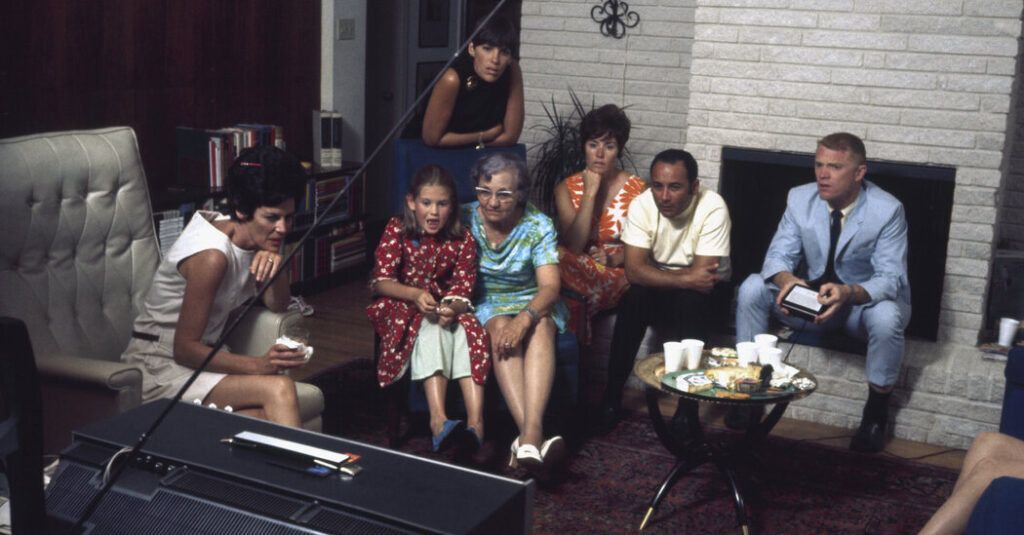
When NASA first began sending astronauts to space in the 1960s, little formal support was available to wives and children.
Tracy L. Scott, a sociologist at Emory University who researches the lives of astronaut families, described the space agency at the time as “much more like a start-up” — small, informal and casual.
“Everybody knew each other,” said Dr. Scott, whose father, Commander David Scott, flew in the agency’s Gemini and Apollo programs.
In the tightknit communities around NASA’s astronaut training facility in Houston, the families forged their own bonds of support.
Astronauts of previous missions would visit the homes of crew members in space to walk them through what was happening. Some of the women, drawn together by the shared experience of raising children while married to absentee husbands in dangerous careers, formed the Astronaut Wives Club (the subject of a book and TV series).
Families were thrust into the public eye, as reporters set up shop on their lawns and even inside homes. NASA provided no media training, though many of the wives live in the spotlight.
According to Dr. Scott, more formal psychological, medical and financial resources for astronaut families began to appear after the 1967 Apollo 1 disaster, in which three crew lost their lives.
“But this was being developed kind of by the seat of the pants at the time,” she said.
As NASA grew, the culture shifted to less personal and more bureaucratic, and astronaut families fell out of public view. The Astronaut Wives Club morphed into an organization known as the Astronaut Spouses Group, which interfaces with NASA’s Astronaut Family Support Office and its Behavioral Health and Performance Operations group.
“Family needs and family support have come into full relief,” Dr. Picano said, adding that the resources were essential for the success of missions, allowing the onboard crew to fully concentrate on tasks in space.
Dr. Picano has worked with Anna Morgenthaler, a NASA psychologist, to offer counseling, routine check-ins and other services for the families of astronauts headed toward the International Space Station.
But the group has had to rethink support strategies for the Artemis program, which plans to establish a sustained presence on the moon and send astronauts to Mars. Deep space exploration will come with new challenges for families.
One big issue will be communication.
On the International Space Station, astronauts can stay in touch with people on Earth via email, phone and video calls. Artemis crews, on the other hand, will have less opportunity to connect with their loved ones. Communications with astronauts on the moon face a brief time delay. The families of the Artemis II crew members were trained on what to expect and on how to navigate around these delays.
There will also be a brief period of time on Monday for this mission when no one — not even mission control — will be able to talk with the astronauts, as they sojourn behind the moon.
“You can imagine some of the complex emotions you might feel as a family member,” Dr. Morgenthaler said. “You’re excited, you’re proud of them, but also there’s some anxiety and some fear about potential risks.”
Two weeks before the launch, the astronauts entered quarantine in Houston with their families. The crew traveled separately from their loved ones to John F. Kennedy Space Center in Florida five days before liftoff.
“This endgame time is probably the most precious time you can have,” Mr. Wiseman said in an interview in January from quarantine in Houston before a postponed launch attempt. “You get a moment to think about what’s truly valuable in your life.”
On Wednesday afternoon, the astronauts, wearing bright orange spacesuits, lined up across from their loved ones to share final goodbyes. Victor Glover, the Artemis II pilot, blew kisses to his wife and four daughters. Mission specialist Christina Koch curled her fingers in the shape of a heart toward her husband.
Then the crew loaded into a van that drove them to the launchpad, got strapped to their seats in a spacecraft atop NASA’s giant rocket and blasted off toward space.
The astronauts did not get a chance to speak with their families until the third and fourth days of the mission. In a video call with NBC News, Mr. Wiseman described speaking with his daughters as “surreal,” as he and the rest of the crew sped toward the moon.
“For a moment, I was reunited with my little family,” he said. “It was the greatest moment of my entire life.”
Timothy Bella contributed reporting.
Katrina Miller is a science reporter for The Times based in Chicago. She earned a Ph.D. in physics from the University of Chicago.
The post NASA Families Don’t Go to the Moon, but They’re on the Mission, Too appeared first on New York Times.