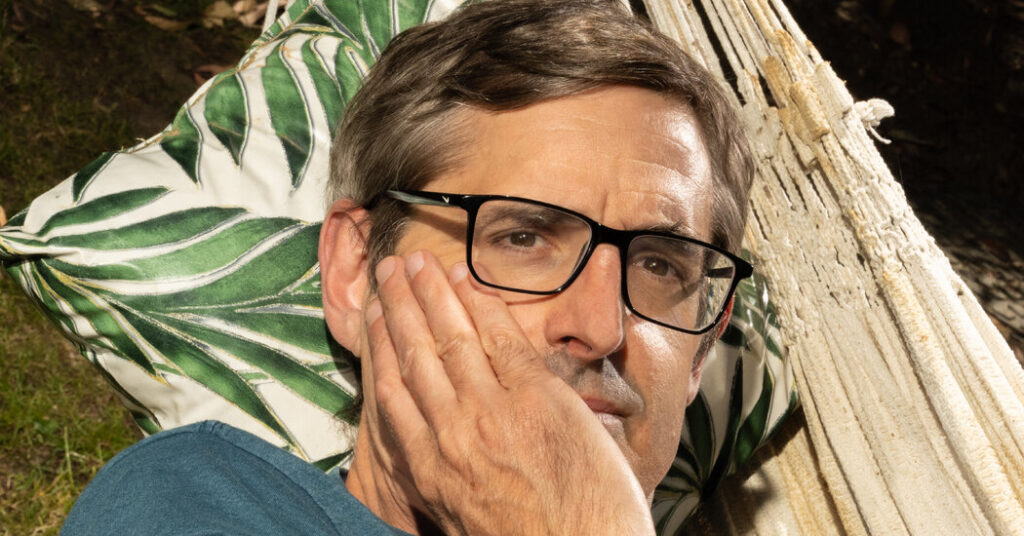
It was at home during the pandemic that the filmmaker Louis Theroux first heard of Andrew Tate, the kickboxer turned social media influencer. Mr. Theroux’s young sons were quoting Mr. Tate’s videos.
“They found it amusingly outrageous and cheeky,” Mr. Theroux said.
Mr. Tate, who has been accused of rape and human trafficking, was rising to prominence in the manosphere, the nebulous online ecosystem made up of men talking to other men — about sports and fitness as well as about incel culture, “looksmaxxing” and the “red pill” mind-set. (Mr. Tate has denied all criminal wrongdoing.)
Mr. Theroux wanted to understand what motivated these men, as he had sought to do with his previous subjects, who have included neo-Nazis, members of the Westboro Baptist Church and Israeli settlers in the West Bank.
By the time Mr. Theroux released his Netflix documentary “Inside the Manosphere” last month, much had been discussed about the subculture. Politicians had harnessed its influence; authors had written books on it.
But as he draws out the manosphere figures at the center of his film — Harrison Sullivan, the 24-year-old who goes by HSTikkyTokky; Amrou Fudl, the 36-year-old podcaster known as Myron Gaines; Nicolas Kenn De Balinthazy, better known as Sneako, who is 27; the entrepreneur-influencer Justin Waller, 40; and the 20-something streamer Ed Matthews — the documentarian shows viewers a world they may have imagined only online.
Mr. Theroux, a lanky 55-year-old usually onscreen in a T-shirt and jeans, follows the men around as they go about their days, huge parts of which are spent shooting content designed to go viral. He is both discreet, at times letting the action play out, and persistent, pressing his subjects for answers. In doing so, he exposes the subjects’ cynical, market-minded drive, seemingly more forceful than ideology.
Talking to The New York Times on a recent morning, Mr. Theroux discussed his interview style, sharing how he maneuvered past the influencers’ skepticism of the mainstream media and what surprised him most.
This conversation, which has been edited for length and clarity, took place over video call Mr. Theroux answered from his home in London.
Once you get past their initial suspicion, a lot of these guys become a bit more comfortable having you around. Some people have said that you’re giving them the rope to hang themselves. I’m not trying to hang anyone, metaphorically or otherwise. I think I’m trying to get to the truth, or some kind of truth. I am trying to create a space that feels safe enough for them to express themselves unguardedly, candidly, or at least perform themselves in a way that is revealing. And then I’m also trying to, at judicious moments, challenge, maybe provoke a little bit.
Something I learned from Michael Moore is that you arrive, you film the first thing when they answer the door, and more or less keep going until you get some sense of the truth coming out. You don’t use lights, you don’t say, “OK, we’re going to start in about five minutes.” But the other part is this slightly more ersatz documentary approach, in which I am kind of messing around with things. I am an interventionist, I’m a participant, I’m trying to drive the action.
When do you choose to push back?
It’s not a science. It may not even be an art. I’m trying to get my questions answered, but I’m also trying to be a pleasant enough presence in the room that the door is open should I need to come back. There’s always this awkward line you walk between wanting to be appropriately challenging but also not burn the bridge.
But if they also say, “And I think the world is run by a satanic cabal and they probably sacrifice babies, right?” — then it’s like, OK, now we’ve got something demonstrably bonkers and dangerous to believe. It bothers me when people say the earth is flat or we haven’t been to the moon. Which you could say, Well, there’s nothing toxic about that. But I think that’s the beginning of the unraveling of your rational process.
Did you see any parallels between the manosphere and other subjects you’ve covered?
Wrestling and gangster rap are two worlds in which feuds are a big part of what drives engagement. And that soap opera of internet influencers is very appealing, just in terms of storytelling, real-life, semi-self-curated, self-fictionalized characters with their own platforms, calling each other out, abusing one another, defining what they’re railing against, just creating a sense of being embattled and then warring against one another.
There’s a moment when one of the influencers conducts a “pred sting” — basically entrapping someone the person perceives to be a predator — and livestreams he and his friends assaulting a man. It seemed as if you had a more averse reaction seeing the online world almost manifest than you did when hearing him just talk.
With documentary making, there’s always a risk that your presence ends up catalyzing the events in some way. It can either minimize, it can have a restraining effect or it can have a kind of catalytic effect on people performing or doing more extreme things. So we just had to move away. It was an upsetting thing to be in the vicinity of.
It’s perhaps the only thing in the film I feel a bit regretful of having to tone down. I slightly wish we could have shown more of that. I don’t think that the assault really even illustrates the beliefs leading to that behavior. It’s more the necessity of keeping the audience engaged.
For the livestreamers especially, what they make is based on how many people are watching at any particular time. Mostly they’re on a platform called Kick. And so they can see that they have 5,000, 6,000, but if they go and do a pred sting, maybe they’ll get a couple more thousand — more money, more exposure, more content’s going to get clipped up from that and go even more viral.
There’s a moment when you speak to Angie, who was then-girlfriend of the podcaster known as Myron Gaines. Things get a bit awkward when you press him on what he calls “one-sided monogamy.” She clearly isn’t comfortable with it, though he says she is.
These guys are promoting a set of values on their streams that they don’t necessarily even live out off stream. They will be saying one thing about “I order my girlfriend around and she does everything I say,” and then we’ll meet the girlfriends and you’ll see that they’ll have to negotiate their relationships much like everyone else does. It isn’t really sustainable when you’re dealing with a real-life human. Compromises get made, and so much of the self-presentation that takes place on stream is a kind of fiction, and we will be able to disrupt that.
So when Angie comes on as Myron’s girlfriend — people have to be who they really are when they’re with their loved ones. Going back years, whenever I’ve had a difficult contributor, someone who I just can’t get through to who they are, it’s actually a tactic I use. That sounds a little bit instrumental, you know, cold. But truthfully, if you have someone who is endlessly “on” and just talking a lot, you put them in a domestic setting, and it’s usually their wife, because often it’s a guy, and then you sort of see who they really are, and everything comes into focus.
What surprised you most?
One surprise was the extent to which it genuinely is predicated on sales, and as much as we’re used to talking about the manosphere as a kind of problem of indoctrination, at its heart it’s really a sales rift reminiscent in a way of of self-help seminars led by people like Marshall Sylver, and pickup artists like Ross Jeffries. And this is the same set of practices and beliefs, but repackaged for the social media era.
The other part of it is the young-ness of the people who are consuming the content. These are 8-, 9-, 10-year-olds. The upper limit is more like 20. We call it the manosphere, but it could more accurately be described as the boyosphere.
Stefano Montali is a news assistant at The Times who contributes reporting across various sections.
The post Is There Anything Left to Learn About the Manosphere? appeared first on New York Times.