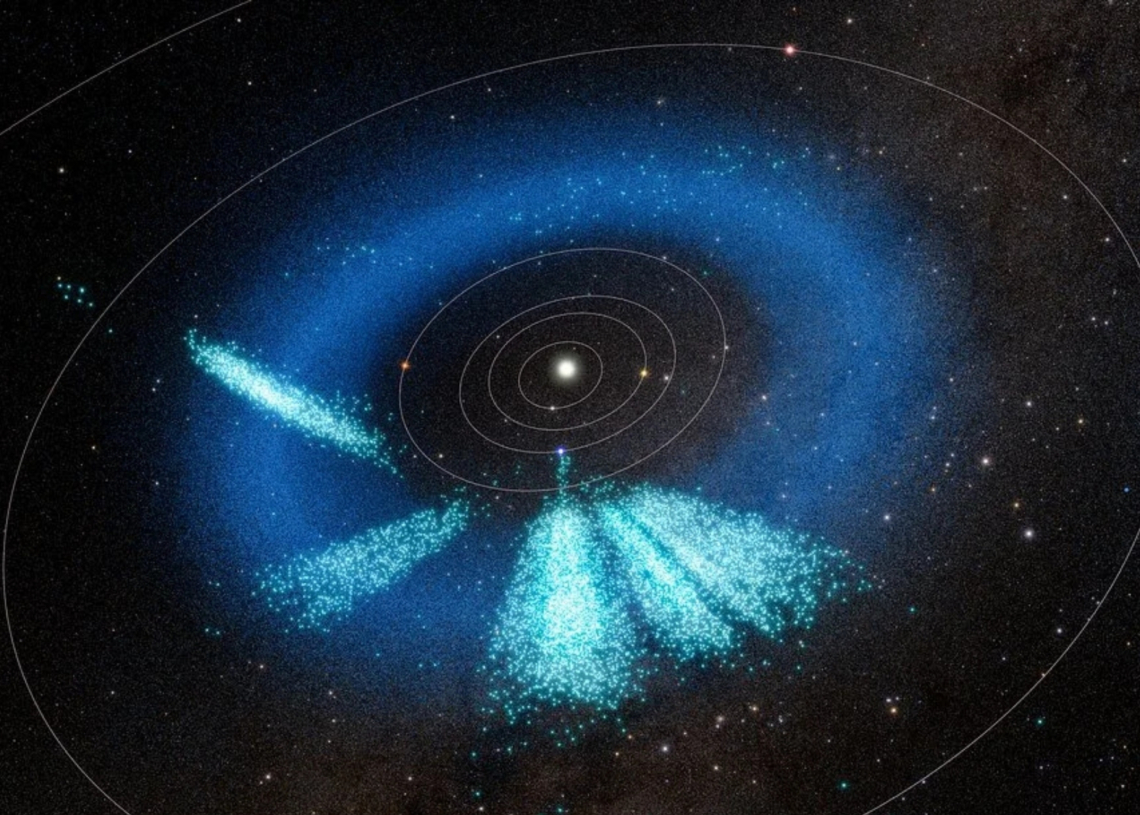
The Vera C. Rubin Observatory hasn’t been around for long, yet its contributions to space science have been immeasurable, many of which we’ve covered right here on VICE. In less than a year of operation, it’s made a series of incredible discoveries and recently added another one to the list. Tens of thousands of discoveries, to be exact.
As announced in a press release published on the observatory’s website, Rubin researchers have identified more than 11,000 new asteroids in a single submission to the International Astronomical Union Minor Planet Center. That’s the largest batch reported in the past year. Alongside those were over 80,000 previously known asteroids, including objects that had effectively gone missing because their orbits couldn’t be tracked.
To be clear, this is an absolutely massive discovery of space objects, and it’s all thanks to Rubin’s combination of a massive mirror. That basically makes it the largest digital camera ever built. Scientists are pairing that with software designed to sift through millions of moving points of light without being overloaded with data.
Highly Advanced Space Observatory Finds Thousands of New Asteroids
Among the discoveries are 33 new near-Earth objects, aka asteroids, whose orbits bring them relatively close to our planet. None of them poses a threat, but they do pose an interesting, if a bit unnerving, prospect: if it took constructing one of the most highly advanced space telescopes human beings ever put together just to see these things, what else is lurking out there that we never noticed, and how many of these have nearly missed us before now?
Scientists estimate that only 40 percent of potentially hazardous mid-sized objects have been identified. Rubin is expected to close that gap tremendously, with projections of up to 90,000 additional near-Earth discoveries once it ramps up into full operation.
The Observatory is also mapping the edges of the solar system. In less than two months, it’s already identified roughly 380 trans-Neptunian objects, which are the icy space things hanging out beyond Neptune. For context, humanity has collectively found 5,000 trans-Newtonian objects over the last 30 years. Rubin found 380 of them in less than a year.
Again, Rubin isn’t even fully online yet. When it is, this scale and bounty of discovery are going to become so routine that research teams are likely to become overwhelmed by the number of objects to study, as it brings us a clearer, extremely vivid picture of what is going on above our heads.
The post How Scientists Found Thousands of Asteroids Hiding in Plain Sight appeared first on VICE.