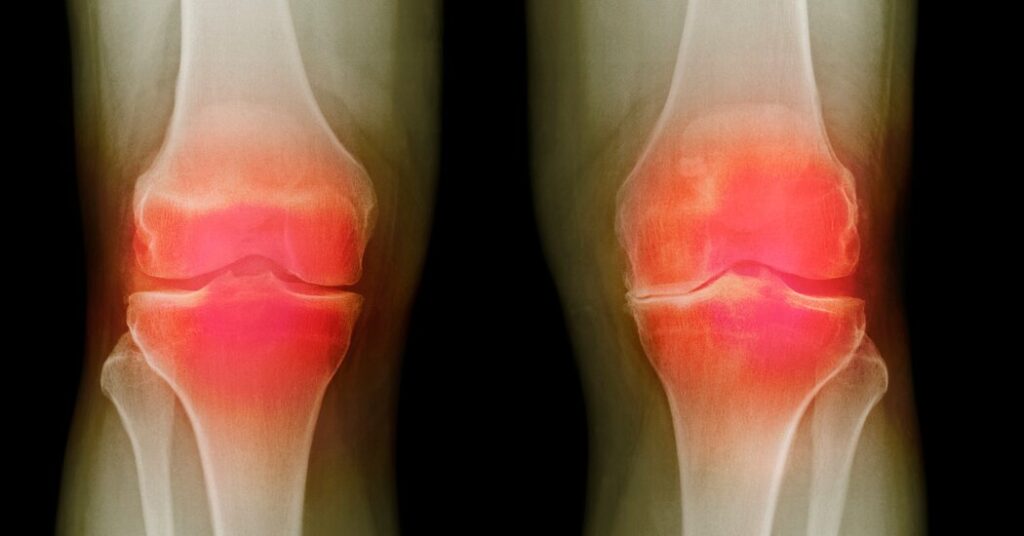
Three years ago, a little-known new federal agency announced its first big project: It would invest tens of millions of dollars over five years to find a cure for osteoarthritis, the painful wearing away of joints that affects 32 million Americans.
Now the agency, ARPA-H (the Advanced Research Projects Agency for Health), says it has several promising solutions. Its research teams are contractually obligated to start testing in patients within 18 months.
The new research focuses on knee osteoarthritis, but the investigators believe the solutions could eventually be applied to osteoarthritis in any joint.
Two research teams, at Duke University and at the University of Colorado, Boulder, have developed injections or infusions that regrow bone and cartilage, ARPA-H announced on Monday.
And a third team, at Columbia University, may have discovered a way to regrow an entire knee.
The methods so far have been tested only in animals. But experts said they were encouraged by the findings.
“It’s hugely promising,” said Dr. Scott Rodeo, vice chair of orthopedic research at the Hospital for Special Surgery in New York, who was not associated with the studies.
“Right now, everything we have just modifies symptoms,” he added. Curing arthritis by regrowing cartilage and bone “would be a paradigm shift.”
Finding a new approach is the point, said Dr. Ross Uhrich, program manager for the arthritis project at ARPA-H. “If your goal is just to publish a journal article, this is not the agency for you,” he said.
ARPA-H is part of the Department of Health and Human Services. It is modeled on a similar program at the Defense Department, DARPA (the Defense Advanced Research Projects Agency), which helped develop the internet, GPS and autonomous drones, among many other technologies.
At ARPA-H, the scientists who applied for the arthritis funding, chosen from a range of companies, labs and teams, agree to solve the problem in preclinical and clinical studies. If their treatments are successful in humans, they must commercialize them.
The investigators also must agree that their arthritis products will be tested in the groups most likely to need it, meaning that more than half of the clinical-trial participants must be women and the trials must include Native Americans and Alaska Natives.
If a treatment is approved for marketing, it must cost no more than 25 percent of the price of the current standard of care.
Columbia University’s team leaders, the biomedical engineers Clark Hung and Nadeen Chahine, say they’ve found a way to regrow a knee using an artificial joint made of a 3-D printed “scaffolding” filled with bone and cartilage cells.
Those cells grow into healthy bone and cartilage while the scaffold slowly dissolves over about a year. The treatment is meant for so-called bone-on-bone patients who have lost all or nearly all the cartilage in their knees.
The cells that fill the scaffold can be derived from the patient’s abdominal fat or banked donor cells. If the cells are taken from abdominal fat, the investigators isolate stem cells and then use biological modifiers to direct them to morph into cartilage and bone cells — a process that takes a month.
Donated banked cells, on the other hand, don’t have to change into bone and cartilage cells, Dr. Chahine said. In the scientists’ experiments, these cells did not provoke an immune reaction despite their origins.
To see if the scaffold would act like a real knee, weight-bearing and flexible, surgeons implanted their experimental knees in cadavers and used robotics to test the joints’ suitability for walking.
The next step is to test the system in large animals, Dr. Chahine said. Their five-year ARPA-H contract supplied the team with a bit more than $42 million. “For academic research, this is like pie-in-the-sky money,” she added.
A federal grant is typically a little more than half-a-million dollars. But with a grant, no one is expected to take their work from theory all the way to marketing approval.
At Duke, Dr. Benjamin Alman, an orthopedic surgeon, said the team’s idea was to ask if they could get a patient’s cartilage cells to regrow.
At the very end stage of osteoarthritis, there are none left. But a vast majority of osteoarthritis patients have some cartilage cells in their knees. Could they make the cells start dividing and repopulating the knee with healthy cartilage?
In osteoarthritis, bone gets thicker, changing the mechanics of the joint. Could they remodel bone to make the knee normal?
The researchers tried a variety of medicines alone and in combination, and they ended up with three treatments.
One, an injection, makes cartilage cells grow. Another shot remodels bone. The third, an infusion that can treat several arthritic joints at once, also makes cartilage grow.
“The idea would be, if a patient’s problem is mostly in cartilage, we would target cartilage,” Dr. Alman said. “If it is mostly bone, we would target bone.”
The treatments have worked in rats and mice. “I tend to be very skeptical, but this surprised me,” Dr. Alman said.
Stephanie Bryant, a chemical and biological engineer who heads the team at the University of Colorado, Boulder, said her goal was “to return the tissue to a healthy state,” with at most one injection.
The group found a drug, a repurposed medicine already on the market, that worked in animals and developed a formulation that releases it in bursts over months. The drug, she said, “resides long-term in the joint.”
Their tests included rabbits that got the equivalent of an A.C.L. tear in humans. Like humans, they quickly developed osteoarthritis. Within two months after the injection, their knees had regenerated.
The other animal model was a guinea pig that develops the sort of degenerative arthritis that often happens as people age. Once again, the treatment seemed completely effective for the knees.
But what about people with advanced bone-on-bone arthritis? The Colorado group has developed a mixture of engineered proteins that are injected into the joint and fill in the space where cartilage should be.
Those proteins recruit so-called progenitor cells from the underlying bone and induce them to regrow. Among the group’s rabbits, it took just three months before all the injected material was gone. What was left was healthy cartilage.
The team, Dr. Bryant said, was overjoyed. “You do all of this work, have all these hypotheses, but you never know if it will work,” she said.
“Very few of us get the opportunity to really push forward things we are working on,” she added. “This is an opportunity to really help patients.”
Gina Kolata reports on diseases and treatments, how treatments are discovered and tested, and how they affect people.
The post Federal Agency Unveils Three Potential Osteoarthritis Treatments appeared first on New York Times.