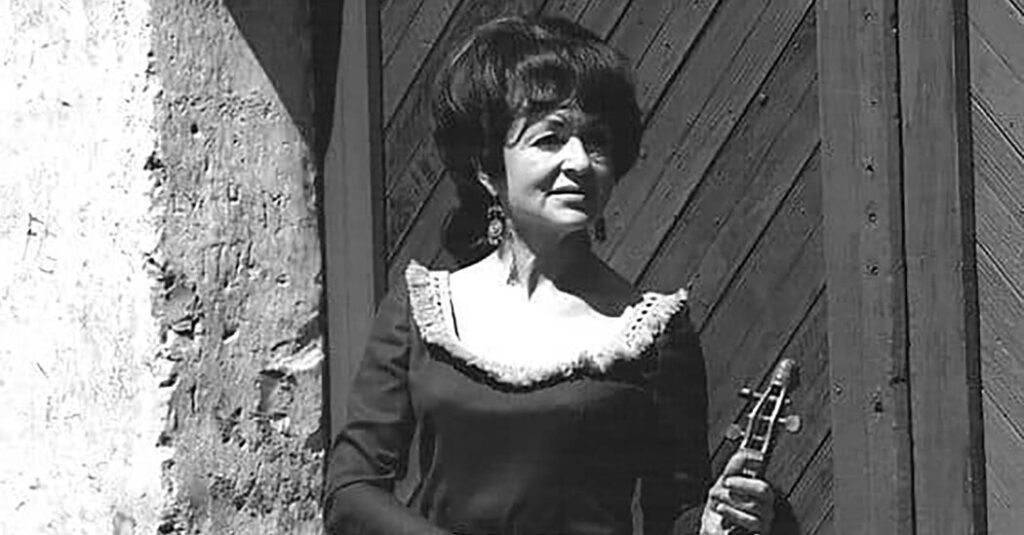
Elisabeth Waldo, a musician and composer who used pre-Columbian instruments in Western-style scores that sought to evoke the atmosphere of Latin America, died on March 16 at her home in Northridge, Calif. She was 107.
Her death was confirmed by her niece, Lucy V. Lee.
Ms. Waldo began her musical life in the 1930s at a sharply different end of the spectrum. She was a classically-trained violinist who had been endorsed by the eminent Jascha Heifetz and studied with the Russian-born virtuoso Efrem Zimbalist at the Curtis Institute of Music in Philadelphia.
But her travels through Latin America in the 1940s, and especially a stay in Mexico, radically reoriented her sound world. “I just couldn’t sit and play only Bach,” she told The Los Angeles Times in 1994.
Through albums in the late 1950s and ’60s with titles like “Rites of the Pagan,” “Realm of the Incas” and “Maracatu,” Ms. Waldo (and an ensemble she created) fused her fascination with bone flutes, conch shell trumpets and Indigenous percussion with her training in Western-influenced harmonies, creating an atmospheric canopy of lush sounds that some likened to the Polynesia-themed easy-listening “exotica” genre that was popular in the ’50s.
Ms. Waldo rejected that comparison, contrasting exotica’s commercialism with her devotion to the authentic instruments of Latin America.
“They wanted me to be like them because they were big sellers,” she said of the exotica purveyors, “but I said, ‘No, to me it’s not authentic, it’s very pop-oriented,’” she told the musician Gabriel Reyes-Whittaker in an interview included in the 2017 book “The Tide Was Always High: The Music of Latin America in Los Angeles,” a compilation of essays edited by Josh Kun.
She added: “I don’t like the synthesized flutes because I’m so used to the real concert flute or these Aztec flutes that are over a thousand years old — they have such a beauty and I think that’s the best.”
Traditional instruments like those pipe through the choruses in albums like “Realm of the Incas,” from 1961, to create a sumptuous movie-music-like effect.
The verdicts from critics were mixed.
“Similar to other exotica albums released at the time, Waldo’s compositions are enjoyable, if rather kitschy fantasies,” Nicholas E. Limansky wrote in his 2008 biography of the Peruvian singer Yma Sumac, with whom Ms. Waldo toured as a violinist in the 1950s.
Earlier in Ms. Waldo’s career, critics in a less multicultural age were mostly intrigued by her experiments. “There are no visible savages, but their spirits certainly have been reincarnated in one way, at least, into this modern world of 1960,” a critic for The Los Angeles Times wrote that year of Ms. Waldo’s efforts.
Three decades later, reactions were sharper. Lewis Segal, also in The Los Angeles Times, wrote in 1989: “Though she led a chamber ensemble bristling with exotic winds and percussion, composer-conductor Elisabeth Waldo inevitably reduced such ‘ethnic’ elements to teasers or dabs of local color in her sweetly melodic evocations of the Spanish conquistadors, Central American Maya, Peruvian Incas, Chinese Silk Route and California Indians.”
He rebuked Ms. Waldo for having “celebrated the forced Christianization of Mexico as if this bloody process of enslavement had been merely a matter of gentle padres winning hearts.”
Ms. Waldo continued to perform and compose until she was over 100, largely on the West Coast.
Elisabeth Ann Waldo was born in Tacoma, Wash., on June 18, 1918, the third of four children of Benjamin Franklin Waldo, a telegraph operator for the Northern Pacific Railroad, and Jane Althea (Blodgett) Waldo, who had studied singing at the New England Conservatory of Music.
She grew up well southeast of Tacoma on a 40-acre ranch at the edge of the Yakama Indian Reservation in Washington; started playing violin at the age of 5; studied the instrument at the Cornish School of Music in Seattle; and, as a teenager, played for Heifetz, who was hearing prospective students on behalf of the Curtis Institute.
Ms. Waldo was “scared” in the presence of one of the 20th century’s greatest virtuosos, she recalled in a 2023 film about her life, “La Maestra,” by Ted Faye.
He called on her to play the notes being sounded by a pianist. “Heifetz said, ‘Just turn your back to me,’” Ms. Waldo recalled. “He didn’t want me to watch the piano.”
She passed the test with flying colors, and Heifetz recommended her for Curtis, from which she graduated in 1938.
She came by her affinity for the music of the Americas when she first toured the region as a violinist with Leopold Stokowski’s All-American Youth Orchestra in 1940. After several seasons playing in the Los Angeles Philharmonic, she returned to Colombia, Panama and Guatemala, playing American music — William Grant Still and George Gershwin — on a solo concert tour sponsored by the governments of those countries.
Conventional orchestra life for her was soon over. “I just couldn’t stay put,” she said in the film. “All these ideas began to combust. I just took off and barnstormed all over Latin America.”
A stay in Mexico City in the mid-1940s, a meeting with the painter Diego Rivera and a trip to the city’s main open-air market in search of folk instruments “made me get out of Bach and Brahms,” she said.
“You hear this cacophony of sound, and you become very excited,” she told Mr. Faye. The course of her future was set.
After her return from Mexico, an early triumph was a collaboration with Still on his orchestral composition “Danzas de Panama” (1948), based on folk tunes she had collected.
In later years, besides concerts with her ensemble, Ms. Waldo played the violin in scores for films like “Doctor Zhivago” (1965) and taught at the University of California, Los Angeles, and California State University.
Her husband, Carl Dentzel, a former director of the Southwest Museum in Los Angeles, whom she married in 1948, died in 1980. A younger sister, Janet Waldo, was a radio and voice actress who was the voice of Judy Jetson on the animated series “The Jetsons.” She died in 2016. Ms. Waldo is survived by two sons, Dana Carl and Paul Dentzel, and two grandchildren.
She saw her mission as nothing less than recreating the sound world of the Indigenous peoples of the Americas, a world that had never existed on the printed page.
“Really, it’s only what you feel that’s left,” Ms. Waldo told The Los Angeles Times in 1987. “You go into the forests of Mexico, and you feel the ancient people. I’ve used that in composing my music.”
Sheelagh McNeill and Susan C. Beachy contributed research.
Adam Nossiter has been bureau chief in Kabul, Paris, West Africa and New Orleans and is now a writer on the Obituaries desk.
The post Elisabeth Waldo Dies at 107; Fused Indigenous and Western Sounds appeared first on New York Times.