It’s sweetly customary for college students filing out of a seminar room or lecture hall to thank the professor who has just finished jabbering at them, as if all that verbiage were a favor rather than a job. I’m amused by it and grateful for it every time.
But my students this semester often murmur something else as well.
“That was depressing,” one student said — not rudely, not as a complaint, but as an accurate summary of a discussion we just had about all the falsehoods and fury that thrive in the digital age.
“Another uplifting class” was another student’s sarcastic review of a conversation about the volume and variety of President Trump’s litigation against news organizations, whose economic and reputational woes are exacerbated by his attacks.
Clearly, some adjustments are in order. But how do I describe this troubled world of ours — the grave crossroads we straddle, the mighty stakes of our decisions — in a manner both truthful and gentle? How do I gird my students for the uncertainties and obstacles ahead while equipping them with an ample store of hope?
I’ve been on the faculty at Duke University for five years now, and this past one has been the most challenging and the strangest by far.
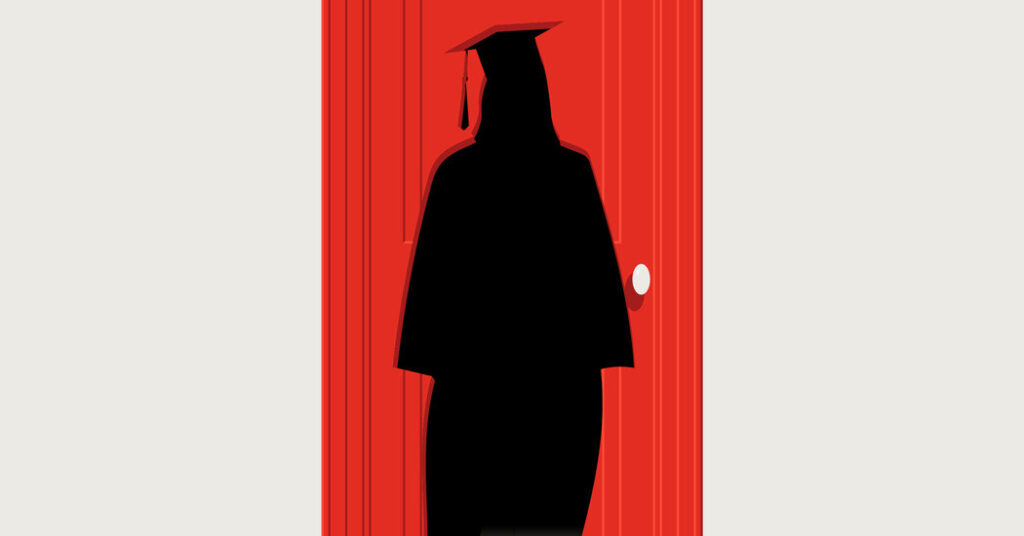
That’s not about Duke. It’s about higher education. It’s about America. It’s about dynamics — chiefly, this country’s tilt toward authoritarianism and the rapidly accelerating advances of A.I. — that render our tomorrows even hazier than usual. None of us knows what we’re in for and up against, and that confusion crystallizes on college campuses, which are by definition gateways to the future. They’re supposed to leave students with maps, routes, a destination. Not with compasses whose needles gyrate this way and that.
For much of the past decade, college students flocked to computer science, wagering that few majors were surer on-ramps to employment. A.I. has exploded that roadway. I teach in Duke’s school of public policy, where many students point themselves toward jobs in government or nonprofit groups. The ax that fell in the first months of Trump’s present term deforested that landscape.
Those are just examples, and this is hardly the first generation of young people to face disruption and major economic shifts. I can’t say just how unusual, in a historic sense, the unease that I feel around me is.
But I can tell you that my previous nine semesters at Duke are no rival for this one when it comes to the number of students who initiate conversations about what they should do next, what they should expect after that, where the country is headed, whether they’ll have any real say in that. I can tell you that their miens are darker, their voices more tremulous. I’m like a Magic 8 Ball who won’t — who can’t — disgorge the desired answers no matter how tightly it’s clutched, how vigorously it’s shaken. One of my faculty colleagues said recently that he’d never felt so inadequate as a mentor. Same here.
And we are both dealing with an extraordinarily lucky group of young people talented, driven or connected enough to breach the sanctum of a highly selective university whose resources and range of course offerings rank it among the nation’s best schools. Still, their advantages can’t compete with their apprehensions.
They’re undoubtedly picking up on their elders’ anxiety. We’re trying to manage not only their fears and bafflement but also our own. News stories about universities since Trump returned to the White House focus on huge funding cuts for research, which have led to painful belt tightening at Duke and other schools; on investigations into admissions practices and incidents of antisemitism; and on fines, more or less, for institutions at odds with Trump’s agenda. But the Trump administration’s impact on campuses has been more sweeping than that.
There’s a nagging sense of being surveilled by invisible eyes. No one wants to draw the White House’s ire. So some of us deliberate how carefully we should watch our language, avoiding “diversity” and “equity” and the Trump administration’s other dirty words. Some of us go out of our way to make our receptiveness to a broad spectrum of ideologies clear and not to play into progressive caricatures. But which adjustments are reasonable corrections of past mistakes, which are defensible self-preservation and which are cop-outs?
And what’s my purpose? A.I. isn’t just upending the job market; it’s raising questions about the necessity and utility of an array of skills. I teach writing, which is increasingly being outsourced to bots. Some are scarily adept at it. So should I pivot to bot maximization? Should other professors in other disciplines?
But what puzzles me even more is how to respond to a concern wisely articulated by Robert Pondiscio, a former public school teacher who is now a senior fellow at the American Enterprise Institute, in several essays and in public remarks. He has been sounding an alarm about “the unbearable bleakness of American schooling,” a trend that predates Trump’s political ascent and that the president and his compatriots have used as populist fodder.
“If you simply listen to the stories we tell students,” Pondiscio wrote in a newsletter late last year, we promote “a view of the world in which everything is broken, corrupt, dangerous or doomed.” But optimism, he argued, is an essential civic virtue. “No society can expect its children to engage with a world they think has already given up on them.”
This world hasn’t. If I’ve given my students the opposite impression, I’ve screwed up. I need to communicate that for all this country’s current trials, it still brims with opportunities, its promise greater than its woes. And a blurry future isn’t the same as a bleak one. It just asks today’s college students to be especially nimble and patient. And it demands that those of us who stand before them work extra hard to find an honest balance between uncomfortable reckonings and reasons not to despair.
Forward this newsletter to friends …
… and they can sign up for themselves here. It’s published every Monday.
For the Love of Sentences
In The Chicago Tribune, Edward Keegan regarded Trump’s gargantuan White House addition as the architectural analogue of his bullying approach to all else: “This ballroom design wants your lunch money; in fact, it wants everybody’s lunch money.” (Thanks to Jon Hattenbach of Skokie, Ill., for nominating this.)
In The Washington Post, Philip Kennicott called the project a colossal mistake: “The scale of the addition will destroy any sense of symmetry between the East and West wings and reorient the White House campus to the east, where it faces the massive Treasury Department building, a dispiriting, fortresslike phalanx of Ionic columns that natter on like someone discoursing on the infallible wisdom of free markets.” (Kathryn Mead, Oxford, England)
In Talking Points Memo, David Kurtz pondered the end of the war with Iran: “There’s no telling what President Trump will resort to doing to save face, create the mirage of victory, and extricate himself from the box canyon into which he so triumphantly galloped.” (Patricia Dickey, Newport, Ore., and Edwin K. Seppa, Wells, Maine, among others)
In The Times, Yonatan Touval stressed the limits of the spycraft and technology behind Israel’s development of strike coordinates in Iran: “That is an extraordinary achievement of surveillance and targeting. Yet never has so much been seen, so precisely, by so many people who understand so little of what they are seeing. A system can tell you where a man is. It cannot tell you what his death will mean for a nation.” (John McGinnis, Long Beach, Calif.)
In The Atlantic, Graeme Wood commented on Trump’s threat, in a social media post, to bomb Iran’s “POWER PLANTS STARTING WITH THE BIGGEST ONE FIRST”: “American air superiority over Iran is matched only by its overwhelming advantage in CAPITAL LETTERS, which Persian lacks.” (Marion Kelly, Addis Ababa, Ethiopia)
Also in The Atlantic, Annie Lowrey emphasized that A.I. is hardly the first huge disruption to employment patterns, which are in constant (and sometimes curious) flux: “More than half of the American labor force worked in agriculture in 1880, compared with 2 percent today. But farmers didn’t become obsolete. They became sewing-machine operators whose children became steamfitters, whose children became teachers, whose children became contestants on reality shows.” (Patti Bower, Odenton, Md.)
And Ellen Cushing bemoaned airports — in general, and especially of late. “They are a vortex of everything annoying: confined spaces, limited options, bad Wi-Fi, overpriced food, fluorescent lighting, other people,” she wrote. “And they lay bare the fragility of this modern life, how easy it is for everything to go wrong — right now, especially. The worst airport isn’t Atlanta, or Dallas, or Newark. The worst airport is whatever airport you are in. I’m joking, of course. The worst airport is Newark.” (Dick Chady, Chapel Hill, N.C.)
In The Times, Cal Newport likened many a social media post to ultraprocessed junk food: “It’s the result of vast databases of user-generated content that are sifted, broken down and recombined by algorithms into personalized streams designed to be irresistible. What is a TikTok video if not a digital Dorito?” (Michael Chimes, Allamuchy, N.J., and Dana Blackburn, Heath, Mass., among others)
Also in The Times, Amy X. Wang sought rejuvenation: “When the luxury wellness company HigherDOSE released a six-and-a-half-foot red-light mat souped up with 1,000 LEDs a few months ago, I took the opportunity to carpe diode on this maximal measure of crimson. How much could it Benjamin Button me? Would the paper cut on my palm close up, Wolverine-like, before my eyes?” (Jim Nolan, Hastings-on-Hudson, N.Y.)
In The Boston Globe, Kevin Paul Dupont ridiculed the arithmetic by which the National Hockey League weights wins versus losses versus overtime or shootout losses: “If you exited high school math studies prior to Algebra II, commissioner Gary Bettman’s course in quantitative standings analysis might not be your slice of pi.” (Dave Goren, Winston-Salem, N.C.)
In the Vermont publication Seven Days, Chelsea Edgar contemplated one of the sires of Ben & Jerry’s: “Ben Cohen looks more like the guy who drives the Good Humor truck than the founder of a multibillion-dollar ice cream brand. His personal aesthetic is Dad Who Buys Everything at Costco: plaid button-down shirts tucked into yard work-ready jeans; slip-on shoes with good tread; a slightly decomposed North Face backpack that, if found unattended in an airport, would prompt an evacuation.” (Helen Toor, Charlotte, Vt.)
And in his newsletter, Tim Barnicle greeted the late March return of the boys of summer: “Baseball remains our game, but it is much more than that. It is a clarion call for hope, for wonder, and for possibility. A warren to protect from the winter wind. A daily American Aeneid, unfolding not verse by verse but pitch by pitch.” (Karen Martin, Davidson, N.C.)
To nominate favorite bits of recent writing from The Times or other publications to be mentioned in “For the Love of Sentences,” please email me here and include your name and place of residence.
What I’m Reading and Listening To
-
I wasn’t as keen on “A Marriage at Sea,” by Sophie Elmhirst, as President Obama evidently was: He made the nonfiction account of a couple’s shipwreck and against-all-odds survival one of his 10 recommended reads for the summer of 2025. Despite the book’s admirable succinctness, it has the feel of material stretched as far as it can go; at a few junctures, Elmhirst provides long lists — of rations, equipment, fantasies of future meals — that deaden the pace. But I appreciated her wise take on the thin line between hope and delusion and on the important role that delusion can play in survival and contentment. We often talk of people “in denial” as saps and sitting ducks, and sometimes they are. But sometimes a well-timed, well-placed, cautiously portioned watering-down of reality is an essential dam against misery.
-
I’ve been a journalist long enough and ventured in enough different directions that I sometimes forget whole chunks of my professional past. Someone brings them up and I think: Oh. That’s right. I did that! Such was the case when I read my friend Jennifer Steinhauer’s excellent article in The Dispatch on the allure of actual, physical cookbooks in a digital age. Jennifer mentioned the two that she has written, the second of which, “A Meatloaf in Every Oven,” was a collaboration with yours truly. She and I came up with almost 50 meatloaves — made of turkey, of duck, of lamb, of pork, of salmon, of crab — for that volume. (My love handles have never recovered.) “Cookbooks offer a sense of discovery,” Jennifer wrote in The Dispatch, contrasting that with the creepy feeling “of being discovered, generally by an algorithm.” I love Jennifer’s smarts and sass, also on display in a newsletter she recently started.
-
And here are two songs for the road, each the kind of easy-listening fare that can come across as aural oatmeal if you’re in one kind of mood but as a subtly lovely treat if you have the right appetite. Give a hungry listen to “Blue Hour” by Anna Graves and “Green Valleys” by the Paper Kites.
On a Personal (By Which I Mean Regan) Note
If we accept the aphorism, old dogs don’t learn new tricks.
But they discover new likes. Develop new habits. Devise new niches. And so I increasingly find Regan not in her doggy bed just outside the kitchen, where she once spent so much time; not on the rectangle of carpet just inside the glass front door, which she likes to press her nose against; but at the top of the stairs, looking down at that vestibule, a queen claiming a taller pedestal, a sentry whose altitude complements her attitude.
It’s surprising. For one thing, she doesn’t ascend steps as gracefully and fleetly as she once did, so she must really like that higher perch. For another, she can’t see as far into the front yard from there as she can from various vantage points on the first floor. The angle is all wrong.
So why does she plant herself there? I have theories. When it comes to Regan, I always have theories. Isn’t that the fun of pets: coming to understand them, but never entirely; mulling the riddle of them without any hope of fully solving it?
The way I figure it, Regan has four great cares in life, though I’m not sure in what order. She wants food. She wants water. She wants physical comfort and safety. And she wants me nearby, where she can keep tabs on me.
At the top of the stairs, inches from my bedroom door, she can see and hear instantly if I take a shower, which she identifies as a grim omen. Grooming is the precursor to leaving the house, a development she can then gird herself for or even appeal, following me around and staring at me with a heartbreaking plangency.
At the top of the stairs, she’s a barricade against my departure. I have to step over her, with all the cruelty that connotes. She’s daring me. She’s shaming me. She’s testing my agility and balance: It’s no simple maneuver to stretch that far forward while also descending to a lower level.
I manage. She sulks. And on we go, this dog who always cracks me up, this human who routinely lets her down.
The post Don’t Blame College Students for Feeling Adrift. I’m Right There With Them. appeared first on New York Times.