Throughout four years of full-scale war in Ukraine, Hungary has worked to undermine European Union action against Russia. It has lobbied to water down sanctions and consistently opposed assistance to Ukraine. It recently blocked an E.U. loan worth tens of billions of dollars for Ukraine to help it survive against Russian aggression.
Now, with Hungary facing a high-stakes general election on April 12, Moscow seems determined to repay the favor from its chief E.U. ally, Prime Minister Viktor Orban, the Hungarian nationalist whose position as the bloc’s longest-serving head of government has suddenly become tenuous.
Giving a boost to Mr. Orban, who relies on cheap Russian energy to keep Hungary’s anemic economy afloat, President Vladimir V. Putin of Russia received the Hungarian foreign minister, Peter Szijjarto, last month at the Kremlin.
Mr. Putin assured him that Hungary could depend on deliveries of Russian oil regardless of disruptions from the war in Iran, and despite the fact the other E.U. members are boycotting most Russian energy supplies over Moscow’s invasion of Ukraine.
President Trump has also given a helping hand, offering his “complete and total endorsement” to Mr. Orban. Vice President JD Vance is scheduled to visit Budapest on Tuesday and Wednesday in an effort to lift Mr. Orban in an election that polls suggest he could lose.
Strong foreign interest in an election in a country on Europe’s eastern fringe with fewer than 10 million people reflects Mr. Orban’s outsize role as a hero for “anti-woke” conservatives abroad and a bugbear for liberals in Europe and beyond.
Russia’s interest has been particularly intense, triggering a hunt by Mr. Orban’s foes for evidence of clandestine meddling of the kind detected in the American presidential election in 2016 and in many European elections since.
But while proving covert Russian mischief in Hungary’s campaign is difficult, it is hardly necessary, analysts say. The collaboration between Moscow and Mr. Orban’s government to influence the election has been mostly open.
“The story is less secret Russian interference than open Russian cooperation with our authorities on anti-Ukrainian messaging, energy cooperation and hostility to the European Union,” said Peter Kreko, the director of Political Capital, a research group in Budapest that studies Mr. Orban’s ties to the Kremlin.
“This is pretty much unprecedented in a European election,” he added.
In the years since President Trump won his first election, aided by what the special counsel, Robert S. Mueller III, described as “sweeping and systematic” interference by Russia, Europe has been on high alert for signs of Russian meddling in its own national votes.
In Hungary, however, the authorities have echoed and amplified Russian narratives, casting President Volodymyr Zelensky of Ukraine as the biggest menace, a role Mr. Orban previously assigned to the Hungarian-born financier George Soros.
Across Hungary, a sinister-looking Mr. Zelensky stares out from billboards that Mr. Orban’s party, Fidesz, has plastered on nearly every street.
New posters appeared last month featuring photos of Mr. Zelensky and the opposition leader, Peter Magyar, with a scary message: “They are dangerous! Let’s Stop Them. Only Fidesz on April 12.”
On Sunday, Mr. Szjjjarto, the foreign minister, suggested that Ukraine was trying to blow up a pipeline carrying Russian natural gas to Hungary, after authorities in neighboring Serbia claimed they had found explosives of “devastating power” on a Serbian stretch of the pipeline.
Mr. Orban called an emergency security meeting and sent troops to protect critical infrastructure, stoking opposition fears that the government would use the episode to spread panic and even call off Sunday’s vote.
The fear mongering borrows from a script outlined in August by Russia’s foreign intelligence service, the S.V.R. In a public statement, the S.V.R. said it had received “information” that Ukraine was working with the European Union to topple Mr. Orban.
The “Zelensky regime is doing the dirty work,” the statement added.
The extent of Hungary’s collaboration with Russia was thrown into high relief last week when a consortium of European media outlets released a recording of a 2024 telephone call between Mr. Szijjarto, the Hungarian foreign minister, and his Russian counterpart, Sergey V. Lavrov.
The two men discussed European Union sanctions on Russia, with Mr. Szijjarto explaining to Mr. Lavrov that, at Moscow’s request, he was working to get sanctions lifted on the sister of Alisher Usmanov, a Russian billionaire close to the Kremlin. The sister, Gulbahor Ismailova, was removed from Europe’s sanction list last March, along with several other Russians whom Hungary had pleaded for.
“We will do our best in order to get her off,” Mr. Szijjarto can be heard saying. Before hanging up, he told Mr. Lavrov, “I am always at your disposal.”
Mr. Szijjarto has not disputed the authenticity of the recording, saying only that it was evidence of foreign intervention in Hungary’s election, though he did not suggest which intelligence service might have tapped his call.
European leaders who support Ukraine reacted with dismay, accusing Hungary, a member of the European Union and NATO, of putting the Kremlin’s interests first.
The prime minister of Ireland, Micheál Martin, said it confirmed “what many suspected — that the Hungarian government has been doing the bidding for Russia within the European Union for quite some time.”
Mr. Orban’s election campaign has increasingly revolved around stoking hostility toward Ukraine and Brussels, the headquarters of the E.U. executive arm.
Mr. Orban, whose Fidesz party trails the opposition in most polls, is clearly hoping that relentless attacks on his opponents as warmongers in cahoots with Ukraine will rally voters to his side, just as they did in the last election in 2022.
In that vote, Fidesz won a landslide victory despite polls that for a time showed it trailing, though not so close to Election Day and never by as wide a margin as now.
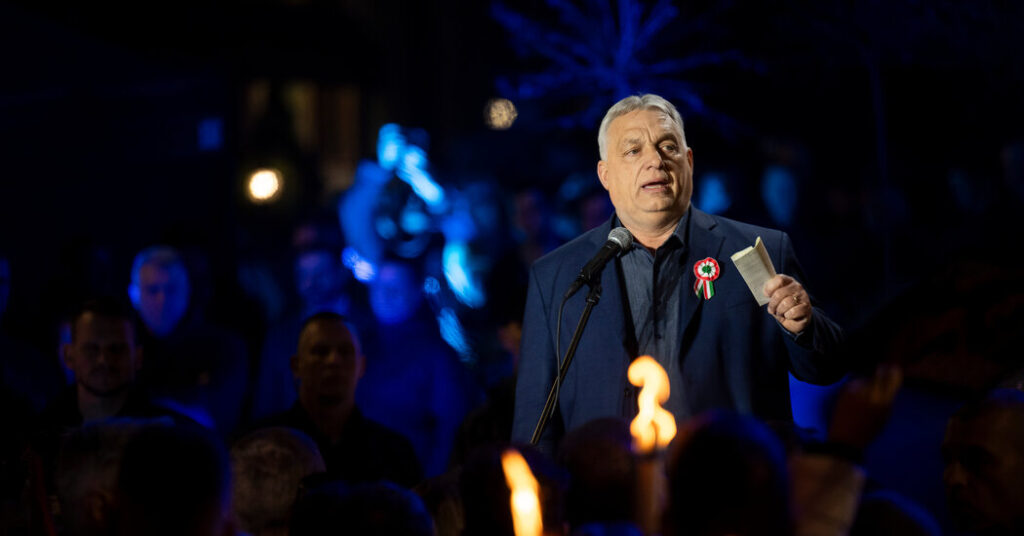
At a recent campaign rally in Pecel, a town near Budapest, Mr. Orban told supporters that the opposition was “supported by Zelensky, supported by Brussels,” and that it would “destroy Hungary.”
It is a message that appeals to Mr. Orban’s base: A recent Gallup survey found that only 3 percent of Hungarians who support Fidesz approve of Ukraine’s leadership, while 55 percent approve of Russia’s.
The opposition leader, Mr. Magyar, a conservative former Orban loyalist who broke with Fidesz in 2024 to form his own party, Tisza, has mostly avoided talking about Ukraine, wary of falling into the trap that doomed Mr. Orban’s opponents in 2022.
He has instead tried to tap into Hungary’s long, painful history of bullying by Russia.
During a recent campaign rally in the western town of Keszthely, Mr. Magyar reminded his audience that this year is the 70th anniversary of the 1956 uprising that Soviet troops crushed.
The election will decide whether “we can finally live in a truly sovereign, truly free, truly independent and European country,” he said, and the result will depend “not on Tehran, not on Brussels, not on Ukraine, but only on you.”
That message resonates with many patriotic Hungarians, but, according to Peter Buda, a former senior intelligence officer, the “obvious collaboration” between Mr. Orban’s government and Russia has left the election unusually vulnerable to Russian narratives.
Russian disinformation, he added, “unfortunately serves the interests of the current governing party.”
That was demonstrated in an episode in March, when the authorities seized two Ukrainian bank vehicles traveling across Hungary as part of the feud between the two nations.
Ukraine said that the vehicles, operated by a state-owned Ukrainian bank, were on a routine run to collect funds from a state-owned Austrian bank.
But the seizure fueled anti-Ukrainian propaganda by Fidesz-controlled media outlets, with accusations that the vehicles were carrying illicit funds for Tisza, Mr. Magyar’s opposition party.
An online tabloid published what it said were photographs of Hungarian police officers looking into the back of one vehicle. Gold bars and shrink-wrapped bundles of cash were piled to the roof.
There was just one curious detail: The police badges on the Hungarian officers’ sleeves were written in Cyrillic, a script not used in Hungary, but in Russia, exposing the images as fakes most likely generated by artificial intelligence.
Lili Rutai contributed reporting from Budapest.
Andrew Higgins is the East and Central Europe bureau chief for The Times based in Warsaw, on temporary assignment in Shanghai.
The post A Hidden Russian Hand in Hungary’s Election? Actually, It’s Quite Open. appeared first on New York Times.