As spring takes hold, Russia is back on the offensive in Ukraine. Moscow’s forces are trying to exploit the warmer weather to regain the momentum they lost over the winter as Ukraine waged successful counterattacks along a crucial section of the front.
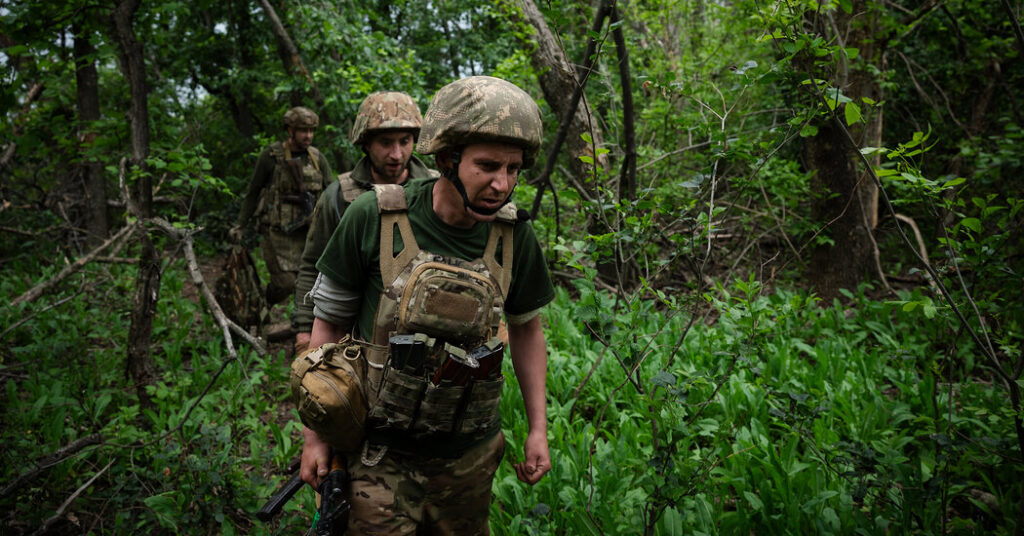
Russia has an edge in soldiers and matériel, and it will look to put those advantages to use by leveraging a critical springtime asset: foliage that helps conceal advancing troops from the omnipresent drones that hunt and strike almost anything that moves.
The days when troops pushed forward in tanks and other armored vehicles are largely over. Most attacks today are carried out on foot, with soldiers moving in small groups to reduce detection. Forested areas are scarce in Ukraine’s east and south, the main theater of the war. As a result, soldiers often move through the tree lines that border agricultural fields.
These lines are a legacy of Soviet-era policies that used trees to shield crops from wind. Now, they are used by troops to seek cover from enemy fire or regroup before an attack. They have also become pathways for troops trying to gain territory or to retreat from the front line.
Both attackers and defenders benefit from vegetation coverage, said Vladyslav Vishtalyuk, a major in Ukraine’s 14th National Guard Brigade, which is fighting near the city of Myrnohrad, in the eastern Donetsk region.
“Leaves in tree lines that are still relatively intact will significantly reduce visibility, making it harder to detect the enemy,” he said by telephone. “But it will also make it harder for the enemy to detect our positions.”
Capt. Dmytro Filatov, the commander of the Ukrainian First Separate Assault Regiment, which fights in the neighboring Zaporizhzhia region, said he thought the vegetation would favor Russia more than Ukraine.
“Once foliage appears, it will give more advantage to the enemy, because they have more manpower, more infantry,” he said. “They will suffer fewer losses and will have more opportunities for concealment.”
Perhaps nowhere is the impact of vegetation more pronounced than along the Dnipro River in Zaporizhzhia. “The soil here is so fertile that everything blooms very, very quickly,” said Lt. Col. Oleh Tiahnybok, the commander of a drone battalion in Ukraine’s 128th Separate Heavy Mechanized Brigade.
Russian troops have been pushing through a water reservoir on the river, which dried up after a dam was destroyed, most likely by Russia, in 2023. “Very dense groves of trees,” several times the height of a person, have sprung up in the reservoir, Colonel Tiahnybok said. “The enemy has the opportunity to accumulate and maneuver there with maximum concealment.”
In each of the past two years, the arrival of spring has marked the start of monthslong Russian offensives stretching into the autumn. These pushes have produced Moscow’s largest territorial gains.
As Ukrainian officials report an intensification of Russian assaults across the front line in recent days, soldiers on the ground said they expected this year to follow the same pattern.
“I think the situation will repeat itself this spring,” Captain Filatov said. “Not just think — I am confident.” Russia, he added, “will again achieve certain successes this spring.”
But he said he was confident these successes would not “cause a collapse of the front.”
A Russian attack near the eastern city of Lyman in mid-March sent a stark signal to Ukrainian soldiers that Moscow’s spring offensive had begun.
The assault began at 5:30 in the morning. More than 500 troops surged toward Ukrainian positions, many riding in armored vehicles or on motorcycles as they raced across open fields in an attempt to punch through the front line.
Ukraine’s Third Army Corps, which described the assault on social media, said the attack was repelled after four hours of fighting, a description supported by independent groups that monitor the battlefield.
The assault, which took place weeks before leaves would return to trees, was an unusual sight four years into the war. While drones have rendered rapid mechanized attacks largely obsolete, Russia tried its luck this time as drier soil eased the movement of vehicles.
Ukraine’s overall strategy this spring will largely remain unchanged, officials say. Its army is focused on holding the defensive line, using drones and extensive lines of anti-tank ditches, barbed wire and earthen berms built during the winter in preparation for a renewed Russian offensive. Ukraine also wants to inflict maximum losses on Russian troops to blunt their offensive abilities.
Ultimately, Kyiv aims to compel Moscow to negotiate a settlement rather than continue a costly and unproductive assault. Whether that strategy will finally bear fruit this year remains to be seen. The war appears far from over, especially as U.S.-brokered peace talks enter a freeze because of the war in Iran.
Ukrainian officials emerged from the winter expressing confidence that time was on their side.
They say Russia’s war effort could be limited by strains on the country’s economy and by mounting losses that Moscow increasingly struggles to offset through army recruitment. The situation on the battlefield also improved during the winter, with Russia’s advance slowing while Ukraine scored successful, though limited, counterattacks in the southeast.
Military analysts cautioned, however, that Ukraine’s improvements were partly tied to wintertime conditions. Russian soldiers’ movements were complicated by frigid temperatures and the lack of vegetation. Ukrainian defenders, by contrast, simply had to stay in place and hold the line, limiting their exposure.
“There’s a strong seasonal dimension to the war,” Rob Lee, a senior fellow in the Foreign Policy Research Institute’s Eurasia Program, said recently on the Russia Contingency podcast. “Most commanders say the cold weather favors the defender, not the attacker.”
Despite the seasonal advantage for Russia in the spring, Ukrainian soldiers and military analysts do not expect Russia to make significant gains this season. The constant drone surveillance and strikes have created a wide “kill zone” along the front that has slowed movement to a near standstill.
Ukrainian soldiers say they worry less that Russian troops will capture cities and more that they will advance close enough to make civilian life unbearable with regular drone attacks.
Sloviansk and Kramatorsk, two of the eastern cities that Russia aims to seize, form a case in point.
Located roughly 10 miles from the front line, they will probably remain under Ukrainian control this year, military experts say. But whether they will remain safe for the more than 250,000 residents still living there is uncertain. Last month, the local authorities ordered the evacuation of children from parts of Sloviansk in response to the growing threat.
Constant Méheut reports on the war in Ukraine, including battlefield developments, attacks on civilian centers and how the war is affecting its people.
The post A Crucial Weapon in Russia’s Spring Offensive: Leafy Trees appeared first on New York Times.