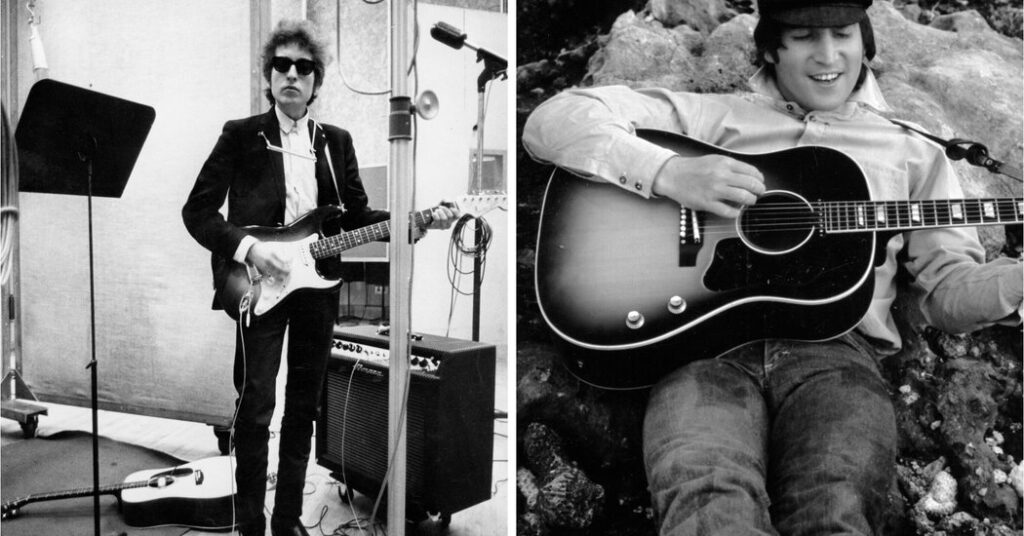
On the night of May 26, 1966, the Beatles entered EMI Studios on Abbey Road to work on their most ambitious album yet, “Revolver.” Three miles away, their friend Bob Dylan stepped onto the stage of the Royal Albert Hall.
Blade-thin, on the verge of exhaustion, Dylan, 25, was nearing the end of a grueling world tour, his first with a band, during which he’d been the target of frequent boos and occasional death threats. Many fans felt betrayed by this new Dylan, a wild-haired character with an electric guitar who wouldn’t play his old protest songs. On this night in London, he and his fellow musicians received “the harshest reaction yet,” according to the guitarist Robbie Robertson.
Around 1 a.m., John Lennon, 25, made his way from Abbey Road to the May Fair Hotel. That was where Dylan was staying with his band and a documentary film crew that was tracking him, onstage and off.
Lennon and his fellow Beatles had spent a lot of time at Dylan’s suite in recent weeks. They avoided the film crew as they smoked pot with their host and listened to tracks from “Revolver” and Dylan’s soon-to-be-released album, “Blonde on Blonde.” On this night at the May Fair, however, Lennon said yes, albeit reluctantly, when Dylan asked him to appear in a scene.
“He said, ‘I want you to be in this film,’” Lennon recalled. “And I thought: Why? What? He’s going to put me down!”
At daybreak, they were dressed sharp for their debut as co-stars — Lennon in a blazer over a turtleneck, Bob in a dark jacket and stiff-collared shirt. As they rode in the back of an Austin Princess limousine, the filmmaker D.A. Pennebaker trained his lens on them from the passenger seat. Lennon was stiff. Dylan was jittery.
Speaking of the limo ride a few years later, Lennon said that he and Dylan were “on junk” — slang for heroin. That contradicts other statements made by Lennon, who would say he didn’t try the drug until 1968. It also goes against what we see in the roughly 20 minutes of footage: Lennon appears sober, or close to it; Dylan slurs his words on occasion and becomes nauseated.
A snippet of the scene would appear in “Eat the Document,” a documentary that had its debut in 1972 and has rarely been screened since. The complete limo-ride footage, in all its awkward glory, later leaked out of the Dylan camp and became a cult item, traded as a bootleg among collectors before it surfaced online. Some writers have described it as the kind of thing that would appeal to only the most ghoulish fan, given its ghastly portrayal of its subjects.
When I first came upon it many years ago, it made me cringe. But after I had gone deep into my own private Dylan-Beatles rabbit hole, trying to determine exactly how they had influenced each other, I returned to this scene, watching a pristinely restored version on a hot July afternoon in the coolness and quiet of the Bob Dylan Center in Tulsa, Okla., where it is one of more than 100,000 items in a voluminous archive.
Now that I was able to follow the references Dylan and Lennon were slinging at each other, I had a different impression of what I was watching. I was more open to the genuinely funny moments mixed into their passive-aggressive remarks and thinly veiled boasts. I could see the affection between them. And it struck me that something real lay at the heart of the scene: Dylan’s desire to wrest from Lennon an on-camera statement about whether or not he had been overly reliant on Dylan’s own work.
This touchy issue had been on Dylan’s mind for weeks. His decision to wait until he was on camera with Lennon to hash it out suggests he believed it would make for a dramatic scene.
Ego Equals?
The Beatles became Dylan fans in January 1964, when they were staying at the George V in Paris during a three-week residency at the Olympia Theater. In their time away from the stage, they listened again and again to Dylan’s first two albums.
At the same time, the Beatles’ first No. 1 hit in America, “I Want to Hold Your Hand,” was inescapable. When Dylan heard it on New York’s pop radio stations, he wasn’t impressed. He told a friend, the journalist Al Aronowitz, that the Beatles were for “teeny-boppers.” Aronowitz, an unlikely Beatles fan at age 35, tried to tell him how wrong he was.
A few weeks later, after more than 70 million Americans had watched the Beatles on “The Ed Sullivan Show,” Dylan had a sudden change of heart. It happened in Colorado, when he was on a cross-country road trip. The Beatles were blasting out of the car radio, hit after hit, and their music now struck him with force.
“Did you hear that?” he said, according to his then road manager, Victor Maymudes. “Man, that was great!” Dylan would later elaborate on what he was thinking in that moment: “I knew they were pointing the direction of where music had to go.”
While interviewing the Beatles for a magazine story, Aronowitz told Lennon he should get to know Dylan, adding that he could arrange a meeting. Lennon begged off, saying he had to wait until he considered himself Dylan’s “ego equal.”
Crowds numbering in the hundreds of thousands watched the Beatles parade through Australian cities on their 1964 world tour. By summer’s end, the adulation had left Lennon feeling more self-assured. He called Aronowitz from the Delmonico Hotel in Manhattan, where the Beatles were staying, and said he was ready.
That night, in a hotel-room get-together that would go down in rock lore, the Beatles and Dylan got high and laughed till dawn.
Hide Your Love
By the end of 1964, the Beatles no longer seemed like cheeky moptops. The cover of their new album, “Beatles for Sale,” a moody affair with folk accents, presented them as weary, melancholy, serious. Maureen Cleave of The London Evening Standard speculated on the reason for the change. “One might hope that John Lennon soon ceases to be so influenced by Bob Dylan,” she wrote in a mixed review.
In an interview with Melody Maker, Lennon revealed that Dylan had inspired him to write “I’m a Loser,” the raw second track of “Beatles For Sale.” An earlier song, “A Hard Day’s Night,” he added, had been in the Dylan vein before it was “Beatle-fied.”
As the world’s most popular group left behind the hormonal enthusiasm of its early hits, Dylan decided to enlist some musicians to help him record a new song, “Subterranean Homesick Blues,” at a Manhattan studio.
This was a big move for someone who had presented himself as a solo troubadour in the tradition of Woody Guthrie. But he was ready to act on his Beatles epiphany, ready to challenge the notion that the mere presence of an electric guitar and drums on a song meant it had to deal with lightweight concerns.
With “Subterranean Homesick Blues,” he laid four rapid-fire verses overflowing with absurd aphorisms and social commentary onto the bones of a rock ’n’ roll hit he had loved as a teenager, Chuck Berry’s “Too Much Monkey Business.”
Weeks later, Lennon started writing his most intimate song yet, “Norwegian Wood (This Bird Has Flown).” Its chords came straight out of folk. The lyrics were also something new for him, belonging to the adult realm of after-hours regret. A first-person narrator tells of his furtive visit to a woman’s flat. They talk “until two,” when she says she must work in the morning, meaning he’s not welcome to join her in bed.
By the time of the Beatles’ next recording session, in February 1965, Lennon had another Dylan-style song ready to go: “You’ve Got to Hide Your Love Away.” It wasn’t lost on his colleagues, what he was up to. “I asked him not to sound too much like Dylan,” the producer George Martin said.
No. 1
Two months later, fans swarmed Dylan on his arrival at London Airport (now Heathrow). It wasn’t quite Beatlemania, but there were a few screams, and officers in bobby helmets stepped in when the mob clawed at his hair and clothes.
Between concerts, Dylan (who declined requests for an interview about his relationship with the Beatles through a spokesman) spent time with the Beatles at the Savoy hotel. He also visited Lennon at his mansion in Surrey, where they wrote and recorded a song together, according to an interview Dylan gave in 1985. That song, which may be lost, has yet to turn up on any bootleg or archival release.
In August, the Beatles returned to New York to play Shea Stadium. On their first night in town, Dylan arrived at their suite in the Warwick Hotel. They lit up joints and listened to an acetate disc of his forthcoming album, “Highway 61 Revisited,” in which he further committed himself to rock. Two nights later, after the Shea concert — the first stadium show headlined by a pop act — Dylan returned to the Warwick to celebrate the Beatles’ triumph.
Their influence on each other was now making itself known to the world. Dylan’s latest single, “Like a Rolling Stone,” and the Beatles’ new one, “Help!”, went to No. 1 on U.S. charts.
Lennon and McCartney soon got busy writing for the next Beatles album, “Rubber Soul.” The batch included something new for them — two songs that had nothing to do with romantic love, “Nowhere Man” and “The Word.”
Around the same time, Dylan was trying to come up with another hit. For inspiration, he turned to a song written by Lennon and McCartney, “I Wanna Be Your Man,” a catchy rocker that had been released as a Rolling Stones single and a Beatles album track. Dylan filled the verses with surreal imagery, making the case that a pop song didn’t have to be saddled with unimaginative lyrics. He called it “I Wanna Be Your Lover.”
The Beatles album “Rubber Soul” came out a few weeks later. When Dylan heard the second track, “Norwegian Wood,” he felt things had gone too far. He would have to respond.
‘Fourth Time Around’
The muse visited him Feb. 14, 1966, at a recording studio in Nashville. With a pen and a yellow legal pad, Dylan wrote furiously while the hired musicians bided their time. This was “Fourth Time Around,” his pointed reply to “Norwegian Wood.”
Like the song that had given rise to it, “Fourth Time Around” describes a romantic visit gone awry. For the music, Dylan mimicked the melody and meter of “Norwegian Wood.”
Al Kooper, a musician who took part in the session, noticed the likeness right away. “I said, ‘It sounds so much like “Norwegian Wood,”’” he recalled in a 1987 interview. “And he said, ‘Well, actually, “Norwegian Wood” sounds a lot like this. I’m afraid they took it from me, and I feel that I have to, you know, record it.’” With that koan-like statement, Dylan was arguing that the Beatles song was so much like one of his own that he had to reclaim it.
The title phrase doesn’t appear in the words. It seems that Dylan meant “Fourth Time Around” to signal that “Norwegian Wood” was the fourth instance of Lennon’s having borrowed too much from his own style.
George Harrison addressed this musical back-and-forth in a 1992 interview: “There’s a funny thing that I don’t think anybody else has noticed, and that is when John wrote ‘Norwegian Wood,’ it was obviously a very Bob Dylan song; and right after that, Bob’s album came out, and it had a song called ‘Fourth Time Around.’ You want to check out the tune of that — it’s the same song, going round and round.”
“Blonde on Blonde,” the album Dylan had been working on in Nashville, wasn’t in stores by the time he arrived in London that May. But he had brought along tapes of its tracks, and he wanted the Beatles to hear them. On the night he unveiled “Fourth Time Around” at the May Fair suite, Lennon felt uneasy to hear his own melody coming back at him.
“This ought to be in Northern Songs,” he said to McCartney.
“What’s Northern Songs?” Dylan asked.
Lennon didn’t bother to explain that it was the publishing company that housed Lennon-McCartney compositions.
As “Fourth Time Around” came to an end, the Beatles heard Dylan break away from the narrative:
And I, I never took much, I never asked for your crutch
Now don’t ask for mine
That stopped Lennon cold. Was this a personal attack in the guise of a love song?
“What do you think?” Dylan asked.
“I don’t like it,” Lennon replied.
Ambush
A few weeks later, around 7 a.m., Dylan and Lennon took their places in the limousine. Pennebaker’s camera was rolling.
The footage shows Dylan moving toward his goal little by little, like a wily prosecutor out of an old courtroom drama. The mood shifts when he says he is “pissed off” about something. He is ready to bring up the thing that has been weighing on his mind.
It went back to that night at the May Fair, when Lennon made his cryptic remark: “This ought to be in Northern Songs.”
“Do you remember what you said to me when I played you those tapes?” Dylan asks. Then he seems to have second thoughts. Perhaps this isn’t a conversation that should go on film. “I’ll say it later,” he says.
Lennon realizes something is up. “Say it now,” he says.
“I played you this song, and you said — I didn’t realize it at the time; Robbie told me. You said this has gotta be in your song publishing company. What’s the name of it?”
“Oh, the song publishing company,” Lennon says. His tone suggests that Dylan has gone cuckoo and must be humored.
But Dylan isn’t kidding. “Yeah,” he says. “What is the name of it?”
“Dick James,” Lennon replies in the muted voice of a schoolboy in trouble, referring to a Northern Songs executive.
“No, no, that wasn’t the name I heard.”
“Northern Songs?” Lennon offers.
“Right,” Dylan says. “And I said, ‘What’s Northern Songs?’ And then I was never told, man. I had to go and find out.”
“Didn’t we tell you?” John asks mildly.
“No, man, you didn’t tell me. You said, ‘This ought to be in Northern Songs’ — and you laughed. And Paul McCartney looked the other way, talking to Ringo.”
Lennon changes course. Rather than debate who may have stolen from whom, he tries to wriggle out of this uncomfortable exchange by turning the story of the night into an absurd show business anecdote.
In a rich voice, he spins a brief tale featuring the Rolling Stones’ lead singer and the Scottish folk hero Robert Roy MacGregor: “And Mick Jagger looked down, and a balloon dropped out of his face! And Rob Roy leapt into the room, with a big kilt on, and he said, ‘Hey, Bobby! Have you heard this one?’”
His embellishment draws cackles from Pennebaker and Dylan. Lennon has broken the tension. Dylan lets the matter drop.
Pennebaker’s camera shows office workers shuffling down rain-darkened sidewalks. In a little more than 12 hours, Dylan will have to go back to work himself, for the final concert of his tour.
The limo approaches the May Fair. Dylan is in bad shape. He pitches forward, head on hand. “I, I, uh, I don’t understand,” he says. “I’m glad it’s over, ’cause I’m getting very sick here.”
‘They Adored Each Other’
Pennebaker turned off the camera, and Lennon helped him haul Dylan from the limo to his hotel room. They laid him on the bed. He looked “dead,” according to Pennebaker.
“John kept looking at me,” Pennebaker told the Dylan biographer Daniel Mark Epstein, “and I could see that his instinct was to bolt, because he didn’t want to be around if something happened. He didn’t want to get caught up in it. But he stuck with us. And John was a very good friend of Dylan’s. John just loved him. And vice versa. They adored each other.”
That night, as the Beatles were taking their seats at the Albert Hall, Dylan was “in no fit state to perform,” with “his eyes rolled up inside his head,” according to a journalist who saw him backstage.
He willed himself into the spotlight. When he played his solo rendition of “Fourth Time Around,” the critic Norman Jopling noticed the similarity between it and a certain “Rubber Soul” track: “If any of the Beatles were in the audience, they may have been embarrassed — or flattered — by Bob’s version of ‘Norwegian Wood,’” he wrote.
Joined by his band, Dylan launched into a ferocious “Tell Me Momma.” Between songs, the naysayers exercised their lungs.
“Go home!”
“Drop dead, Dylan!”
“Rubbish!”
The harsh reaction left the Beatles aghast. “It was really good,” McCartney told me. “We didn’t agree with the folkies who were complaining that he was playing with an electric band.”
Amid the jeers, Lennon and his bandmates were among Dylan’s loudest defenders. “Shut up!” they shouted, according to a journalist who was seated nearby. “Leave him alone!”
Jim Windolf is an editor for the Styles section of The Times.
The post What Were Bob Dylan and John Lennon Really Saying in the Back of That Limo? appeared first on New York Times.