An Air Force officer whose fighter jet had been shot down in Iran was rescued by U.S. Special Operations forces in a risky mission Saturday night, President Trump said on social media early Sunday.
The rescue followed a life-or-death race between U.S. and Iranian forces to reach the airman, a weapons system officer, that stretched over two days, officials said. There were no U.S. casualties among the rescue team, Mr. Trump said. The rescued officer had “sustained injuries, but he will be just fine,” Mr. Trump added.
Iran shot down the jet on Friday, the first known instance of a U.S. combat aircraft being shot down by Iran since the war began more than a month ago. It was a high-profile setback for the Trump administration, which has repeatedly sought to project American air supremacy in the war.
The two crew members on the plane, an F-15E Strike Eagle, were able to eject from it, U.S. military officials said. The pilot was rescued soon afterward, and officials launched an urgent search for the other airman.
Separately, another Air Force combat plane, an A-10 Warthog, crashed in the Persian Gulf region on Friday. The lone pilot was rescued, according to two U.S. officials who spoke on condition of anonymity to discuss operational matters.
Where was the first jet shot down?
Iran shot down the F-15E over the southwestern part of the country on Friday. Iran’s state broadcaster shared images that it claimed showed part of the wreckage.
The images showed the wingtip and top section of a vertical stabilizer from an F-15E, according to Justin Bronk, a senior research fellow who studies air power and technology at the Royal United Services Institute, a research institution in London. He said markings on the vertical stabilizer section were consistent with the 494th Fighter Squadron of the U.S. Air Force, based at R.A.F. Lakenheath in England.
How did rescue efforts unfold?
Navy SEAL Team 6 commandos rescued the weapons systems officer in an operation that involved hundreds of special operations troops and other military personnel working deep in enemy territory, current and former U.S. officials said.
After ejecting from the F-15E, the officer hid in a mountain crevice. He evaded Iranian forces for more than 24 hours, at one point hiking up a 7,000-foot ridgeline, a senior U.S. military official said. His location was initially unknown to the United States but the C.I.A. found his hiding place, a senior administration official said.
U.S. aircraft dropped bombs and opened fire on Iranian convoys to keep them away from where the airman was hiding. U.S. commandos also fired their weapons to keep Iranian forces away from the rescue site as they converged on the airman but did not engage in a firefight with the Iranians, a U.S. military official said.
“This brave Warrior was behind enemy lines in the treacherous mountains of Iran, being hunted down by our enemies, who were getting closer and closer by the hour,” Mr. Trump said in his social media post.
How have Iran and the United States reacted?
The loss of the two aircraft, days after Mr. Trump declared in an address to the nation that the United States was moving closer to achieving its military objectives, raised questions Iran’s capabilities after a month of attacks. Mr. Trump hailed the rescue as evidence that Iran’s defenses had been badly damaged, if not destroyed.
“The fact that we were able to pull off both of these operations, without a SINGLE American killed, or even wounded, just proves once again, that we have achieved overwhelming Air Dominance and Superiority over the Iranian skies,” he wrote.
Iran’s regime had offered a reward for the capture of “enemy’s pilot or pilots,” who it said should be turned over alive to security forces, according to a local affiliate of Iran’s state broadcaster.
What kind of jet were the airmen flying?
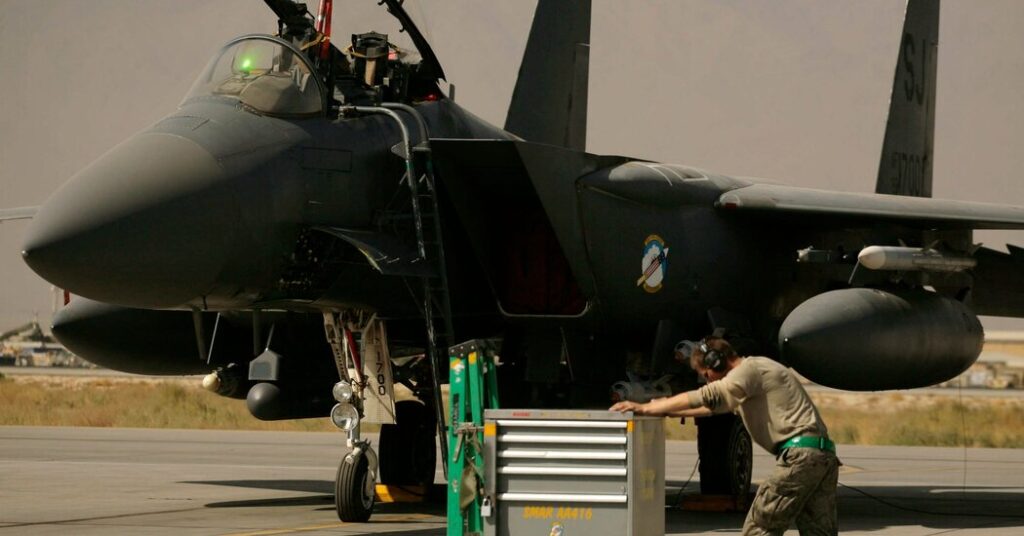
The F-15E Strike Eagle does not have the stealth capabilities of more recent generations of fighter jets. The warplane, which first flew in 1986, can be used for air-to-ground and air-to-air combat and has been deployed by the U.S. military in Iraq, Libya and Syria.
It carries a crew of two, the pilot and a weapons system officer, according to the U.S. Air Force. It can reach speeds of 1,875 miles per hour, or Mach 2.5, and carry a payload of more than 20,000 pounds.
What about the other plane that crashed?
That aircraft, an A-10 Warthog, crashed on Friday at about the same time the F-15E was shot down, according to the two U.S. officials who spoke on condition of anonymity to discuss operational matters.
The officials said it crashed near the Strait of Hormuz, the crucial oil shipping lane that Iran has been blocking, but they did not say what caused the plane to go down. The Iranian military said its air-defense systems had hit an A-10.
Two Pentagon officials said this month that it was doubling its Middle East fleet of A-10 Warthogs, a support plane with a nose-mounted cannon that can fire 70 30-millimeter shells a second. It flies at low altitudes and slow speeds, which allows it to loiter over targets on land and at sea and to support advancing ground troops.
Pranav Baskar, Ronen Bergman and Eric Schmitt contributed reporting.
Neil Vigdor covers breaking news for The Times, with a focus on politics.
The post What We Know About the Rescue of a U.S. Airman After Two Jet Crashes appeared first on New York Times.