What are we not talking about after a month of war in Iran? The news will continue to question the strategy or lack thereof. It will count casualties, rising prices, the remaining days until November — but what it will not tally is the egregious cost to the planet.
The numbers are dumbfounding.
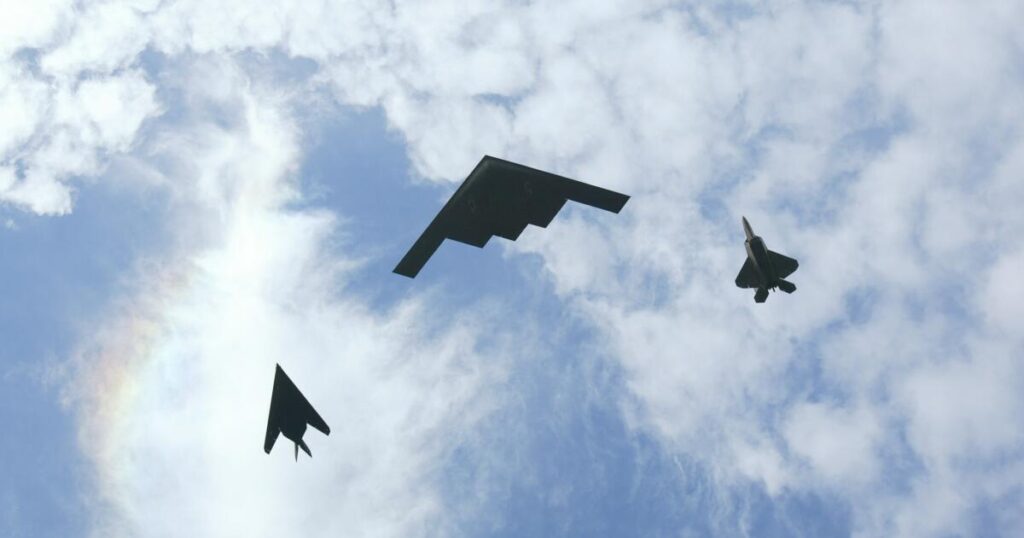
An F-16 in combat consumes as much fuel in one hour as the average American driver uses in three years. Forty-two F-117 fighter jets flying 1,300 combat sorties — the figure for the first month of Operation Iraqi Freedom in 2003 — produce 52 billion pounds of carbon pollution.
To match that output, a Boeing 747 would need to make more than 100,000 round trips between LAX and JFK. At 40 commercial flights a day, that’s almost seven years’ worth of aviation — for a few weeks of one war.
A pair of Apache helicopter battalions burns 60,000 gallons of jet fuel in a single raid. A B-52 Stratofortress gulps 55 gallons of fuel every minute it is airborne, or 3,300 gallons of fuel per hour. Boots on the ground? Humvees get 4 miles per gallon. M-1 tanks get 1.5 to 3 miles per gallon. A single U.S. Army armored division consumes 600,000 gallons of fuel per day.
These are not anomalies.
This is the ordinary metabolism of modern American warfare.
The U.S. Department of Defense purchases and consumes more petroleum than any other single institution on Earth. Even before the wars in Iraq and Afghanistan, in 1999 the department bought 100 million barrels of petroleum for $3.5 billion, a peacetime baseline. The Defense Logistics Agency attempted to translate: “That’s enough fuel for 1,000 cars to drive around the world 4,620 times.” Or 115 billion miles, equivalent to 410 round trips to and from Mars.
The Pentagon is not merely a participant in the climate crisis. It is the most prolific and perhaps least scrutinized engine. By 2004, it had purchased 144 million barrels of oil — 6 billion gallons — for $8.2 billion. By 2008, a price spike forced it to spend nearly $20 billion for slightly less oil. “When your fuel bill goes up that much,” Navy Vice Adm. Philip Cullom admitted, “you’ve got to ask yourself, ‘What are you not going to do?’”
In 2009, President Obama signed Executive Order 13514, requiring all federal agencies to develop annual Strategic Sustainability Performance Plans — concrete, measurable targets for reducing greenhouse gas emissions, energy consumption, water use and waste. “As the largest consumer of energy in the U.S. economy,” Obama said at the signing, “the federal government can and should lead by example.”
And yet, quietly inserted at the center of the Pentagon’s own sustainability plan was this crucial phrase: “Operational energy is necessarily exempt from the targets of this Plan and Executive Order 13514.”
What is more, the Department of Defense could not actually account for how much operational energy it consumes or how much greenhouse gas emissions it produces. The U.S. Energy Information Administration admitted during the Iraq War that estimating military fuel consumption overseas is “an uncertain procedure.”
Some analysts believe the military may consume more than double its official figures, in which case only 14 countries on Earth, the United States included, would surpass the Pentagon’s annual oil intake.
It goes without saying that the Trump administration’s open rejection of climate science has not strengthened whatever sustainable energy initiatives the executive branch once paid lip service to. Although for decades the Pentagon considered climate change a national security threat that needed to be addressed, the Trump administration cut research and adaptation budgets. Of course, the cuts did not eliminate the harm to the Earth and to U.S. troops; they only prevent leaders from gaining actionable information that could have helped to protect Americans and U.S. interests.
The current Middle East conflict differs from the Iraq War in one crucial respect: We can no longer pretend we’re fighting over scarce energy reserves. There is sufficient oil elsewhere to deep-fry the human species and all others a thousand times over without tapping into any of Iran’s supply. The Canadian tar sands alone hold more oil than theorist Marion King Hubbert believed remained in the entire world when he proposed the idea of “peak oil” in 1956. The U.S. has been a net exporter of petroleum since 2020. The constraint, as BP’s own chief economist has noted, is not the supply of oil but the atmosphere’s capacity to absorb what burning it produces.
And yet, today as yesterday, there is one familiar justification for deploying the U.S. military in pursuit of greater access to foreign oil: security. Protecting a way of life. But what does any way of life — American or otherwise — depend upon first but an atmosphere and biome capable of providing food, air, water and shelter?
Barret Baumgart is the author, most recently, of “Yuck: The Birth & Death of the Weird & Wondrous Joshua Tree” and of “China Lake: A Journey Into the Contradicted Heart of a Global Climate Catastrophe.” He lives in Los Angeles.
The post Unspoken cost of U.S. military is a stunning volume of pollution appeared first on Los Angeles Times.