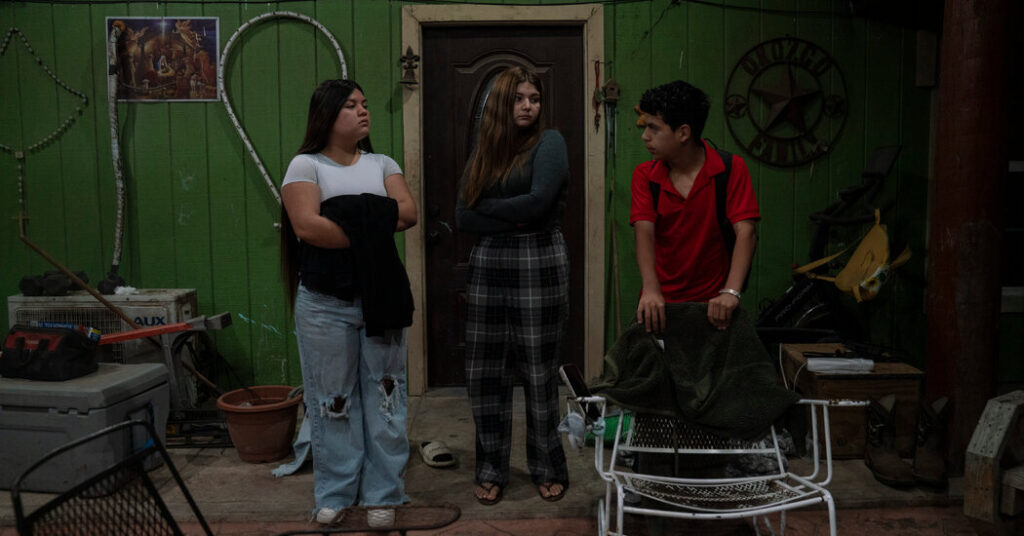
Before the sun rises, Andrea García is already awake, unsettled by an unusual cold spell and tormented by the memory of immigration agents upending her life.
Andrea, 22, willed herself out of bed. A child-sized statue of La Virgen de Guadalupe in the living room, a symbol of maternal protection for many Mexican Catholics, stood watch as Andrea set the home in motion.
She had to get her five siblings ready for early Sunday mass. After waking her sister Ana, who shares a bed with her, she nudged her two younger brothers sleeping in a nearby room.
“Levantense. Get up,” Andrea said using Spanglish, the mixture of English and Spanish that is common along the border.
Jorge Orozco, 11, sprang out of bed, his eyes shut tight. He didn’t move again until Andrea returned with an urgent plea, “Ya es hora, it is time.”
Getting everyone up and ready for school had gone faster when their parents were around, Andrea said. “They used to listen to dad more. They are not ready to see me as their parent.”
In January, immigration agents raided the family’s home in a rural section of Donna, Texas, a small border town of about 17,000 people. They arrested Andrea’s parents, Julio Orosco and Lucero Garza, who had been living in the country without authorization for years. Ms. Garza was deported to Mexico; Mr. Orosco is still in custody.
But Andrea and all of her siblings, ages 11 through 22, are all citizens, born in the U.S. And so Andrea, who had been making plans to one day start her own young adult life, to live in her own apartment, and to perhaps find a husband, was instead thrust abruptly into an unlikely and unfamiliar role: matriarch.
In the weeks since, the older siblings have put relationships, careers, and education on hold, substituting as caretakers for their younger brothers and sisters.
Their story illustrates some of the less-seen effects of the Trump administration’s immigration crackdown, scrambling the lives of American citizens who were raised by undocumented parents who chose to raise their family in the United States despite the risks. Immigration stories like theirs are under increasing scrutiny, as the Supreme Court considers arguments about birthright citizenship, which guarantees that nearly all babies born in the U.S. are citizens.
“We are not going to deny that they crossed illegally, like many people here have done,” Andrea said as her siblings nodded their heads. “They did it for a better life.”
Mr. Orosco and Ms. Garza crossed the border as young adults, and reconnected later, after Ms. Garza had three young children. They fell in love and had three more, and the family made its home in South Texas, where Mr. Orosco worked in construction with his oldest son.
But under the Trump administration’s immigration crackdown, some border areas are seeing more than 5,300 ICE arrests per month this year. Early on Jan. 9, several agents descended on their home as some of the children slept.
According to interviews with the siblings, and a lawsuit filed by the family, the agents stormed the house and injured some of the children, including a 15-year-old with histiocytosis, a rare disorder that can affect the bones.
Humberto, 21, was leaving for work when he said he first noticed the agents, many of them wearing masks. An exterior home camera captured images of the agents drawing their guns on Humberto and knocking him to the ground. He was detained and released after several hours in detention.
The fallout was swift: Within weeks, Ms. Garza became depressed in custody and decided to sign a self-deportation order. Mr. Orosco, the father, has a court date in the coming weeks. He expects to be deported. The Department of Homeland Security said agents identified themselves and were serving a judicial warrant, and that Humberto initiated physical contact after they entered the property.
Mr. Orosco had previously been removed from the country eight times, according to DHS. A search of public records did not reveal any additional charges for him or Ms. Garza.
Life for their children changed immediately, in big and small ways. Humberto, the second oldest, postponed a pending wedding and took a job in Dallas cutting trees to help support his siblings. Ana García decided not to pursue a degree in law enforcement after the incident and joined her sister Andrea, 22, as a cleaner.
And the three underage children, Juan, 17, Lucero, 15, and Jorge, 11 have become withdrawn and insulated from the rest of the world outside school, unsure who they can trust.
“Our family is not the same,” Andrea said in an interview.
On a recent Thursday afternoon, Ana found herself home alone in the house her father built. She tried to make sense of recent events while standing next to an altar decorated with figurines of angels and religious saints. Reminders of her parents are everywhere, on the medicines her father used to take for diabetes and hypertension on top of the refrigerator and letters her mom sent them periodically from detention and now Mexico.
She picked up the latest one and read part of it to herself, “Los amo mis hijos, I love you, my children.”
Her older sister, Andrea, was out running errands and Ana knew it fell on her to make dinner. Until recently, she didn’t have to worry about feeding a family of six.
She grabbed a piece of ground beef from the freezer and laughed, realizing it didn’t fit in the pan. She ran it under water to thaw it and then decided that the heat from the stove would have to do. She added potatoes and seasonings and stepped back to admire her work.
“I hope they like it,” she said. “I watched my mom cook and helped growing up, but it’s not the same. She was the cook of the family.”
Later that afternoon, the children began arriving home. Jorge, the youngest, got off the school bus and sat on the couch. He pet his dog Max, a poodle, without saying a word.
“He used to be more outgoing,” Ana said. Now he’s more reserved.
When Ana nudged him to eat dinner, he shrugged and said he wanted eggs instead. She threw her hands in the air in exasperation, and obliged. The boy ate quietly and stared at a photo of himself adorned with the word “Mom.” It was an old Mother’s Day gift.
Ana was happy he was eating his dinner, but she did not feel much like a mother.
“I feel like I’m still young and not ready for this,” she said of being responsible for growing children. “And he’s still young enough that he needs his mom and dad.”
Her older brother Juan, 17, a high school senior taking college level courses, doesn’t dwell on what happened and instead tries to focus on schoolwork. Like most days, Juan got home from school and hopped in his bed to listen to a science lecture. He hopes to leave Donna one day and move to San Antonio to study law enforcement. “I like state trooper uniforms,” he said.
His sister Ana, who before the raid was also considering a career in law enforcement, told him that she could not in good conscience pursue that field anymore after what she witnessed. “They treated us like we were the worst criminals,” she said to the group, with everyone lowering their heads. “I can’t be part of that.”
Lucero, the 15-year-old, was a self-described daddy’s girl. She bonded with her father over the daily routine of feeding chickens and roosters they kept in the backyard. Now that he’s gone, it is the one activity that makes her feel like he’s still home in some way, she said.
She smiled when the chickens and roosters greeted her the second she poured rice and water on their plates.
“Mi dad siempre lo hacía, my dad used to do it,” Lucero said on this day. “Y como le gustaba a mi dad, me gusta a mi. And since he liked doing it, now I like doing it.”
One night, an exhausted Humberto got home from his job in construction and collapsed on an old couch. He had news for his five siblings. He had recently landed a job in Dallas, more than 500 miles north of the region, cutting trees that would help cover the about $2,400 monthly bills. Andrea and Ana had picked up more cleaning shifts to make ends meet. The siblings nodded their heads and said little.
“I feel bad leaving them behind, but Juan is going to help out more,” Humberto said of his brother.
Two days later, the six siblings attended an early Catholic mass in the nearby town of Weslaco and glanced at each other quietly when the priest encouraged parents and children to volunteer to help make repairs needed at the church.
Andrea let out a bittersweet chuckle. Her father, a religious man who often dragged his children to church events, would have loved to participate.
“We don’t have parents anymore,” she said. “At least not now and maybe never.”
Gabriel V. Cárdenas contributed reporting. Susan Beachy contributed research.
Edgar Sandoval covers Texas for The Times, with a focus on the Latino community and the border with Mexico. He is based in San Antonio.
The post Their Parents Were Taken by ICE. The Children Had to Raise One Another. appeared first on New York Times.