On the bridge of the U.S.S. Enterprise, Commander William Riker stares into the face of his captain and sees a future worse than death. Jean-Luc Picard—principled diplomat, conscience of the Federation—stands on the viewscreen, stripped of everything that made him human. His ashen skin is snaked with circuitry, his voice flattened into the cold register of the Borg, a cybernetic collective that assimilates entire civilizations and reshapes them in its own image. In that moment, it wasn’t just a captain taken; it was the Federation’s belief in itself.
“I am Locutus of Borg,” Picard announces. “Resistance is futile.”
Riker doesn’t hesitate to neutralize the threat. “Mr. Worf,” he says. “Fire.”
The screen cuts to black. Then come the words: “To Be Continued…” That summer, millions waited.
The cliffhanger marked the end of “The Best of Both Worlds” Part I, the Season 3 finale of Star Trek: The Next Generation, which aired in June 1990. “The Best of Both Worlds” is a story about control—what it means to lose it, what it costs to take it back—made by creators who didn’t yet know how the story would end. Conceived in uncertainty and produced without an ending, it transformed what the franchise could be, expanding its emotional range while pushing its storytelling toward serialization. More than three decades later, its influence is still felt across Star Trek and in the season-defining storytelling that became a staple of modern television. As the franchise reaches its 60th anniversary, the two-parter remains one of the clearest expressions of Star Trek at its best and a turning point for what followed.
For three months, nobody knew whether Picard would survive. Fans debated on the phone and at convention tables; tabloids speculated. A mythology took hold around the cliffhanger and Picard’s future.
The reality was more complicated. “It was not a question of, are people going to be leaving the show? Are we killing anybody off?” says Rick Berman, who served as executive producer from 1987 to 1994. As Patrick Stewart later recalled in his memoir Make It So, he had signed a six-year contract up front, ahead of the series debut in 1987. The real ambiguity lay in the storytelling—not in front of the camera, but behind it. When that cliffhanger aired, no one on the writing staff knew how to resolve it.
Read more: The Best Sci-Fi TV Shows of All Time
Writing into the dark
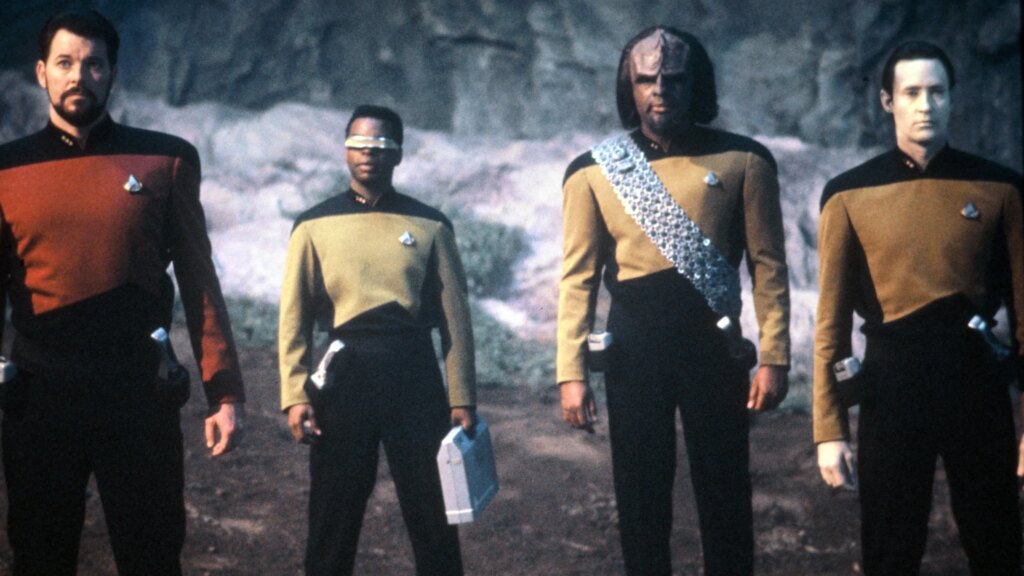
By the spring of 1990, Star Trek: The Next Generation had spent two uneven seasons trying to escape the gravitational pull of the original series. Aside from an animated series in the early ‘70s—which led to four films with the original cast by the time The Next Generation premiered—the franchise had been off the air for nearly two decades. Set in the 24th century—almost a century after the 1960s show—the new series followed the crew of the U.S.S. Enterprise as they explored new worlds on behalf of the United Federation of Planets. Its stories were built more on moral dilemmas than combat, and on the belief that humanity had moved beyond many of its present conflicts.
Its success wasn’t a given. Among fans of the original series, skepticism ran deep. Bumper stickers sold at conventions read, “Who’s the bald guy?”, a jab at Patrick Stewart’s Picard; T-shirts pledged allegiance to the original series’ Kirk and Spock, played by William Shatner and Leonard Nimoy. But midway through the third season, under executive producer Michael Piller, the show found its footing, and Piller wanted to end the season in a way that forced the doubters to reconsider.
Piller returned again and again to the Borg. The hivelike cybernetic collective appeared only once, in the Season 2 episode “Q Who,” but their menace lingered. Piller deliberately kept them in reserve, telling the staff that when the Borg returned, it had to feel seismic. Now he saw his opening: a season finale cliffhanger that would pit the U.S.S. Enterprise—the Federation’s flagship—against one of the Federation’s most formidable enemies and leave the audience stranded.
The Next Generation was syndicated television, sold directly to local stations across the country, where scheduling varied from market to market. At the time, Paramount was wary of multi-part storytelling in syndication. In a system where episodes might not always air consistently or in order, a serialized story wasn’t just a creative risk; it was a logistical one. Berman describes the push for a two-parter as a “continual battle.” Even with a strong rapport with the studio, he says, the idea of a continuing storyline was “verboten.”
Berman spent weeks lobbying Paramount Television president John Pike and its chairman Kerry McCluggage. “We had to put up a lot of begging,” Berman recalls. They ultimately granted permission only because the two halves would straddle seasons—the finale of one, the premiere of the next—minimizing the disruption to local scheduling.
With clearance secured, Piller wrote Part I alone. Moore recalls the rest of the writing staff, stressed and exhausted from a grueling 26-episode season, were happy to let him. They were barely ahead of the production schedule, “desperately” trying to get scripts out in time. “We were like, oh, OK, sure, Mike, go do it,” recalls Ronald D. Moore, then the staff’s most junior member. “Less work for us.”
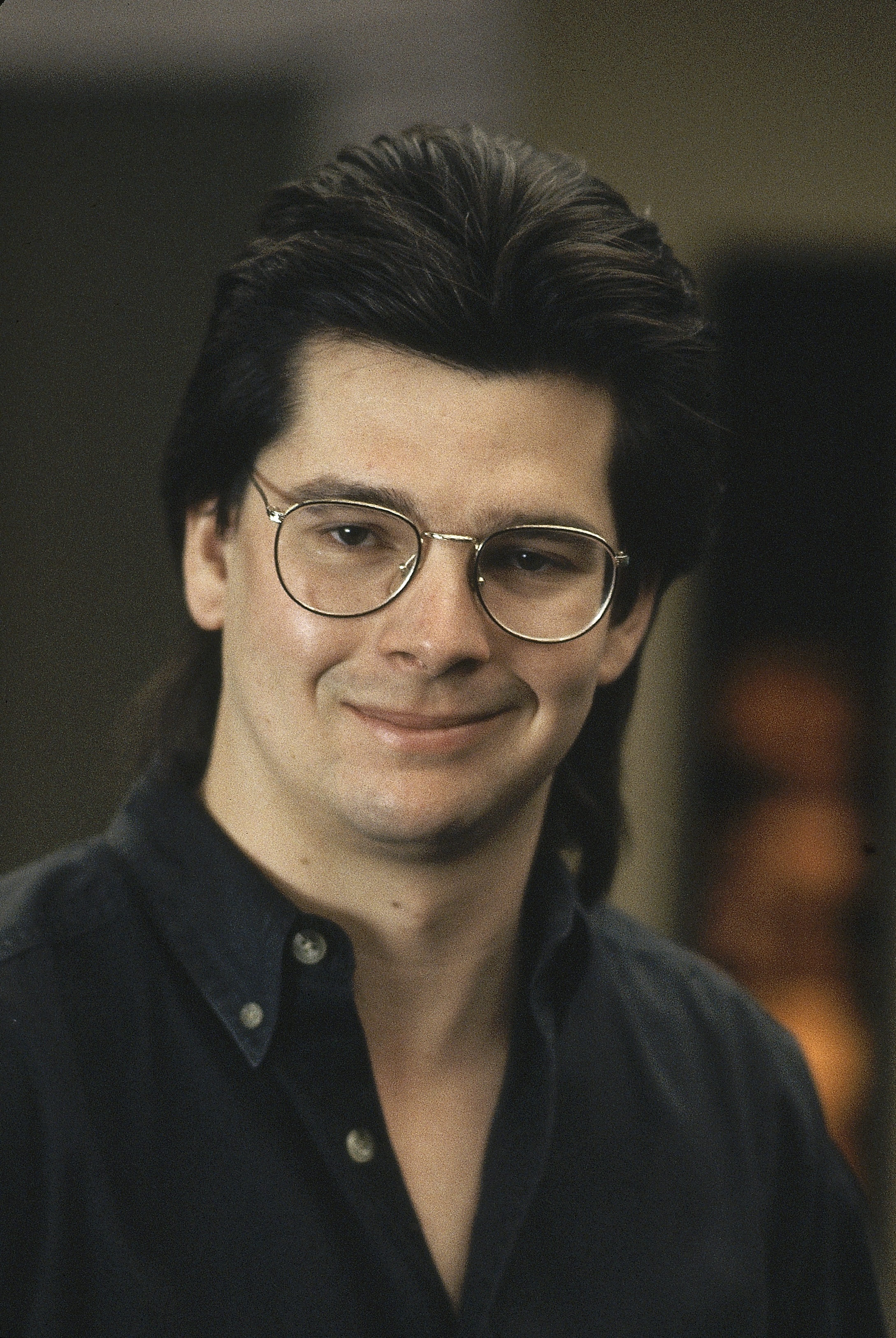
But Piller wasn’t simply writing a Borg episode. He was working through a crisis of his own. Unsure whether he wanted to return to the show or leave to run a new one, Piller poured that indecision directly into the script. The character who bore it wasn’t Picard; it was Riker, the Enterprise’s first officer, played by Jonathan Frakes, who keeps turning down his own command of a starship because he can’t bring himself to leave. “The two-parter is really about Riker,” Moore says. “It’s a Riker story, because Michael himself was going through his own indecision about what he wanted to do with Star Trek.” The question in the script was one he hadn’t yet answered for himself.
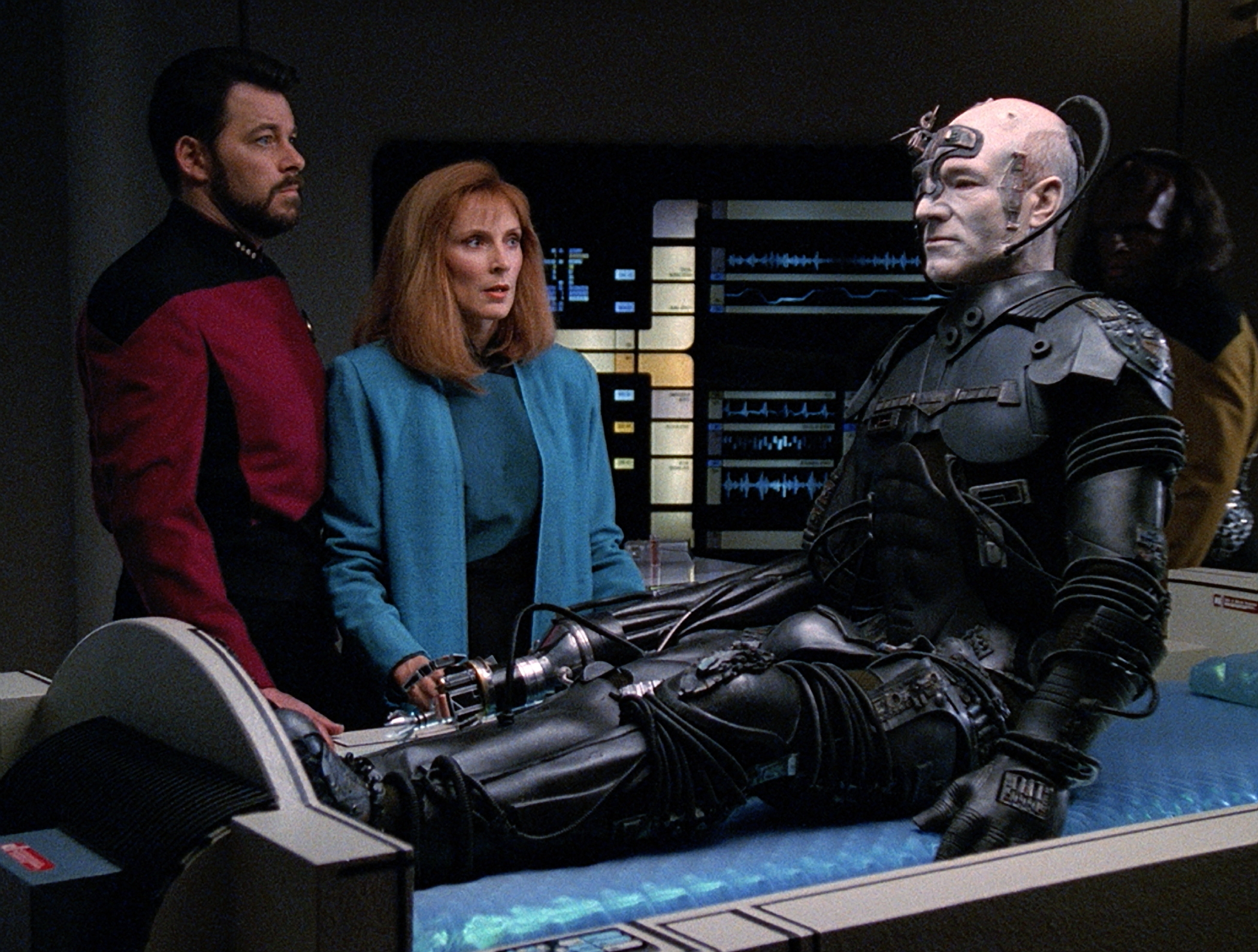
Piller was proud of one thing above all: he wrote Part I with no plan for Part II. In the first act, the Enterprise learns that a Borg cube—a massive, featureless warship—is carving a path toward Earth, destroying Starfleet vessels along the way. Lt. Cmdr. Shelby, a Borg expert, is brought aboard to help mount a defense. Riker, meanwhile, is weighing whether to accept his own command of a starship or remain as Picard’s first officer. When the Enterprise engages the cube, its weapons prove ineffective. The Borg beam board the ship, abduct Picard, and transform him into Locutus—their spokesman and strategic weapon against the Federation. In the final moments, Riker, now in command and staring down the cube that holds his captain, gives the order to fire before the screen goes black.
It was a genuine creative cliff, and no one knew the way down. “Suddenly, it was next season, and we had to figure out what it was going to be,” Moore says.
A new arrival
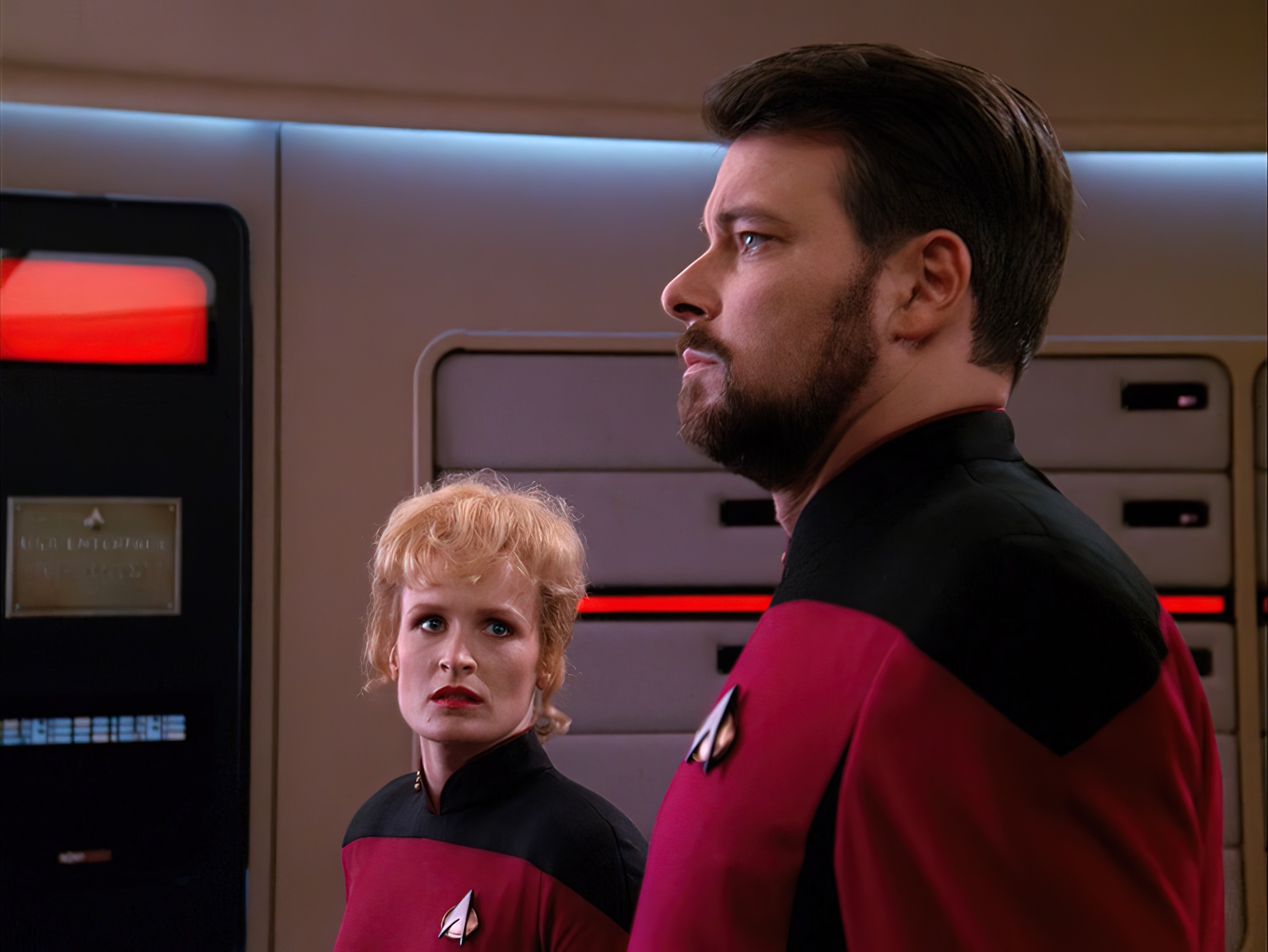
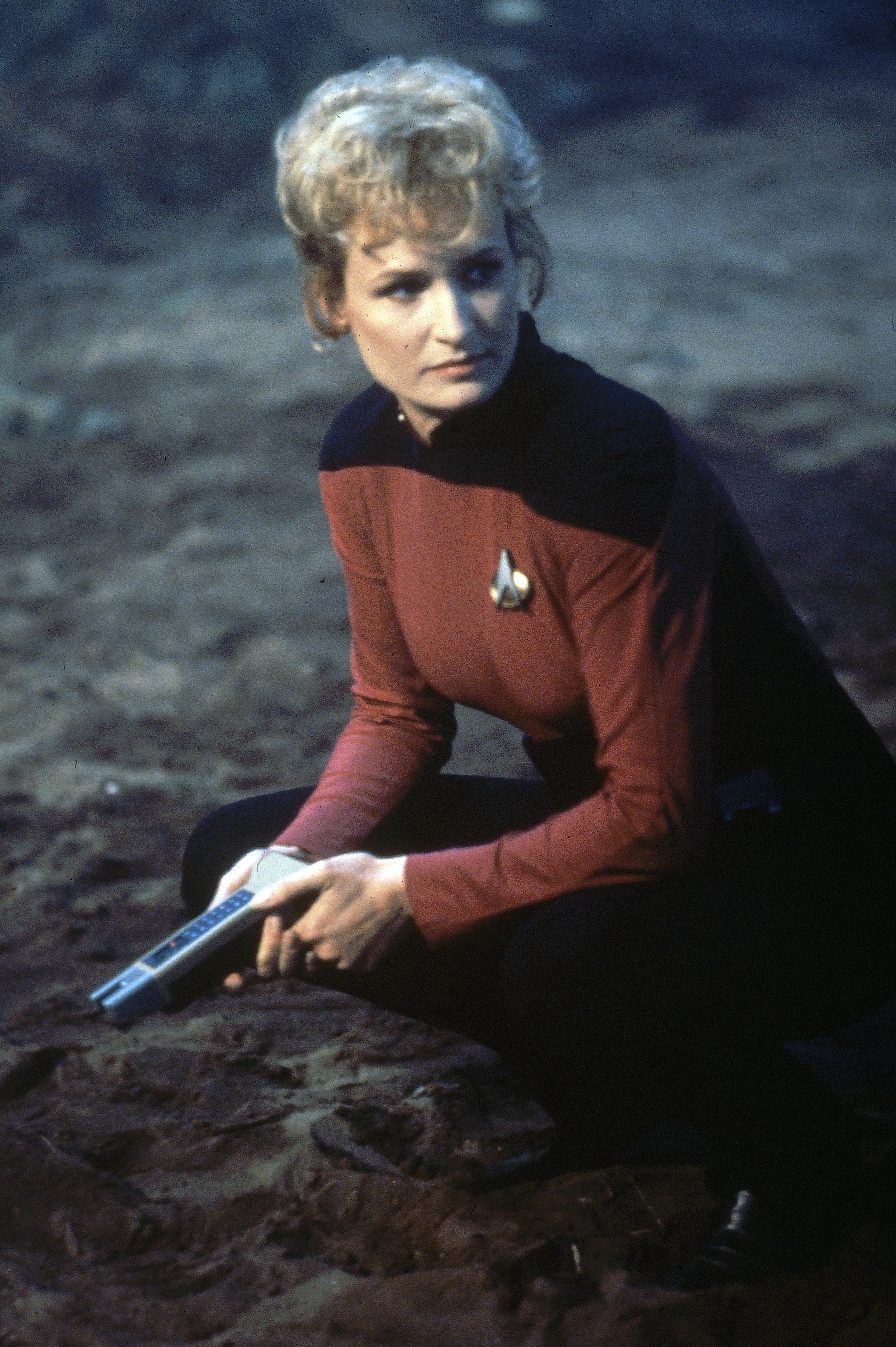
On the Paramount lot that spring, the cast was grinding through the final stretch of the third season, moving with the fatigue of a long production run nearing its end. The days stretched well past 12 hours, with some actors arriving as early as 4 a.m. for makeup. Elizabeth Dennehy, who was making her debut as Lt. Cmdr. Shelby, arrived having never seen an episode. “I didn’t know what the Enterprise was,” she says. “Knew nothing.”
Her lack of familiarity proved an unlikely gift. Shelby, on the page, didn’t care about the food chain: she walked into a room and started working regardless of whose authority she might be stepping on. Dennehy, unburdened by reverence for the franchise’s hierarchy, channeled that energy without trying. On her first day, Frakes introduced himself in the makeup trailer. “I said, oh, I thought the baldy guy was playing Riker,” says Dennehy, referring to Stewart. “When I read the script, I pictured him as Riker.” She left that first day unsure of her performance, worried she might be fired. “I had a really rude awakening. I did not know my lines well enough.”
Her obliviousness registered as confidence on camera. But it took a note from director Cliff Bole to sharpen it into a lasting performance. In the turbolift confrontation scene—Shelby’s declaration that Riker is “in my way” in her move up the ladder—Dennehy glared upwards at the considerably taller Frakes, which Bole felt diminished her authority. “He said, plant your feet on the ground and look more straight ahead,” Dennehy says. “Make it look like you’re meeting him eye to eye.” She adjusted her stance, a small intervention that helped unlock the performance. “It changed everything and gave me the character.”
Frakes, for his part, made it his practice to welcome guest actors into a cast that by then operated with an easy, established rhythm. He’d been a guest star himself and knew how easily an outsider could be made to feel unwelcome. “We had a collective consciousness of making our actors feel comfortable,” he says. With Dennehy, the connection was immediate, deepened by a personal thread: Frakes had worked with her father, the late Brian Dennehy, and gone to school with her uncle Ed. “She fit in with us,” he says. “She got us.”
But there was one complication that made their performances harder to pin down. Filmed across eight days in April 1990, Part I was made without a script for Part II. Neither Dennehy nor Frakes knew whether Shelby and Riker would end up as allies, adversaries, or even lovers. “We had absolutely no idea what was going to happen,” Dennehy says. So the two made a quiet decision: plant seeds in every direction. Small gestures—a side glance, a smirk, a flicker of unresolved tension—so that whatever Part II demanded, the groundwork was in place.
The violation of self
The key to Part I’s power was Piller’s most radical decision: assimilate the captain, make him the mouthpiece of the enemy. Turning the show’s moral authority into its villain was, as Moore puts it, a “big, bold move.” The writing staff was energized but wary. “We were all kind of like, wow,” Moore recalls. “That’s really going to take us big places.”
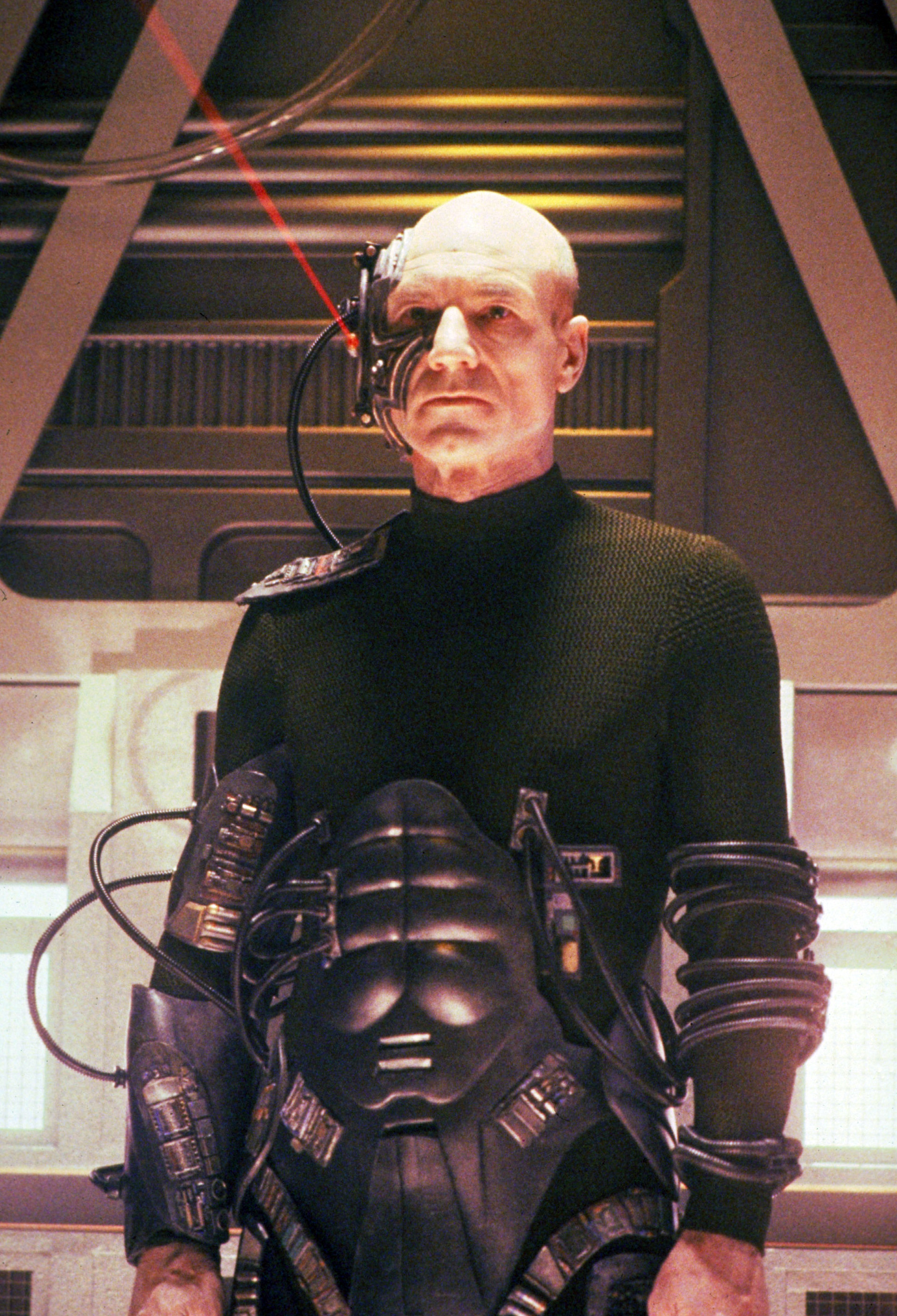
The physical transformation of Stewart into Locutus required hours in the makeup chair as layers of prosthetics and mechanical elements were applied, under the direction of Michael Westmore, whose family’s legacy in Hollywood makeup artistry stretched back to the early 20th century. “[Patrick] got a kick out of his ‘Borgification,’” Berman says. The result was a figure designed to disturb: Picard’s face was still recognizable but threaded with dark tubing, implants, one eye replaced by a glowing red laser and his skin drained of color. He looked less like a captured man than one hollowed out and rebuilt.
It was a rarity for the franchise: a violation not of the ship but of the self. When Locutus appeared on the viewscreen and addressed Starfleet in Picard’s voice, the horror landed not just because of what you saw but because of what you didn’t. “You suddenly kind of realize, oh, there’s a hive of thousands of these people who were once individual human beings,” Moore says.
Stewart, in a detail Berman remembers fondly, made one small but permanent choice. The scripted line read, “Resistance is futile,” with the American pronunciation of the last word. Stewart changed it to the British pronunciation of “futile.” “Everyone used it from then on,” Berman says. It was the actor’s signature on the villain—a reminder that even inside the machine, Picard’s voice was still his own.
Cracking the code
When production for The Next Generation’s fourth season began in July 1990, the writing staff had almost entirely turned over—a consequence of the show’s punishing schedule and the high burnout rate that plagued its early years. Moore was the sole holdover. New writers filled the room: more senior but unfamiliar with the show’s rhythms. The problem Piller left behind was now theirs to untangle.
Through it all, Moore stayed at the dry-erase board, writing out the scene-by-scene story break while the room talked it through. It took a couple of days before the room landed on a solution that felt both technical and human. Once the crew rescued Picard, they could use his lingering connection to the Borg collective to issue a command that triggered a regeneration cycle, forcing the Borg into dormancy and setting off a cascading failure across the cube. The mechanics mattered, but the emotional logic mattered more. The crew had to reach Picard inside the machine, find the remnant of the man they knew and use that connection to save themselves.
But Piller’s ambition for the story extended well beyond the mechanics of resolution. He arrived at The Next Generation in the third season with a philosophy that reshaped the series. “His marching orders to the writing staff were, it’s a character show,” Moore recalls. “Every episode has to start with us saying, which of our characters is this about? What do they learn? What do they struggle with?” That single directive, Moore says, flipped the “whole series on a dime.”
Applied to “The Best of Both Worlds,” the mantra clarified everything. Whose story was this? Riker’s first, Picard’s second. And once Picard was rescued and the Borg defeated, Piller insisted the story wasn’t finished. He was determined to keep the ready room’s final image—Picard alone at the window, haunted—despite the studio’s reluctance. “The studio was kind of against it, because it implied that he was still struggling,” Moore recalls. The writing staff held firm. They understood, even if the studio didn’t, that the most important scene in a story about losing yourself is the one where you realize you never fully came back.
That moment opened a door. If Picard couldn’t simply return to normal after what the Borg did to him, then the show owed its audience—and its character—a reckoning. Moore wrote the following episode, “Family,” a rare Earth-bound hour in which Picard returns to his family’s vineyard in France and, in a scene that still catches in the throat, collapses in the mud, his brother a few feet away. It was a singular departure for the era: an episode that stripped away the weekly crisis to focus entirely on the domestic wreckage of a soldier returning home. Moore saw it as an essential continuation: the emotional aftermath that gave the two-parter’s scope its meaning. Six years later, the 1996 film Star Trek: First Contact found Picard still reckoning with what the Borg did to him—proof that the wound Piller opened in 1990 had permanently imprinted on the character.
“Because [Michael] pried that door open for Picard, it implied that you could start doing that to some of the other characters, too,” Moore says. “You could start, little by little, building on things.” That same season, the writing staff followed up on a storyline about Worf (Michael Dorn) from the year before—his lost honor among the Klingon species—and built it into a full arc. The precedent was set. Serialized storytelling on Star Trek—the emotional continuity that came to define later spin-offs like Star Trek: Deep Space Nine and the modern era of the franchise—traces a line back to this two-parter and the episode that followed it.
Piller died in 2005 at 57, before he could watch “The Best of Both Worlds” take its place in the television canon. But his influence on the franchise only widened after that landmark: he remained an executive producer with The Next Generation through Season 6, co-created Star Trek: Deep Space Nine and Star Trek: Voyager, and also co-wrote the 1998 film Star Trek: Insurrection with Berman.
Frakes still believes his influence remains underrecognized, felt not only in the episodes themselves but in the people he championed, Next Generation writers who went on to shape television in their own right: Moore (Battlestar Galactica, Outlander), Brannon Braga (Star Trek: Voyager, Star Trek: Enterprise), René Echevarria (The 4400), and Naren Shankar (The Expanse). Piller also made room for outsiders, establishing a spec-script policy that allowed unrepresented writers to submit original episodes for consideration. “He trusted his taste, and he was willing to share the spotlight with these young, hungry, smart, clever writers,” Frakes says. If the franchise remembers “The Best of Both Worlds” as a turning point, it also remembers the man who taught it how to grow.
The opposite of being human
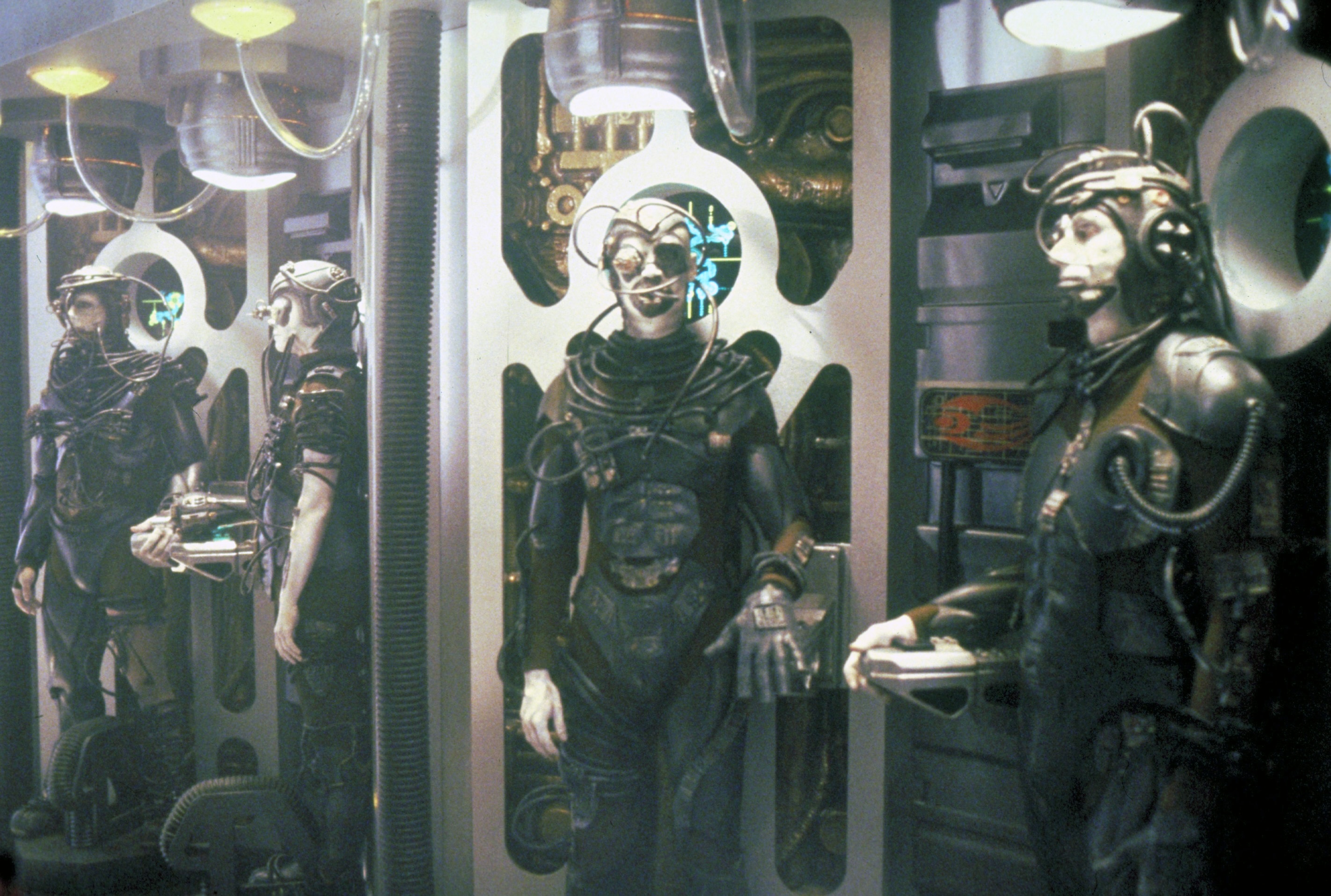
The Borg appeared only once before, in the Season 2 episode “Q Who,” but “The Best of Both Worlds” was the story that fixed them in the franchise’s imagination. Before this two-parter, they were a menacing idea, a faceless swarm not yet fully realized. After it, they were seared into the culture. The Borg didn’t simply conquer you; they erased you. Frakes remembers their evolution not as a single creative breakthrough but as a convergence of disciplines. The writing made them dangerous, but it was the collective work of the show’s artists—makeup, costume, production design—that gave the Borg their final form. “It’s a fabulous example of how a company of artists share their talents by focusing on one element, and the end result is exponentially better than the pieces individually,” he says.
Rod Roddenberry, Star Trek creator Gene Roddenberry’s son, frames their endurance in the franchise through the philosophical lens his father spent a lifetime building. “They are the exact opposite of being human,” Roddenberry says. In a franchise built on his father’s principle of “IDIC”—infinite diversity in infinite combinations—the Borg represent the negation of everything the Federation holds sacred, suppressing autonomy and reducing consciousness to function.
Roddenberry resists the impulse to simply despise them. “I love having empathy for the ‘bad guys,’” he says. “They’re just trying to assimilate and get more knowledge.” The Borg lasted because every era could recognize its own nightmare in them. When “The Best of Both Worlds” aired in June 1990, with the Cold War in its final months, their insistence on collective conformity echoed an old Western fear: the erasure of the individual into the state. In the years after 9/11, as American culture grew preoccupied with infiltration, hidden enemies, and identities corrupted from within, the Borg’s violation of the self took on a different resonance. Now, in an age when algorithms curate our feeds, deepfakes replicate faces and voices, and AI grows more fluent by the month, their central horror—the dissolution of selfhood into a networked intelligence—feels less like science fiction than our present reality.
His father, Roddenberry notes, evolved between The Original Series, which ran from 1966-1969, and The Next Generation—and the shows reflect that. “Captain Kirk was the cowboy: he was going to throw a punch,” he says. “Picard was the diplomat. The last thing we do is fight; we avoid violence at all costs. That was the refined Gene Roddenberry.”
The refinement from instinct to restraint shaped The Next Generation into a future Roddenberry finds more appealing. “I would rather live in the TNG future than the TOS [The Original Series’] future,” he says. The Original Series imagined a future where humanity reached the stars; The Next Generation imagined one where humanity learned to reach itself….
A change in the stars
When “The Best of Both Worlds” Part I aired, the ground gave way. Moore, who attended conventions as a fan before joining the show, watched the change happen in real time. “There was this unexpected kind of reaction,” Moore recalls. “It got a lot of mainstream press, and a lot of eyes and chatter.”
The fandom realigned. The hostility that greeted The Next Generation’s cast—a bald English captain with a French name, a Klingon on the bridge—eased into acceptance, then admiration. “We were real Star Trek, too,” Moore says. “We had earned it, and we were part of the firmament at that point.” Frakes sees that moment as inseparable from the risks the show was finally able to take. “We had found our stride,” he says. “It was fitting that the stakes were that high for that cliffhanger.”
For Dennehy, the change happened more gradually, and it struck a more personal chord. Her first convention, in St. Louis alongside George Takei, who played Hikaru Sulu in The Original Series, brought fans to her table with a verdict that stung. “People would come up to me and say, ‘I hated you. You were such a bitch,’” she recalls. “‘How dare you question Riker’s authority?’” She would ask them: “But was I right?” The grudging answer was usually yes.
Over the decades, the response to her character changed. Young women began approaching with a different message entirely: that Shelby helped set them on paths into science and, in some cases, the space industry. The culture caught up. As depictions of women on screen grew sharper and less apologetic across the ‘90s and 2000s—from Dana Scully in The X-Files and Star Trek: Voyager’s Kathryn Janeway to Battlestar Galactica’s Kara Thrace—audiences rethought what confidence looked like on a woman, and in Shelby it began to read more as authority.
Shelby embodied an ambition the show had not yet learned to accommodate: one of the franchise’s earliest female characters who was professionally driven, even challenging, without the narrative punishing her for it. Decades later, Star Trek: Picard returned to her as an admiral, reaffirming how much that two-part introduction had already changed the franchise’s understanding of female ambition and command. Once her initial character arc was complete, she became, for a generation that grew up without the expectation that women should defer, a model of self-possession.
The point of no return
Thirty-six years after it first aired, “The Best of Both Worlds” still serves as a threshold: the story casual fans point to when they realized Star Trek could wound them, and a moment longtime viewers return to when they want to see the franchise at full power.
Its legacy courses through Star Trek. What followed shows how vital that franchise era became: four films with The Next Generation cast, spin-offs in Deep Space Nine, Voyager, and Enterprise, three films led by Chris Pine as Kirk, and a newer wave of shows that included Discovery, Picard, Lower Decks, Prodigy, Strange New Worlds, and Starfleet Academy. The serialization Piller fought for—consequence moving forward, episode to episode and season to season—became the grammar of modern Trek. Picard’s trauma, rendered with such care across the two-parter and “Family,” proved science fiction could honor the interior lives of its characters without sacrificing scale. The Next Generation earned its place not by replacing The Original Series but by proving it could stand beside it.
“The Best of Both Worlds” was built on the edge of uncertainty: Piller writing through indecision, a cast working without an ending—and that uncertainty is etched into every frame. In the language of science fiction, the two-parter distilled an experience that isn’t bound to any one era: the terror of losing the self, and the fragile, unfinished work of taking it back.
Berman describes the two-parter as Star Trek’s “first chance to tell a two-hour story” in the modern serialized sense. Frakes calls the cliffhanger the “reason it resonates,” and sees in it a larger truth about what Roddenberry built: a franchise unafraid to argue that the future can be better than the present. For Moore, it became the foundation for everything that followed on Star Trek and in his own career. “TNG [The Next Generation] was like going to undergraduate school for TV,” he says. “Deep Space Nine was like doing graduate school. I owe everything to that.”
People return to “The Best of Both Worlds” for more than nostalgia. Nostalgia softens, blurs; the two-parter still cuts. It takes what its audience loves most about The Next Generation—a captain and his crew, a sense of order—and cracks it open, not for shock value but for revelation. It asks what remains when authority is compromised, when we hold the line despite knowing the cost. Sometimes, that cost is the person you were before it happened.
It feels inevitable now, as if Star Trek was always going to become this version of itself. But “The Best of Both Worlds” emerged from creative instability: from writers without an ending, actors performing toward the unknown, and a story that refused to offer its captain easy rescue. On the bridge of the Enterprise, a commander gave an order he could not take back. More than three decades later, Star Trek still moves in its wake.
The post The Star Trek Episodes That Changed the Franchise—And TV—Forever appeared first on TIME.