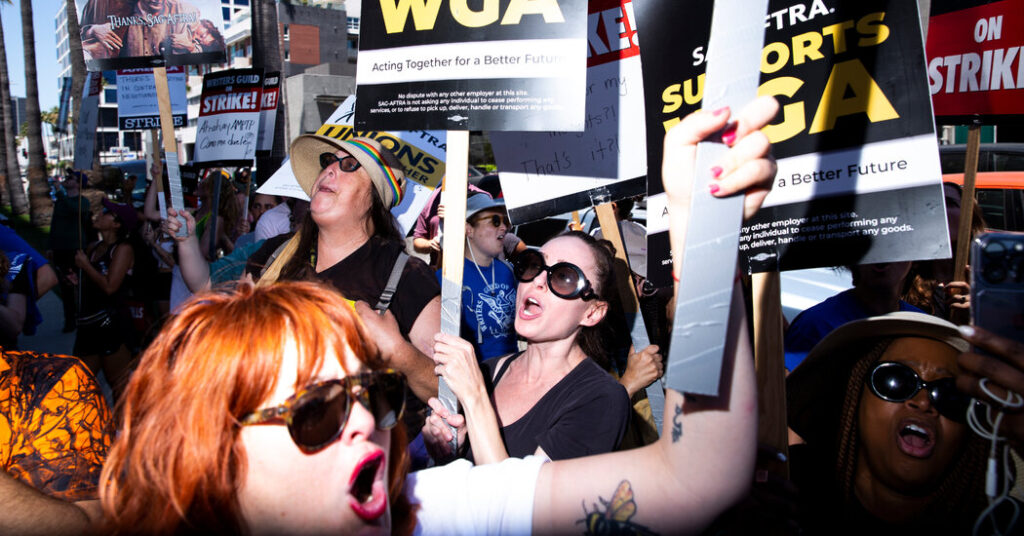
Moving quietly and quickly — remarkably so, given past rancor — the Writers Guild of America and entertainment companies reached a tentative deal on a new contract on Saturday.
“Crucially, it protects our health plan and puts it on a sustainable path, with increased company contributions across many areas,” the guild said in a brief email to members, a copy of which was reviewed by The New York Times. The guild’s health fund has lost an estimated $200 million in recent years, leaving some members facing an uncertain future of medical coverage.
The guild’s negotiating committee unanimously agreed to the deal, the email said. If ratified, the contract would last for four years, one year longer than has been typical. Studios had sought a five-year contract to lower strike risks and increase cost predictability during a period of rapid change for the industry.
The Alliance of Motion Picture and Television Producers, which bargains on behalf of studios and streaming services, confirmed that a tentative agreement had been reached. “We look forward to building on this progress as we continue working toward agreements that support long-term industry stability,” the alliance said in a statement. It declined to comment further.
The Writers Guild of America, which represents more than 10,000 screenwriters, has traditionally been Hollywood’s feistiest labor organization. Contract negotiations with studios in 2023 were particularly drawn out and acrimonious, with the guild ultimately going on strike for 146 days — an action that emboldened the actors’ union, SAG-AFTRA, to call its own strike, bringing movie and television production to a near-complete halt.
In the end, studios agreed to a Writers Guild contract that included an increase in royalty payments for streamed content and guarantees that artificial intelligence technology would not encroach on writers’ credits and compensation.
This time, talks between the guild and studios happened at lightning speed, concluding nearly a month before the previous contract was set to expire on May 1. With the global entertainment business reeling from widespread layoffs, a contraction in streaming spending, and an industry landscape reshaped by the last round of strikes, there was little enthusiasm among writers or studios for another costly standoff.
Complicating matters for the Writers Guild, employees at the guild’s Los Angeles branch have been on strike since mid-February. A prolonged contract dispute with studios would have demanded some of the administrative and logistical resources that the striking staff would normally provide.
Entertainment companies will now turn back to contract negotiations with SAG-AFTRA. The talks went on for roughly a month starting in early February without a resolution. In a joint statement on March 15, when those talks paused so studios could focus on the Writers Guild, the actors’ union said that bargaining sessions had been “productive.”
The actors’ contract expires on June 30.
Brooks Barnes is the chief Hollywood correspondent for The Times. He has reported on the entertainment industry for 25 years.
The post Screenwriters Union and Studios Swiftly Reach Tentative Deal appeared first on New York Times.