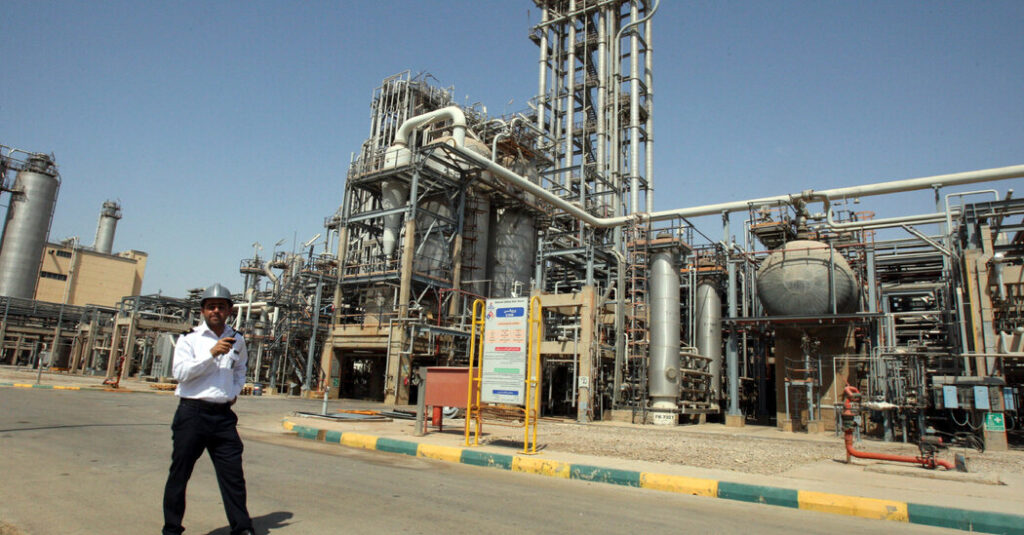
Israel attacked Iran’s largest petrochemical industrial complex in the city of Mahshahr on Saturday, a move that has effectively shut down all production across the sprawling complex, according to two senior Iranian oil ministry officials.
The airstrikes targeted two utility plants, known as Fajr 1 and Fajr 2, that provided the over 50 petrochemical plants operating inside the complex with the basic services needed to function — gas, power and industrial water, among others — according to Iranian state media reports and the two senior Iranian oil ministry officials, who spoke on condition of anonymity to discuss sensitive matters.
Hamed Shams, the head of marketing and communications for the oil ministry’s petrochemical industries, said on social media that the attacks had targeted vital infrastructure that not only supplies electricity to Mahshahr’s petrochemical plants but also, in summer, “plays a key role in providing electricity to 500,000” people in Khuzestan Province.
Israel’s military said that it had struck the petrochemical complex “responsible for the production of chemical materials used for weapons,” and that the sites were “central to producing materials for explosives, ballistic missiles and additional weaponry.”
Israel and the United States have intensified attacks on Iran’s critical infrastructure in the past few days, targeting the country’s two main steel manufacturing plants, pharmaceutical and scientific research centers, airports and seaports, according to state media reports.
The Bandar Imam Petrochemical Complex, as the area is formally known, is one of Iran’s main petrochemical hubs, producing 72 million tons of petrochemical products annually, according to data from Iran’s oil ministry. Located near the cities of Mahshahr and Bandar Imam Khomeini, a major industrial port, the industrial center is the leading employer of the area’s estimated 300,000 residents.
The petrochemical plants in Mahshahr produce a wide range of basic chemicals, polymers and other materials. These outputs can feed into a variety of products, including plastics, clothing and textiles, fertilizers and medical equipment.
The two oil ministry officials said the plants’ total shutdown was an immeasurable blow to Iran’s already frail economy. They said rebuilding the utility plants and bringing the productions lines fully online again could take about two years.
Hamid Hosseini, an oil and energy expert and a member of Tehran’s Chamber of Commerce, said in an interview that downstream industries, like food production, car manufacturing and textiles, that rely on the industrial center’s products would face a crisis when the war was over.
“These are civilian industries that had nothing to do with military use and should not have been attacked,” Mr. Hosseini said. “This is people’s livelihoods. Social security funds have big shares in these companies, and so do many ordinary people.”
The Israeli military has said that the critical industries it has struck are often “dual use,” with both civilian and military applications, or have ties to the government and armed forces. Experts say that even if a facility is dual use, there is still an obligation to weigh proportionality in attacks.
The governor of Khuzestan Province, Seyed Mohammadreza Mavalizadeh, visited the site after the attacks and told Iranian media that rescue teams and firefighters had responded quickly. The governor’s office said five people had been killed and 170 injured. Videos of the attack published on social media show large plumes of smoke and fire rising from the ground inside the complex.
Mr. Mavalizadeh said Israeli airstrikes had targeted other sites in the zone in addition to the two utility plants, including the Razi, Karoun and Bandar Imam petrochemical plants. Iran’s state television said the complex was evacuated after the attacks.
“Attacking Mahshahr’s petrochemical plants means attacking the heart of Iran, the vital arteries of Iran’s economy,” Mehdi Bostanchi, the head of a private industrial complex and a representative for a group of Iranian industrial leaders, said in a social media post.
Petrochemical goods represent about 25 percent of Iran’s total exports, with products going to about 60 countries, and provide a critical source of revenue, bringing in about $10 billion to $15 billion per year, according to Iranian media reports. Petrochemical product sales have served as a main alternative source of revenue for Iran as it has tried to diversify its economy away from oil dependency.
Farnaz Fassihi is the United Nations bureau chief for The Times, leading coverage of the organization. She also covers Iran and has written about conflict in the Middle East for 15 years.
The post Israel Strikes Iran’s Largest Petrochemical Complex appeared first on New York Times.