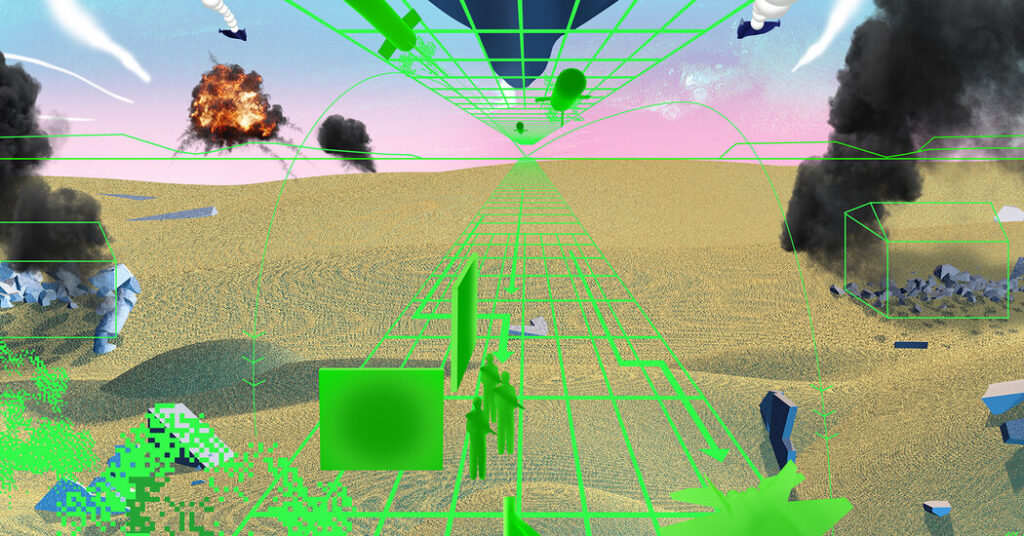
In Washington, planning for a war with Iran always started with the same stubborn reality: It would be hard to fight and even harder to win. The country is vast and mountainous. Much of its military infrastructure is buried in caves and bunkers. Any serious plan to neutralize Iran’s nuclear ambitions or topple the regime quickly arrived at the same conclusion — that success required ground forces and would result in American casualties.
Then came machine learning and artificial intelligence, and with them, the seductive idea that America might finally be able to fight a major adversary indefinitely without sending its citizens into the line of fire.
The promise is not mere fantasy. A.I., fused with increasingly precise weapons and blanket surveillance, has transformed what the U.S. military can do from a distance. The accuracy and speed with which American forces can now find and destroy enemies with potentially fewer U.S. and civilian casualties are a major advance in the nuts and bolts of warfare. As Adm. Brad Cooper, the commander of U.S. Central Command who is leading the war with Iran, said on March 11, A.I. tools can turn targeting processes that “used to take hours and sometimes even days into seconds.”
Yet for all the increased speed and accuracy of A.I.-assisted targeting, the war is showing that the physical world still imposes major barriers to victory. The scale and dispersion of Iranian drones are more than A.I. alone can overcome. Short-range missiles, especially on mobile launchers, can survive even in a world of constant blanket surveillance. If planners had dreams of a final victory for remote-controlled warfare, in Iran they have awakened to a harder reality.
The changes technology has brought to warfare in a single generation are genuinely striking. On one occasion several years before Sept. 11, 2001, for example, the United States used satellite-phone data to target Osama bin Laden at a camp he was expected to visit in eastern Afghanistan, as Lawrence Wright reported in his book “The Looming Tower.” By the time the Tomahawk missiles were fired, however, bin Laden had made new plans; in the end, he never appeared at the site the United States struck. Today, as missiles and drones take off toward Iran, real-time satellite and drone footage of their targets allows them to adjust course and speed based on live inputs.
A.I. is also delivering better battlefield intelligence from a distance than soldiers deployed in the field could have done just a few years ago. Right now, U.S. drones are blanketing Iran, collecting video and images and intercepting signals, transmitting all of them to warships in the Persian Gulf. That data can be cross-referenced with people via their phone numbers, the transcripts of their communications and the places they recently visited. All of this informs strike decisions.
In remote areas of Iran, where missiles and drones are hidden in underground bunkers, A.I. can study changes to the soil, thermal signatures, the appearance of new construction, and vehicular patterns in search of possible launch sites. When Iranian fighters exit bunkers to fire missiles or drones, surveillance drones can identify them as a threat, sending a signal to nearby ships or planes to fire before the munition is launched.
These capabilities have been discussed in public, including last year by Vice Adm. Frank Whitworth, then chief of the National Geospatial-Intelligence Agency, and during the current Iran conflict by Cameron Stanley, the Pentagon’s chief digital and artificial intelligence officer.
Used to create detailed A.I.-generated targeting packages, these capabilities could have given decision makers the impression of a low-risk, quick-turn war with Iran. The further into the conflict the United States gets, however, the more it seems that hope has been a mirage.
Iran is larger than France, Germany, Britain and Italy combined, and drones are hard to find even when you know where to look. Their launch does not emit a detectable explosion like a missile, and they are smaller and easier to conceal. Iran’s Shahed drones can even be launched from the back of a pickup truck. There are simply too many trucks in Iran, spread across too large an area, for automated surveillance and precision strikes to find and destroy every target before it takes flight.
Short-range ballistic missiles have also proved harder to counter than the long-range ones that dominated Israel’s and Iran’s 12-day war last year. Most of the missiles that Iran has fired this year have been short-range weapons aimed at Gulf countries. These are more mobile and smaller, with shorter flight paths, which means that the United States has less time to collect data and respond. Short-range missiles are also easier to disperse and so, like drones, are harder to track down and strike.
For all the advantages of A.I.-enabled targeting, it has not eliminated civilian casualties. The Pentagon has attributed the mistaken targeting of a school in southern Iran, where at least 175 people died, most of them children, to outdated intelligence. A government investigation is underway, but the episode shows that A.I. has not solved the fundamental challenge of preventing civilian deaths in a dense, contested environment.
That shortcoming is especially worrying now, as the administration considers deploying ground forces into Iran. The limits of A.I. warfare will most likely only become clearer if troops fight Iranian adversaries up close. One thing is already clear: A.I.’s impressive capabilities have made it easier to start a war, but they have not yet been enough to win one.
Marc Gustafson was the former chief of intelligence at the White House, head of the Situation Room and a C.I.A. officer. He is a senior director of analysis at Eurasia Group. Justin Kosslyn was a director of product management at Google and is a special adviser at Eurasia Group.
The Times is committed to publishing a diversity of letters to the editor. We’d like to hear what you think about this or any of our articles. Here are some tips. And here’s our email: [email protected].
Follow the New York Times Opinion section on Facebook, Instagram, TikTok, Bluesky, WhatsApp and Threads.
The post Iran Is Ending the Dream of Remote-Controlled War appeared first on New York Times.