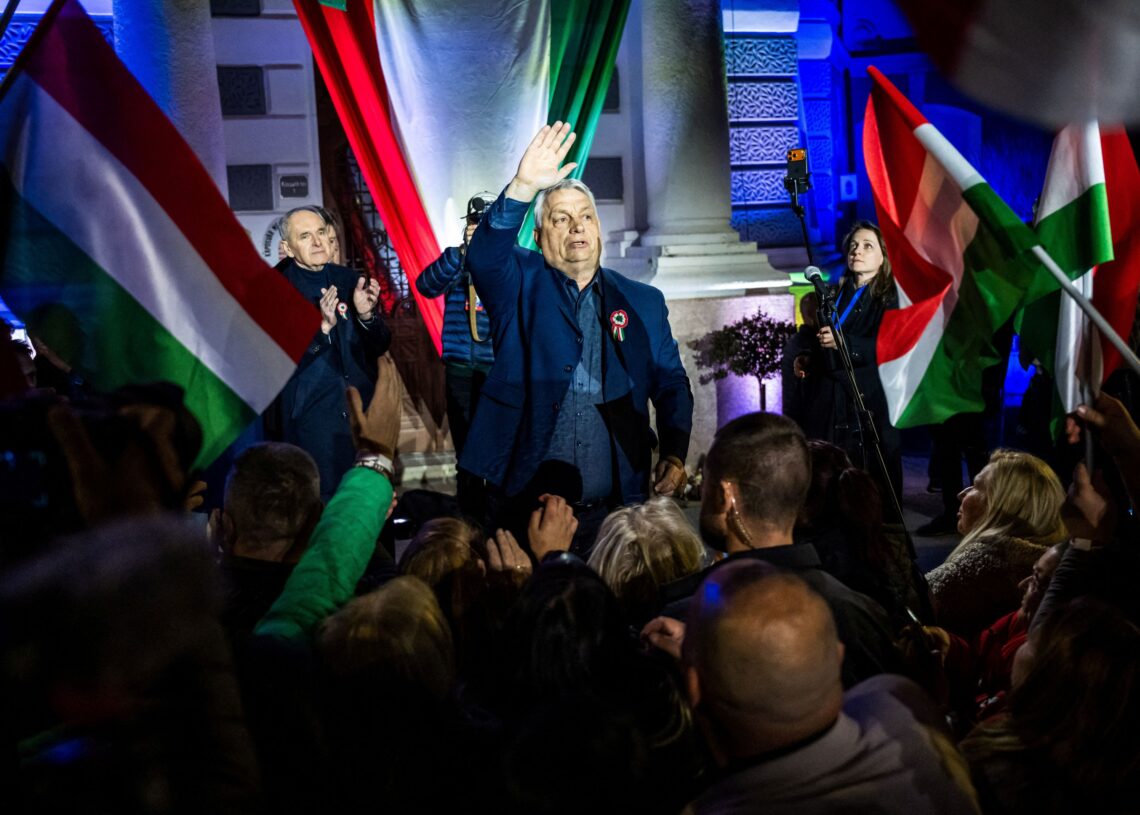
When Vice President JD Vance heads to Budapest this week, his support for Hungary’s embattled prime minister, Viktor Orban, will represent a last-ditch bid to rescue the pro-Kremlin Hungarian who has forged ties to the top of the MAGA movement but is trailing in the polls ahead of a national election on April 12.
Questions are mounting about Vance’s visit, with polls indicating that Orban is falling increasingly behind his center-right rival Peter Magyar, who is challenging Orban over alleged corruption and Hungary’s flagging economy, in the toughest election Orban has faced since reclaiming the premiership 16 years ago.
Orban’s campaign has been racked by reports that his government colludes with Moscow, and tension has risen over government efforts to crack down on his political opponents. A report by Russian foreign intelligence showed that Moscow was so worried about Orban’s standing that it considered staging an assassination attempt on Orban to try to boost his sagging popularity.
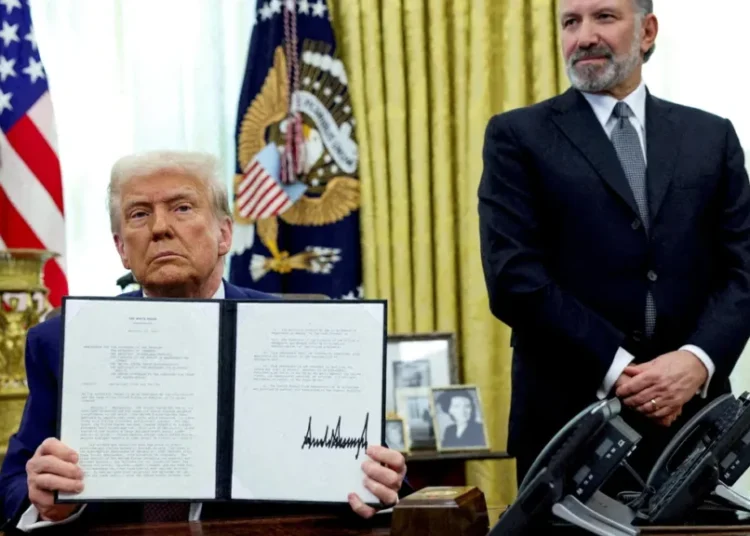
Orban reportedly wanted a visit by President Donald Trump, but Trump is focused on the Iran war and often doesn’t campaign for candidates at serious risk of losing.
“The U.S. Embassy certainly knows the polls and that Viktor is not on the winning track,” said Andras Racz, a senior fellow at the German Council on Foreign Relations’ Center for Security and Defense. “Betting on a loser — that sounds weird.”
Daniel Fried, a former U.S. ambassador to Poland and former assistant secretary of state for Europe, said Vance’s visit showed the White House putting unusual priority on a foreign election.
“The immediate rejoinder will be: We’re at war with Iran. It seems to be going either not well or escalating — and this is how you spend your time,” Fried said. “Orban has made it a hallmark of his political culture to say we resist foreign interference, in particular from Brussels, and yet now he’s inviting foreign interference. … I’m not sure it will work, and … it smacks of desperation.”
A spokesperson for Vance played down the electoral dimension to the trip and said the vice president was looking forward to visiting Hungary “a close U.S. ally, to build on the progress President Trump and Prime Minister Orbán have made on many key issues, including energy, technology, and defense.”
But Western officials said the visit by Vance, scheduled for April 7-8, right before the election, is a sign of how important Orban has become for certain MAGA circles, in particular for Vance and those around him. Among them are supporters of a new alignment between the United States and Russia who criticize Europe’s liberal democracies.
As Orban over the past decade took a forceful stance against migrants and refugees and proclaimed himself Europe’s champion of illiberal Christian democracy, Budapest became a magnet for American conservatives. Orban’s government — bankrolled in part by cheap Russian energy supplies — poured money into a network of think tanks that became hubs for MAGA and nationalist ideology, and that in turn provided channels for the Kremlin to filter its talking points to American right-wing groups.
“It’s been a years-long campaign: very persistent and deliberate and far more sophisticated than people give it credit for,” said a former State Department official from Trump’s first term, who like others in this article spoke on the condition of anonymity to discuss sensitive matters.
The risk that Orban could lose the election is “cataclysmic for a subset on the [American] right,” including for Vance’s electoral coalition, the former official said. “And for the Russians it’s very very bad because they launder all their narratives through these networks.”
Benjamin Harnwell, a close associate of former Trump adviser Stephen K. Bannon, said Orban has symbolic resonance far beyond Hungary. “Orban really is now one of the global leaders of the worldwide populist-nationalist movement, and it would be a massive psychological blow were he not to get reelected,” Harnwell said. “Viktor Orban was Trump before Trump.”
puttthe closest links with the Orban government, according to several Western officials, Harnwell and a person familiar with the situation, as well as a study of public records, reported here for the first time by The Washington Post.
Public records appear to show the most prominent member of Vance’s closest circle with connections to Orban’s Hungary is Chris Buskirk, head of the Rockbridge Network, the secretive fundraising group backed by billionaire Peter Thiel, which has established itself as one of the most influential forces in GOP politics and is credited with helping fuel Trump’s reelection as well as Vance’s rise to the vice presidency.
Buskirk in February 2021 was included on a list of new members of the academic team at the Mathias Corvinus Collegium, or MCC, a key Budapest cultural foundation promoting MAGA and pro-Russian views, according to a news release issued at the time by MCC. The think tank, which is bankrolled in part by cheap Russian energy supplies, also currently lists Buskirk on its website as among its large network of guest speakers and names Buskirk among the “renowned experts” available to teach students at MCC’s university program for the academic year starting September 2025.
A spokesperson for Buskirk, who also is a co-founder of 1789 Capital, the investment firm where Donald Trump Jr. serves as a partner, said he had “no affiliation with MCC, never has, and did not attend these conferences. Any statement suggesting otherwise is false.”
MCC has received hundreds of millions of dollars from Hungary’s position as a beneficiary of cheap Russian energy supplies. In 2020, Orban gifted to MCC a previously state-owned 10 percent stake in MOL, the Hungarian oil and gas conglomerate, one of the country’s biggest and most profitable companies.
According to analysts, MOL is a central node in Kremlin efforts to prop up Orban’s regime through its purchase of Russian energy on beneficial terms. The stake lifted MCC’s fortunes, enabling it to finance numerous junkets for congressional and other conservative U.S. officials to Budapest, including TV host Tucker Carlson in 2021 and 2023, as well as to grant fellowships to Western pundits known for repeating Kremlin talking points.
MCC’s chairman, Balazs Orban, also serves as Viktor Orban’s political director and is another of Vance’s close contacts in Hungary, according to two people familiar with the matter.
Another former MCC senior fellow close to Vance is Gladden Pappin, an American Catholic who founded media publications influential among the American right in 2016 and grew close to Vance before he moved to Budapest in 2021, when he was appointed as a senior visiting fellow at MCC.
Pappin is now paid by the Hungarian government to run a state-owned think tank, the Hungarian Institute for International Affairs. Pappin “has very strong ties to the U.S. leadership and ideological minds shaping foreign policy,” one of the Western officials said.
“It’s the JD, Thiel, Elon [Musk] nexus,” Harnwell said.
Pappin, who has posted photos of himself posing with Vance and Balazs Orban at least three times since the beginning of Trump’s second administration, told The Post: “Vice President Vance’s visit signals a strong commitment to American-Hungarian friendship as a key foundation of peace and prosperity.”
When Trump said in mid-October that he would meet Putin in Budapest within weeks to discuss an end to the war in Ukraine — a meeting that was later aborted — Balazs Orban and Pappin were in Washington meeting with top U.S. officials, people familiar with the matter said.
“There is a new way of looking at the European relationship on the American side, and I think that is reflected in some of the partnerships that are being built,” Pappin told The Post at the time.
Since Orban was elected prime minister for the second time in 2010, the Hungarian leader has been at the forefront of efforts to forge a post-liberal world order.
While forging ever-closer relations with Russian President Vladimir Putin, Orban began espousing a brand of nationalist populism that emphasized traditional conservative values, and he railed against LGBTQ+ and other rights movements.
As Orban ramped up efforts to forge connections with the American right, Hungary first became an echo chamber for Kremlin talking points and then a means of funneling them into the American mainstream, according to the former State Department official.
The pro-government Hungarian media often repeats Kremlin disinformation as fact, according to Andras Telkes, a former Hungarian deputy foreign intelligence chief, and Peter Kreko, the head of Political Capital, an independent Budapest consultancy.
“Without [Orban’s] role legitimizing Kremlin talking points and sanitizing them,” Russian narratives may never have broken through in the United States, the former official said. “There are a lot of people on the right in the U.S. who would never associate with Russians but think that Hungarians are perfectly fine.”
The numerous junkets funded by Budapest think tanks also played a role. Buoyed by his reputation as an anti-woke crusader, Orban’s government was able to build influence by targeting those on the American right “who don’t do foreign policy and generating goodwill from the ground up,” the former official said, adding: “They’ve been doing trips where they invite congressional staff to Hungary, but they don’t bring the national security staff who know better.”
According to Harnwell, for many, the invitations to Budapest, complete with lavish hospitality, have been no more than a gravy train. “I think some of them may just be going for the money,” he said.
Nevertheless, Hungarian institutions have forged close connections with U.S. think tanks at the cutting edge of the MAGA movement. Another Hungarian state-financed outlet, the Danube Institute, signed a memorandum of understanding in March 2023 with the Heritage Foundation, just before the conservative Washington think tank published its “Project 2025” manifesto on overhauling the U.S. government. Heritage’s president, Kevin Roberts, has been a speaker at MCC events.
Some Hungarian officials said they worry that any last-minute intervention by Vance to support Orban’s beleaguered campaign is unlikely to turn undecided voters. “I think it’s only Trump that counts … I don’t think that Vance would do any good,” one Hungarian official said. “Trump is different. He is a global celebrity.”
But even Trump’s public endorsements of Orban — twice in recent weeks by video and social media — have given no visible boost to the prime minister’s standing. A visit by Secretary of State Marco Rubio to Budapest in February, where he told Orban that “your success is our success,” similarly did not appear to produce a bump.
Trump’s war in Iran has not helped, Racz said: “Apart from really hard-line ruling-party voters, no one likes Trump that much.”
Orban’s campaign has faced increasing pressure in recent weeks following reporting in The Post citing a European security official that his foreign minister, Peter Szijjarto, regularly telephoned his Russian counterpart Sergei Lavrov to give “live reports” during breaks of sensitive European Union meetings.
Szijjarto initially denied the report saying it was “fake news” but later admitted that he “coordinates about decisions” during E.U. meetings with foreign leaders, including Russians, saying such steps were “one of the essences of diplomacy.”
The European security official dismissed Szijjarto’s description of the calls as no more than an attempt to “blur” the picture, claiming his calls to Lavrov were “completely different” from those made to other foreign ministers.
Several independent investigative outlets, including Hungary’s VSquare, last week published a leaked recording of a call between Szijjarto and Lavrov, which showed them coordinating on an effort to help Russian billionaires, companies and banks win reprieve from sanctions imposed by the European Union.
“I am always at your disposal,” Szijjarto told Lavrov, according to the recording.
Szijjarto did not deny the recording but played down the contents of the call, saying that the journalists had “proved that I say the same publicly as I do on the phone.”
But concerns about sensitive information being relayed to Moscow by Hungary have been rising among E.U. officials. “What these recordings have revealed is more than just the political dependency of the Budapest government on Moscow; it has exposed just how unacceptable and bizarre this relationship truly is,” Polish Prime Minister Donald Tusk said at a news conference in Warsaw last week.
The Hungarian government has sought to counter the revelations by claiming that Szijjarto was a victim of wiretapping by a foreign intelligence service and last week said it had opened an espionage case against a prominent Hungarian journalist at VSquare, Szabolcs Panyi, who has led reporting into Russian efforts to influence Hungarian politics.
Critics have decried the effort as an attempt to divert attention away from the Orban government’s alleged collusion with Moscow, and Panyi has denounced the allegations as false. He said that Hungary was adopting tactics that “really belong in Putin’s Russia, Belarus and similar regimes.”
Analysts said Orban’s Fidesz party seems increasingly desperate.
“It feels like Fidesz has its back to the wall, and they are grasping about for what they can do at the last minute to try to fend off what in any normal democratic country would be what looks like a fairly clear defeat coming for them,” said Thomas Carothers, director of the democracy program at the Carnegie Endowment for International Peace. “It’s very striking that the government campaign is entirely built on one issue and that’s the issue of fear, and insecurity using the Ukraine war as a lever. They are doing nothing to tout their record because they know their record is very weak.”
Ellen Francis and Elizabeth Dwoskin contributed to this report.
The post In tight Hungary election, Trump and Putin are backing Viktor Orban appeared first on Washington Post.